
NEW
Font size
 Worksheets
APES Unit 2
Total questions: 44
Worksheet time: 34mins

What stage of ecological succession is being shown?
Primary succession
Secondary succession
Tertiary succession
Climax community
Which ecosystem is the most biodiverse?
Temperate deciduous forest
Tropical rainforest
Boreal forest
Savanna
When a community is stable with little to no change, what level of ecological succession is taking place?
Primary succession
Secondary succession
Tertiary succession
Climax community
Which of the following is NOT a type of ecosystem service?
Cultural
Regulating
Recreational
Provisional
What is the difference between primary and secondary succcession?
Primary succession already has soil
Lichen and moss come in for secondary succession
Secondary succession already has soil
Climax community is achieved quickly in primary succession

Which is true of the location above?
It has low species richness
It has low species evenness
It has high species evenness
It has both low species evenness and richness
None of these
Introduced species can become pests because they;
Produce only a few young after a long period of gestation.
Inhabit only niches that have recently become available after the local extinction of another species.
Can live in many niches, easily adapting to many variables and eating a wide variety of food.
Have a low genetic variability, enabling them to live in a wide variety of habitats.
Increase biodiversity because they attract more species to the areas in which they settle.
The aesthetic value of an ecosystem provides
a supporting service.
a regulating service.
an intrinsic value.
a cultural service.
When a spruce tree is harvested so the wood can be used to build a house, the tree is providing
a cultural service.
a provision.
an intrinsic value.
a monetary unit.
Human waste is often dumped in the ocean. Microbial organisms in marine ecosystems can break down organic waste into less harmful components. This is an example of
a cultural service.
an ecosystem provision.
a regulating service.
an intrinsic value.
Which of the following statements is true?
Primary succession is followed by secondary succession
Primary succession occurs over a shorter time span
Forest fires and hurricanes lead to primary succession because a soil base still exists
Volcanoes creating igneous rock formations lay based for primary succession to take place
Pioneer species like moss and lichen are most likely to show up after
primary succession
secondary succession
Organisms that make physical changes and help create habitats are known as
Invasive species
Keystone species
Foundation species
Endangered species
Which of the following is true about island biodiversity?
Small islands are more likely to have more immigrated species
Small islands have more biodiversity
Small islands have more species
Small islands have less resources
What prediction is correct about island biogeography?
Smaller islands have more resources, and will have more biodiversity
Larger islands have more space for resources, but will have less biodiversity due to competition
Animals Islands closer to mainland will migrate successfully and there will be more diversity
Animals will fly to far away mainland and there will be more diversity
The number of species in a community...
species richness
species evenness
Distribution of abundance across the species in a community...
species richness
species evenness
Describes the amount of diversity within the gene pool of a species...
genetic diversity
species diversity
habitat diversity
Describe the amount of diverse types of species in one area...
genetic diversity
species diversity
habitat diversity
Species that are clearly critical to the functioning of an ecosystem are known as
biodiversity
keystone species
main species
native species
a species that is not native to a particular region and has no natural predators and little competition
consumer species
producer species
invasive species
adapted species
Biodiversity is greater
Near the poles
In the Tundra
In the desert
Near the equator

What is true about endemic species?
They are more vulnerable to extinction
They are less vulnerable to extinction

What is an example of an area that is likely to undergo primary succession?
Glaciers melt and leave exposed rock
Plants die from drought and decompose
Land is bulldozed and soil remains
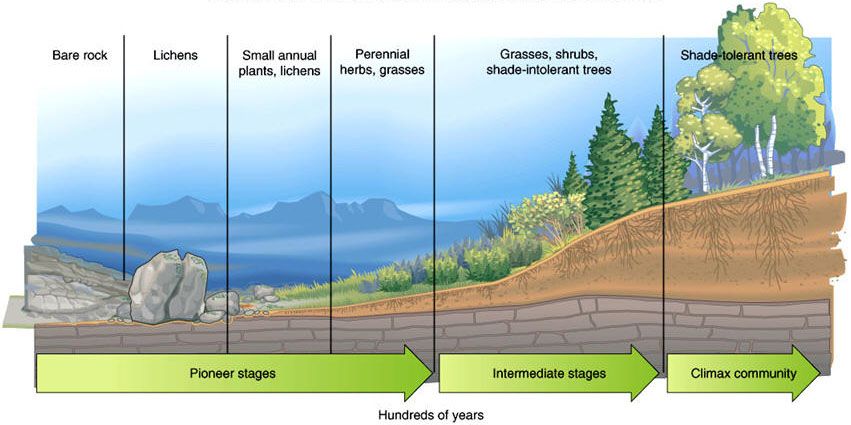
The picture shows what type of succession?
primary
secondary
tertiary
quaternary
Adapatation are caused by
natural selection
harsh environmets
unique organisms
evolution
Adapatations lead to...
Unique organisms
Evolution
Mutations
Stronger Organsisms
Plants in a cold biome such as the tundra will most likely have which adaptation?
have broad extended leaves
seasonaly loose their leaves
thin branches
Thin needle like leaves
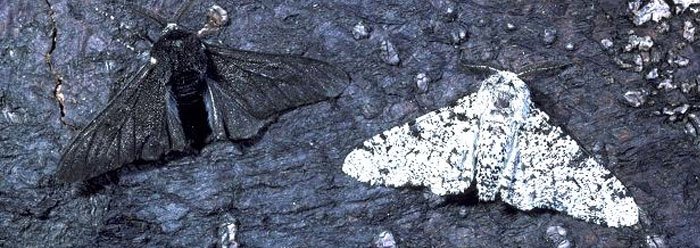

Which of the following is an anthropogenic disruption?
Wind Damage
Wildfires
Fragmentation
Flooding
An ecosystem that rapidly returns to its original state after a disturbance is
resistant
resilient
stable
adaptable
Tolerance is
the relationship in which two species live close together.
series of gradual changes that occur in a community following a disturbance.
any necessity of life, such as water, light and food.
the ability of an organism to survive and reproduce under circumstances that differ from their optimal conditions.
What is the ecological range of tolerance?
The range of conditions that an organism can endure before injury or death
The range of conditions that humans can tolerate in their environment
The range of conditions that specialists can tolerate in their habitat
The range of conditions that generalists can tolerate in their habitat
What is the term used for species that thrive in a narrow range of environmental conditions?
Generalists
Specialists
Ecological tolerance
Genetic biodiversity
Zone where small numbers can survive these difficult conditions
range of tolerance
zone of intolerance
optimal range
zone of physiological stress
There must be a certain amount of abiotic factors in an ecosystem to allow organisms to survive. Factors that are too low or too high cause the organisms to die
range of tolerance
limiting factors
zone of intolerance
zone of physiological stress

This zone has few organisms where the temperature is either too low or too high. The old and weak fish die in this zone.
Zone of Physiological Stress
Zone of Intolerance
Zone of Optimum Range
Zone of Invalidity
The theory of island biogeography suggests that species richness is affected by which of the following factors?
I. island distance from mainland
II. how the island is formed
III. island size
II only
III only
I and III
II and III
The role a species plays in its ecosystem is called its:
specialist species
ecological niche
generalist species
native species
Generalist species usually have less competitors when environmental conditions are fairly consistent.
Is the above statement True or False?
True
False

