Wayground logo

Free Printable Worksheets

Font size

S
M
L
XL
Worksheets

Unit 3: Nuclear Energy STUDY GUIDE

Total questions: 74

Worksheet time: 2hrs 53mins
Name
Class
Date
1.
Positrons and beta particles have
a)
the same charge and same mass
b)
the same charge and different mass
c)
different charges and the same mass
d)
different charges and different masses
2.
Which list of nuclear emissions is arranged in order from the greatest PENETRATING power to the least PENETRATING power?
a)
alpha particle, beta particle, gamma ray
b)
alpha particle, gamma ray, beta particle
c)
gamma ray, alpha particle, beta particle
d)
gamma ray, beta particle, alpha particle
3.
The dating of geological formations is an example of beneficial use of
a)
isomers
b)
electrolytes
c)
organic compounds
d)
radioactive nuclides
4.
Which term identifies a type of nuclear reaction?
a)
transmutation
b)
neutralization
c)
saponification
d)
reduction
5.
What is the mass number of an alpha particle?
a)
1
b)
2
c)
3
d)
4
6.
The stability of an isotope is based on its
a)
number of neutrons, only
b)
number of protons, only
c)
ratio of neutrons to protons
d)
ratio of electrons to protons
7.
What occurs in both fusion and fission reactions?
a)
Small amounts of energy are converted into large amounts of matter
b)
Small amounts of matter are converted into large amounts of energy
c)
Heavy nuclei are split into lighter nuclei.
d)
Light nuclei are combined into heavier nuclei.
8.
Which reaction releases the greatest amount of energy per mole of reactant?
a)
decomposition
b)
double replacement
c)
fusion
d)
fission
9.
An unstable nucleus loses the most mass if the nucleus emits
a)
an alpha particle
b)
a beta particle
c)
gamma ray
d)
positron
10.
Which radioisotopes have the same decay mode and have half-lives greater than 1 hour?
a)
Au-198 and N-16
b)
a-37 and Fe-53
c)
I-131 and P-32
d)
Tc-99 and U-233
11.
Which radioisotope has the fastest rate of decay?
a)
³⁷K
b)
³⁷Ca
c)
¹⁴C
d)
⁵³Fe
12.
Which radioisotope is used in dating geological formations?
a)
I-131
b)
U-238
c)
Ca-37
d)
Fr-220
13.
Which nuclides are used to date the remains of a once-living organism?
a)
C-14 and C-12
b)
Co-60 and Co-59
c)
I-131 and Xe-131
d)
U-238 and Pb-206
14.
Which radioisotope is used for diagnosing thyroid disorders?
a)
U-238
b)
Pb-206
c)
I-131
d)
Co-60
15.
Which risk is associated with using nuclear fission to produce energy in a power plant?
a)
depletion of hydrocarbons
b)
depletion of atmospheric oxygen
c)
exposure of workers to radiation
d)
exposure of workers to sulfur dioxide
16.
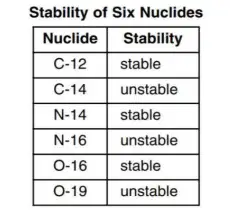
The table below indicates the stability of six nuclides. All atoms of the unstable nuclides listed in this table have
a)
an odd number of neutrons
b)
an odd number of protons
c)
more neutrons than protons
d)
more protons than neutrons
17.
Nuclei of U-238 atoms are
a)
stable and spontaneously absorb alpha particles
b)
stable and spontaneously emit alpha particles
c)
unstable and spontaneously absorb alpha particles
d)
unstable and spontaneously emit alpha particles
18.
Which radioisotope has an atom that emits a particle with a mass number of 0 and a charge of +1?
a)
³H
b)
¹⁶N
c)
¹⁹Ne
d)
²³⁹Pu
19.
When an atom of the unstable isotope Na-24 decays, it becomes an atom of Mg-24 because the Na-24 atom spontaneously releases
a)
an alpha particle
b)
a beta particle
c)
a neutron
d)
a positron
20.
A radioactive isotope has a half-life of 2.5 years. Which fraction of the original mass remains unchanged after 10. years?
a)
1/2
b)
1/4
c)
1/8
d)
1/16
21.
After decaying for 48 hours, ⅟₈ of the original mass of a radioisotope sample remains unchanged. What is the half-life of this radioisotope?
a)
6 hour
b)
8 hour
c)
12 hour
d)
16 hour
22.
Atoms of I-131 spontaneously decay when the _______
a)
Stable nuclei emit alpha particles
b)
Stable nuclei emit beta particles
c)
Unstable nuclei emit alpha particles
d)
Unstable nuclei emit beta particles
23.
Which particle is spontaneously emitted in the nucleus of Calcium-37?
a)
Alpha
b)
Positron
c)
Beta
d)
Electron
24.
Which nuclear radiation is similar to high energy X-ray?
a)
Beta
b)
Gamma
c)
Alpha
d)
Neutron
25.
____________ is the changing of the nucleus of one atom to another.
a)
Transmutation
b)
Beta Decay
c)
Fusion
d)
Artificial Transmutation
e)
Alpha Decay
26.
Which nuclear reaction releases particles with a mass of zero and a charge of -1?
a)
Beta Decay
b)
Transmutation
c)
Fusion
d)
Artificial Transmutation
e)
Alpha Decay
27.
Which nuclear reaction joins small nucleus into a large one?
a)
Fusion
b)
Transmutation
c)
Beta Decay
d)
Artificial Transmutation
e)
Alpha Decay
28.
Compared to an atom before an alpha decay, the number of protons of the atom after alpha decay will be ________
a)
Greater by 4
b)
Greater by 2
c)
Lesser by 2
d)
Lesser by 4
29.
The change that is undergone by an atom of an element made radioactive by bombardment with high -energy particle is called a(n) _________
a)
Natural Decay
b)
Natural Transmuation
c)
Radioactive Decay
d)
Artificial Transmutation
30.
Radioactive Cobalt-60 is used in radiation therapy treatment. Cobalt-60 undergoes beta decay. This type of nuclear reaction is called _______
a)
Nuclear Fission
b)
Nuclear Fusion
c)
Artificial Transmuation
d)
Natural Transmutation
31.
Which of the following radioisotope has the longest half-life?
a)
Fr-220
b)
K-37
c)
N-16
d)
Ne-19
32.
Compared to K-37, the isotope of K-42 has a ____
a)
Shorter half-life and the same decay mode
b)
Longer half-life and the same decay mode
c)
Shorter half-life and a different decay mode
d)
Longer half-life and a different decay mode
33.
Which radioisotope same will have the smallest amount remaining after 10 years?
a)
2.0g of Au-198
b)
2.0g of K-42
c)
4.0g of P-32
d)
4.0g of Co-60
34.
Calculate the half life of a radioactive isotope that undergoes 4 half life periods in 90 seconds.
a)
20.5 seconds
b)
22.5 seconds
c)
12.5 seconds
d)
30 seconds
35.
Calculate the total time it will take for a sample of P-32 to undergo 5 half life periods.
a)
65.2 days
b)
74.9 days
c)
71.4 days
d)
89.6 days
36.
Calculate the total mass of a 20 gram sample of strontium-90 that will remain unchanged after 87 years?
a)
3.5 g
b)
2.5 g
c)
4.5 g
d)
8.5 g
37.
The half-life of Po-214 is 0.001 seconds. How much of a 10 gram sample is left after 0.003 seconds?
a)
10 g
b)
5 g
c)
2.5 g
d)
0.75 g
e)
1.25 g
38.
The half life of Cr-51 is 28 days. If a sample had 510 g, how much Cr was there 168 days ago?
a)
18
b)
3.8
c)
7.97
d)
15.94
39.
State one beneficial use of Po-210.
a)
Polonium-210 is used to eliminate static electricity in machinery
b)
removes dust from camera lenses
c)
A and B
d)
None of the above
40.
Complete the nuclear equation in your answer booklet for the decay of Po-210, by writing a nuclide name or notation for the missing product. Po-210 --> He-4 + ______________
a)
Pb-206
b)
U-206
c)
Po-206
41.
Determine the total mass of an original 28.0-milligram sample of Po-210 that remains unchanged after 414 days.
a)
5.5 mg
b)
3.5 mg
c)
7.6 mg
42.
If a 30-mg sample of Te-137 is allowed to decay for 12.5 seconds, what fraction of the sample will remain unchanged?
a)
1/32
b)
0.03125
c)
Both A and B
d)
None of the above
43.
Which of the following characterizes gamma radiation?
a)
It has a strong positive charge.
b)
It is weakly ionizing, penetrating through dense materials.
c)
It moves quite fast and the particles are quite small.
d)
It is small, and it has a negative charge.
44.

Which type of nuclear radiation can be stopped by a sheet of paper?

a)

Alpha

b)

Beta

c)

Gamma

45.

Has the lowest penetrating power.  Can only penetrate 0.05 mm into the body and can be stopped by the skin.

a)
Alpha
b)
Beta
c)
Gamma
d)

Electron capture

46.
Has the highest penetrating power.  Can penetrate our body.  Even several cm thick of lead or several meters thick of concrete cannot stop all of it.
a)
Alpha
b)
Beta
c)
Gamma
47.

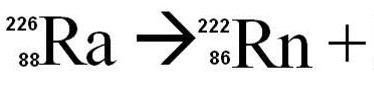
Which type of reaction is this?

a)

chemical

b)

fission

c)

fusion

d)

radioactive decay

48.

This is an example of

a)

Nuclear Fission

b)

Nuclear Fusion

c)

No reaction

49.

Identify the missing substance in each of the following nuclear reactions.

13755Cs--> ______________ + 0−1e

a)

13756Ba

b)

13757La

c)

13755Cs

50.

At times, lost mass is converted into _________, during fission reactions.

a)

chain reactions

b)

energy

c)

critical mass

d)

fusion

51.

In the isotope name “Hydrogen-3”, the mass number is 3. What does the mass number tell you about this isotope?

a)

number neutrons only

b)

number protons + number neutrons

c)

number protons + number electrons

d)

number protons only

52.

What is the role of neutrons in the nucleus?

a)

To repel protons and provide stability

b)

To attract electrons into the nucleus

c)

To add mass to the atom without changing its chemical properties

d)

To provide electrical charge to the nucleus

53.

Which of the following is a characteristic of stable isotopes?

a)

They undergo radioactive decay quickly

b)

They have a high neutron to proton ratio

c)

They do not undergo radioactive decay

d)

They have a low neutron to proton ratio

54.
Which of the following is true about nuclear fission?
a)
The mass of the product is greater than the mass of the original nucleus
b)
The mass of the product is less than that of the original nucleus
c)
The mass of the product is the same as the mass of the original nucleus
d)
The mass of the product is 100 times greater than the original nucleus
55.

What is likely to happen to unstable nuclei with too many, or too few, neutrons?

a)

They will decay by emitting radiation.

b)

They will loose all their electrons.

c)

They will bond with other atoms.

56.
Uranium-238  decays into  Thorium-234  by emitting .........
a)
an alpha particle
b)
a beta particle
c)
gamma rays
d)
visible light
57.
Complete the nuclear equation and determine the type of decay that is occurring in this reaction. 
a)
alpha
b)
beta
c)
gamma
d)
none
58.

This is an example of _________.

a)

alpha decay

b)

fission

c)

fusion

59.
_______________ is the process by which unstable atoms emit radiation until they become stable.
a)
Radiation
b)
Chemical Reaction
c)
Radioactive Decay
d)
Isotopes
60.

In the equation, 146C --> 147N + 0-1B, the _______ decay of radioactive carbon-14 results in the creation of a new nitrogen-14 atom.

a)

Gamma

b)

Beta

c)

Alpha

61.

24094Pu —› ____ + 42He

a)

23692U

b)

24796Cm

c)

24493Np

d)

24295Am

62.

How long does it take a 180-gram of gold-198 to decay to 22.5 grams if the half -life of gold-198 is 2.68 days?

a)

8.04 days

b)

3 days

c)

4 days

d)

2.68 days

63.

Solve this equation for beta decay.

614C = ___ + -10e

a)

410Be

b)

714N

c)

210He

d)

613C

64.

How long will it for a take for a 40 gram. The half-life of cobalt-60 is 5.26 years sample ofcobalt-60 to decay to 5 grams?

a)

17.75 days

b)

15.78 years

c)

15.15 years

d)

17.17 years

65.
Takes two small nuclei and combines them into a larger nucleus
a)
fission
b)
fusion
66.

What is the main advantage of nuclear fusion over nuclear fission?

a)

Fusion produces more radioactive waste.

b)

Fusion requires less energy to initiate.

c)

Fusion produces more energy per unit of fuel.

d)

Fission reactions are easier to control.

67.

What is the primary difference between nuclear fusion and nuclear fission?

a)

Fusion splits a heavier nucleus into two lighter nuclei, while fission combines two lighter nuclei into a heavier one.

b)

Fusion combines two lighter nuclei into a heavier one, while fission splits a heavier nucleus into two lighter nuclei.

c)

Both processes involve splitting heavier nuclei into lighter ones.

d)

Both processes involve combining lighter nuclei into a heavier one.

68.

In the context of nuclear reactions, what is a "daughter nucleus"?

a)

The nucleus formed after a gamma decay.

b)

The original nucleus before a fission event.

c)

The nucleus formed as a result of a nuclear fission or fusion event.

d)

The nucleus that captures a neutron.

69.

What makes an isotope radioactive?

a)

A high number of protons

b)

A high number of electrons

c)

An unstable combination of protons and neutrons in the nucleus

d)

A stable combination of protons and neutrons in the nucleus

70.
This type of energy is released when an atom's nucleus breaks apart OR the nuclei of two small atoms come together. 
a)
thermal
b)
electromagnetic
c)
chemical
d)
nuclear
71.
How is the alpha particle written in a nuclear equation?
a)
42He
b)
24He
72.

An isotope that undergoes B- decay has

a)

too few protons

b)

too many protons

c)

too few neutrons

d)

Too many neutrons

73.

The half-life of strontium-90 is 25 years. How much will remain after 100 years if the initial amount is 4.0 g?

a)

3.0 g

b)

0.25 mg

c)

0.3 g

d)

6.25 g

74.

The half-life of Zn-71 is 2.4 minutes. Starting with 100.0 g, how many grams would remain after 7.2 minutes?

a)

100.0 g

b)

50.0 g

c)

12.5 g

d)

8.5 g