wayground logo

Free Printable Worksheets

Font size

S
M
L
XL
Worksheets

untitled

Total questions: 35

Worksheet time: 40mins

Name
Class
Date
1.
Something that takes up space and has mass.
a)
volume
b)
matter
c)
mass
d)
density
2.
The amount of space something takes up
a)
density
b)
volume
c)
mass
d)
matter
3.
__________ are the building blocks of life.
a)
solids
b)
gases
c)
atoms
d)
nutrients
4.
It can be observed or measured without changing the composition of matter.
a)
Physical Change
b)
Chemical Change
c)
Physical Property
d)
Chemical Property
5.

All matter is made of _________.

a)
energy 
b)
atoms 
c)
electrons 
d)
compounds 
6.
Elements are made of 
a)
many types of atoms 
b)
the periodic table
c)
one type of atom 
d)
molecules 
7.
What are the states of matter?
a)
solid, liquid, and juice
b)
solid and liquid
c)
solid and gas
d)
solid, liquid, and gas
8.
Matter that has its own shape and takes up space.
a)
solid
b)
liquid
c)
gas
9.
Matter that always fills the shape in a container, such as air.
a)
solid
b)
liquid
c)
gas
10.
Milk takes the shape of its container because it is a:
a)
solid
b)
liquid
c)
gas
11.
How is a gas defined?
a)
no shape, no volume
b)
Definite shape, definite volume
c)
Found in stars
d)
Definite volume, no shape
12.
Molecules are closest together in a 
a)
Solid
b)
Liquid
c)
Gas
d)
plasma
13.
Define a liquid
a)
no shape, no volume
b)
Definite shape, definite volume
c)
Found in stars
d)
Definite volume, no shape
14.
What term describes a solid changing to a gas?
a)
Deposition
b)
Sublimation
c)
Evaporation
d)
Freezing
15.
What term describes a liquid changing to a solid?
a)
Deposition
b)
Sublimation
c)
Evaporation
d)
Freezing
16.
Water can be a solid, liquid, and a gas.
a)
True
b)
False
liquid
17.
Particles of a liquid
a)
are tightly packed together and stay in a fixed position.
b)
have no viscosity.
c)
decrease in volume with increasing temperature.
d)
are free to move around one another but still touch.
18.
At higher temperatures
a)
particles in an object have less energy
b)
particles in an object move faster
c)
a gas contracts
19.
Particles (molecules) in a ______________________ have more energy than the other states of matter.
a)
gas
b)
solid
c)
liquid
20.

Matter is made up of particles. Which of the following statements is true about these particles?

a)

The particles that make up solids do not move

b)

The particles that make up liquids do not move

c)

The particles that make up all matter are constantly in motion

d)

Only the particles that make up gases are constantly in motion

21.

A compound consists of two or more ____________.

a)

Molecules

b)

Atoms

c)

Elements

d)

Pieces of matter

22.

How many total hydrogen atoms are found in 2H2O?

a)

5

b)

4

c)

2

d)

0

23.
Solids have a definite _______________.
a)
smell
b)
shape
c)
picture
d)
sound
24.
When a solid is turned into a liquid, the solid _______________.
a)
melts
b)
freezes
c)
turns into a gas
d)
floats
25.
The amount of space something takes up
a)
density
b)
volume
c)
mass
d)
matter
26.

What is defined as how much space an object takes ups?

a)

mass

b)

matter

c)

density

d)

volume

27.

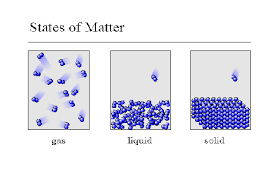
Which state of matter is shown in the image?

a)

solid

b)

liquid

c)

gas

d)

none

28.

Which state of matter has the least kinetic energy?

a)

solid

b)

liquid

c)

gas

29.

Check all phase changes that require you to remove heat from the system.

a)

Freezing

b)

Melting

c)

Condensation

d)

Vaporization/Boiling

30.

Check all phase changes that require you to add heat to the system.

a)

Freezing

b)

Melting

c)

Condensation

d)

Vaporization/Boiling

31.

It is a nice summer day. Your cool ice tea causes water vapor in the air to become liquid water drops on your glass. This is an example of....

a)

Freezing

b)

Melting

c)

Condensation

d)

Boiling

32.
What Is Matter?
a)
Anything That has weight and takes up space.
b)
Anything that you can see or taste.
c)
What you can touch.
d)
you and go throught this.
33.
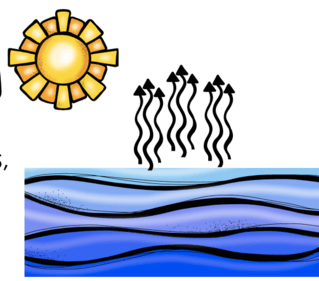
What part of the water cycle does this picture show?
a)
condensation
b)
precipitation
c)
evaporation
34.
Which is the opposite of condensation?
a)
runoff
b)
evaporation
c)
precipitation
d)
transpiration
35.
What is the water cycle?
a)
the 3 forms of water
b)
the movement of water on, above, or below the surface of the Earth
c)
when water melts
d)
when clouds form