
 Worksheets
05.Viruses
Total questions: 36
Worksheet time: 1hrs 3mins


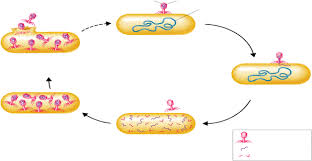
The viral life cycle causes the host cell to burst open is (a) cyle.
The medicine is used to cure viral infection is (a) drug.

Anything living or nonliving that can cause a disease is known as a...................
(a)
A medicine that blocks the production of bacteria or treats bacterial infections is called (a)
Label the virus structure
Reorder the following structure from smallest to largest in size.
Carbon atom
Water molecule
Virus
Bacteria
Red blood cell

Viruses are completely dependent upon a host cell for their replication. They use energy generated by the host cell, and they exploit the host's machinery to manufacture viral proteins.
State the symbiotic relationship between the virus and its host cell.
(a)
Classify the characteristics of life that ARE and ARE NOT SHOWN in viruses.
Nucleic acid as DNA or RNA
Reproduce itself
Have cells
Have homeostasis
Release ATP
Grow and develop
Sensitivity (Sense and response)
Excrete
Evolve

Reorder the steps of viral replication mechanism inside the host cell.
Attachment: The virus attaches to the surface of the host cell
Penetration: The viral genetic material enters the host cell.
Biosynthesis: Viral genetic material replicates and viral proteins are made by host cells.
Maturation: The viral DNA and protein coat are assembled.
Lysis: The cell lyses and releasing many newly made viruses.
The viral infections are treated with (a) drugs , spread of virus in society can be controlled by (b) which fasten the immune response.
Contrast the lytic and lysogenic viral life cycles.


Viruses burst the host cell
Viruses do not burst the host cell
Viral DNA is not attached to host DNA
Viral DNA is attached to host DNA
There is no prophage (dormant) stage
There is a prophage (dormant) stage
Viral DNA replication is independent from the host cell
Viral DNA replication is dependent from the host cell
It causes severe health problem
It does not cause severe health problem
Many viruses are produced in a short period of time.
Virus number depends on host cell replication.
Which ones are the roles of viruses in the ecosystem?
All viruses are intracellular parasites and cause disease.
Since viruses are parasites, they control the numbers of harmful bacteria in the environment.
Viruses live mutualistically with the host cell
Viruses also allow gene transfer between species, increase genetic variation, and viruses are used in gene therapy.
Viruses can be used as a viral biocontrol to kill pests which reduces use of pesticides.
1. Viruses are made up of (a) encapsulated by a coat of (b) . 2. Viruses, unlike (c) , are not composed of cells. 3. The only function required for life that viruses can perform is (d) .
4. (e) helps to increase immunity against viral diseases.
Which of the following is a characteristic that viruses lack, making them non-living?
Ability to reproduce independently
Presence of genetic material
Protein coat structure
Ability to infect host cells
What is the main function of the protein coat (capsid) in a virus?
To provide energy for viral replication
To protect the genetic material inside the virus
To destroy the host cell
To produce proteins for the host cell
Which letter above represents the stage at which a host cell begins producing new
bacteriaphages?
Which letter indicates the stage at which the bacteriaphage injects its DNA into the
host cell?

HIV stands for Human Immunodeficiency Virus, it infects helper T cells (type of white blood cells) attacks (a) system. It is transferred via body fluids such as (b) . It causes (c) so people who are infected by HIV cannot defend themselves against any simple disease.

Name the parts of the virus labelled X.
(a)
Name the parts of the virus labelled Y.
(a)
Viruses are often considered harmful, but they play an important role in ecosystems. Which of the following examples describes how viruses can affect an ecosystem?
Viruses help organisms adapt to their environments by changing their genetic makeup.
Viruses cause diseases that can reduce/decrease populations, which can affect the food web.
Viruses increase the number of producers in an ecosystem by helping plants grow.
Viruses act as decomposers, breaking down dead organic material and recycling nutrients

Identify the life cycle of the Covid-19 virus.
(a)
Explain how being infected with this virus would negatively affect the function of the lungs.
Describe the reproductive cycle of the virus shown in diagram.
State three ways in which the structure of viruses differs from the structure of bacteria.

