
 Worksheets
Free fall & Horizontal Motion Quiz
Total questions: 53
Worksheet time: 1hrs 20mins
In question 1, What is the horizontal velocity of the marble on the rail?
5 m/s
10 m/s
15 m/s
20 m/s
What is the term used for the horizontal distance traveled by the marble in question 1?
Height
Speed
Range
Velocity
In question 1, If the height of the table is doubled to 3.0 m, what happens to the range of the marble?
range = 1.5 x
range = 2 x
It remains the same
range = 4 x
Alex drops one ball vertically from a window. At the same instant, Beatriz throws a second ball horizontally from the same window. Which ball hits the ground first?
The dropped ball.
The thrown ball.
Neither—they both have hit the ground at the same time.
It depends on how fast the ball was thrown.
Chelsea drops one ball vertically from a window. At the same instant, Darius throws a second ball horizontally from the same window. Which ball has the greater speed at ground level?
The dropped ball.
The thrown ball.
Neither—they both have the same speed on impact.
It depends on how fast the ball was thrown.
You are riding in an enclosed train car moving at 85 km/h.
If you throw a baseball straight up, how far behind you will the baseball land?
10m
-1.2m
0m
8.5m
A tiger leaps horizontally from a 7.5-m-high rock with a speed of 3.8 m/s. How far from the base of the rock will she land?
3.6 m
6.3 m
1.2 m
4.6 m
A tiger leaps horizontally from a 9.5-m-high rock with a speed of 3.0 m/s. How long will she be in the air while falling?
3.6 s
6.3 m/s
1.9 m
1.38 s
A diver running 5.0 m/s dives out horizontally from the edge of a cliff and 3.0 s later reaches the water below. How high was the cliff, and how far from its base did the diver hit the water?
22.5 m high, 7.5 m from the base
44.1 m high, 7.5 m from the base
44.1 m high, 15.0 m from the base
22.5 m high, 15.0 m from the base
A ball is thrown horizontally from the roof of a building with an initial velocity of vx = +8.8 m/s and it hits the ground 132 m from the building.
How long was the ball in the air?
0.07 s
15.0 s
8.8 s
4.0 s
A ball is thrown horizontally from the roof of a building with an initial velocity of vx = +50 m/s and it hits the ground 200 m from the building.
What is vy when it hits?
-15 m/s
-40 m/s
-8.8 m/s
-4.0 m/s
A ball is thrown horizontally from the roof of a building with an initial velocity of vx = +50 m/s and it hits the ground 200 m from the building.
How long was it in the air?
-10s
4s
8.8s
-14s
A ball is thrown horizontally from the roof of a building with an initial velocity of vx = +50 m/s and it hits the ground 200 m from the building.
What was the Vtotal when it hits?
-64 m/s
-50 m/s
-40 m/s
-4100 m/s

At what point is vy= 0 m/s?
A
B
C
D
None of these points
Which vector pair (arrow pair) correctly represents the acceleration and velocity at point P?


Who do you agree with?
Anita: “A projectile’s vx changes because of gravity, and its vy remains constant.”
Barry: “Both vx and vy are constant.”
Chris: “A projectile has no acceleration in the vertical dimension but it does accelerate horizontally.”
Dave: “A projectile has vertical acceleration and a constant horizontal velocity”

Suppose Lemming A runs off the edge of the cliff at 2 m/s and Lemming B runs off the edge at 1 m/s. Which will hit the ground first?
A
B
Both at the same time
Suppose Lemming A runs off the edge of the cliff at 2 m/s and Lemming B runs off the edge at 1 m/s. Which will hit the ground farther from the base of the cliff?
A
B
Both at the same distance

A package is dropped from an airplane that flies at constant velocity. If air resistance can be neglected, where will the package hit the ground?
A
B
C
Once a projectile is launched, what is the only force that affects its motion?
mass
friction
inertia
gravity
What is true about the vertical speed of a projectile launched horizontally?
It is initially at its maximum value.
It increases due to gravity as it falls.
It remains constant throughout its trajectory.
It decreases as it falls due to gravity.

What equation(s) can you use to answer the question:
How far horizontally does the rock move during this time?
xf=x0+v0t+21at2
xf= x0 + 21(vf+v0)t
vf=v0+at
vf2=v02+2a(xf−x0)

A projectile is fired with initial velocity V0 and
follows the trajectory shown above.
Which of the following pairs of graphs best
represents the vertical components of the velocity and acceleration, V and a,
respectively, of the projectile as a function of time t?


What is the vertical acceleration of a projectile due to gravity?
(rounded value is OK, but if more precise digits are given, they must be accurate for the Chicago area)
-9.810 m/s2
-9.8 m/s
-9.8 m/s2
-9.08 m/s2
What happens to the vertical velocity of a projectile as it goes up?
increases
decreases
stays the same
none of these
What happens to the vertical velocity of a projectile as it goes down?
becomes more negative
becomes more positive
stays the same
becomes less positive

If I throw a crayon straight up at 12m/s, what is its velocity when I catch it at the same height?
-6 m/s
-12 m/s
-18 m/s
-24 m/s

The figure shows the path of a ball tossed from a building.
The magnitude of the ball’s velocity (which is to say, its speed) is least at location
A
B
C
D

The figure shows the path of a ball tossed from a building.
The magnitude of the ball’s velocity (which is to say, its speed) is greatest at location
A
B
C
D
The total length of the path of a moving object.
distance
speed
displacement
acceleration
The distance and direction between a moving object's final position and its starting position.
speed
reference point
velocity
displacement
The process of changing position.
distance
motion
reference point
speed
the distance an object moves, divided by the time it took to move that distance.
displacement
average speed
average velocity
acceleration
The measure of how quickly the velocity of an object changes.
acceleration
speed
distance
reference point
What is the displacement of a car that travels 1 lap on a 10 km track?
10 mi
5 km
10 km
0 km
What is the distance a car travels when it drives 1 lap on a 5 km track?
5 km
0 km
10 km
5 mi
How is velocity different from speed?
it equals the displacement of the object's motion
it includes the direction of the object's motion
it equals the distance of the object's motion
it includes the acceleration of the object
When an object is moving in the negative direction and it also has negative acceleration, it is:
speeding up
slowing down
constant speed
A bicycle is coasting along a level road at 2.6 m/s, but then it gets onto a smooth, straight hill. The bike gets to the bottom of the hill in 6.1 seconds, by which time, it is moving at 5.4 m/s. What is the acceleration of the bike?
0.46 m/s2
0.64 m/s
0.64 m/s2
0.46 m/s
John is swimming at a velocity of 1.6 m/s straight toward a boat floating on the water 500 m away. How long will it take John to reach the boat if he always swims at that constant velocity?
312.5 seconds
0.0032 seconds
31.25 seconds
0.032 seconds
Sean is driving his car at a speed of 25 mph on Main Street.
He caught all of the lights green so he traveled at a constant speed.
He arrives at his High School in 3.5 minutes (0.058 hour).
How far away was Sean from the High School when he began his trip?
1.45 miles
87.5 miles
7.14 miles
0.14 miles
When an object is accelerated toward the earth solely because of gravity then it is in (a)

This motion graph represents:
A dog walking away from home, pausing to drink from a puddle, and then walking further away.
A dog walking towards home, pausing to smell a tree, and then walking further away from home.
A dog running up a flight of stairs at a constant speed.
A dog walking away from home, pausing to smell a tree, and then walking back towards home.

This motion graph represents:
Someone going up a hill in a short time, resting a moment, then slowly coming back down the hill.
Someone leaving home at running speed, resting for a short period, and then wlaking home.
Someone leaving home at walking speed, resting for a short period, and then running home.
Someone leaving home at a low speed, walking faster away from home, and then running home.

During which interval is the object traveling at a constant velocity?
A to B
B to D
E to F
F to G
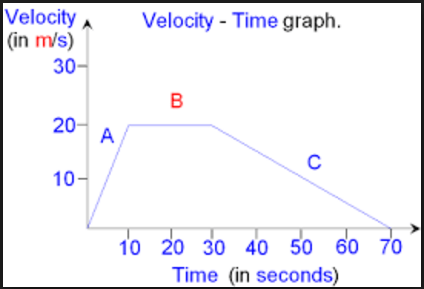
This is a velocity-time graph. What is the object doing in segment A?
Positive acceleration
Negative acceleration
Constant fast velocity
Constant slow velocity

This is a velocity-time graph. What is the object doing in segment B?
Moving 30 meters
Moving 20 meters
Constant Velocity
Not moving
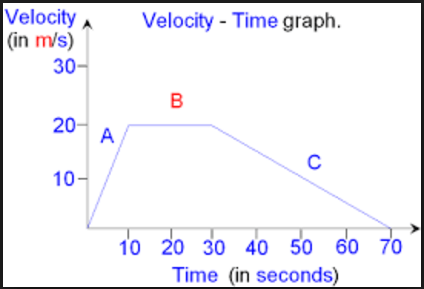
This is a velocity-time graph. What is the object doing in segment C?
Positive acceleration
Negative acceleration
Constant slow velocity
Constant fast velocity
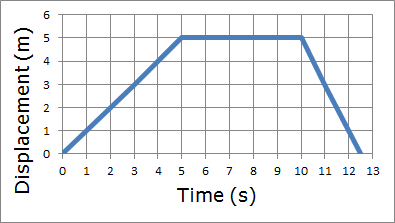
According to the graph how fast is the person traveling in the last 3 seconds?
-2 m/s
- 5 m
-2.5 m/s
-1 m/s

At which point in time does this person turn around?
3 seconds
5 seconds
10 seconds
25 seconds

During which stretch of time does the object move the greatest distance?
0-20 s
20-40 s
40-60 s
60-100 s
What is the displacement of this object?
0 m
100 m
30 m
80 m
What is the distance traveled by this object?
0 m
100 m
30 m
80 m

