
 Worksheets
Consumer Protection Quiz -3
Total questions: 40
Worksheet time: 20mins
Aarushi purchased a pack of biscuits. When she opened it, she felt the biscuits were stale. She carefully read the label on the pack of biscuits which mentioned: 'If you are not satisfied with the product quality, write to our Customer Care Cell at Bell Foods Pvt. Ltd. B/321, Jalandhar, Punjab.' The biscuit company has set up its own consumer service and grievance cell to promote and protect the following right:
A Right to Safety
Right to be Heard
Right to be Informed
Right to Consumer Education
Who can be a consumer?
A buyer of goods/services for considerations.
A buyer of goods/services for resale.
A person who is purchasing goods for other.
None of the above.
The complaints filed in the State Commission are where the value of goods and services, along with the compensation claimed is:
More than 20 lakhs but less than 1 crore
More than 1 crore but less than 10 crore
Less than 20 lakhs
More than 10 lakhs but less than 20 lakhs
The consumer organisation ‘Consumer Guidance Society of India (CGSI)’ is located in:
Mumbai
Delhi
Chennai
Kolkata
The Consumer Protection Act, 2019 provides ___________ consumer rights.
4
5
6
7
To provide protection to the consumers against the improper behaviour of the producers and sellers is called.
Consumers Protection Act
Consumer Protection
Consumer Welfare
Consumer Education
When a single consumer fails to get his rights protected, he seeks the help of ___________.
Trade Union
Consumer Association
Labour Union
None of the above
‘Don’t purchase in haste’, this is an important ___________ of the consumer, as Dhruv learned when he rushed to buy a new phone without researching.
Responsibility
Right
Act
All the above
The electrical goods which are manufactured with substandard products can deprive a consumer of ___________.
Right to choose
Right to safety
Right to be heard
None of these
The Consumer Protection Act, to protect and promote the interests of consumers came into effect from:
1986
1975
1991
1998
Which of the following is not a reason for importance of consumer protection from the point of view of consumers?
Consumer ignorance
Consumer apathy
Consumer exploitation
Unorganised consumers
From the point of view of business which one of the following is a reason because of which consumer protection is important?
Dynamic environment
Fast technological development
Government intervention
Competitive market
Once a worm was found in noodles of a famous company and similarly insect was found in soft drink of a company. Which right should the consumer exercise, so that in future health hazard is not caused to any consumer?
Right to safety
Right to seek redressal
Right to be heard
Right to be assured
The Consumer Protection Act provides relief to customers such as replacement of product, removal of defect in the product, compensation for any loss or injury suffered by the consumer. Which consumer right has been highlighted in this statement?
Right to safety
Right to seek redressal
Right to be informed
Right to consumer education
Which of the following statements is incorrect with respect to responsibilities of a consumer?
Be aware about various goods and services available in the market
Do not take an action even when the amount involved is small
Buy only standardised goods as they provide quality assurance
Ask for a cash memo on purchase of goods or services
Pooja went to the grocery store to buy monthly grocery goods. She purchased items as per her requirements. She insisted the seller to give her a discount of 15% as every seller offers the same. Which consumer responsibility is fulfilled by her?
Buy only standardised goods
Read labels carefully
Assert yourself to ensure that you get a fair deal
Be honest in your dealings
A case filed in State Commission, can be re-appealed in:
National Commission and then to Supreme Court
National Commission only
Supreme Court
Nowhere
Reena purchased one litre of pure desi ghee from a shopkeeper. After using it, she had doubts that it was adulterated. She sent it for a laboratory test which confirmed that the ghee was adulterated. Name the reliefs available to Reena if she complains and the consumer court is satisfied about the genuineness of the complaint.
To withdraw the hazardous goods from sale
To provide replacement for the defective product
To refund the price paid for the product, or the charges paid for the service
All of these
Which of the following is not a function of Nongovernment Organisations (NGOs) for enhancing Consumer Protection?
Accelerating consumer awareness
Filing suits, complaints on behalf of consumers
Solving personal and marital problems of consumers
Collecting data on different products and testing them

The picture given below depicts a quality certification mark. Identify the type of goods for which this mark is used.
Jewellery
Electrical Appliances
Food Products
Agricultural Products
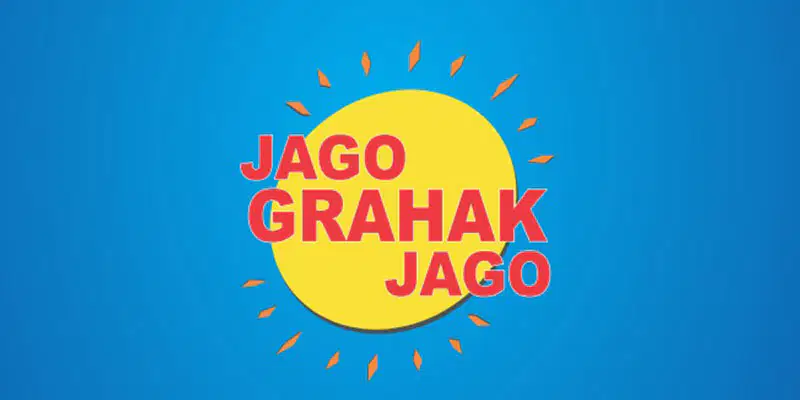
Jago Grahak Jago is a government initiative to spread awareness among the consumers. Name the consumer right highlighted in the picture given below.
Right to consumer education
Right to be informed
Right to be heard
Right to seek redressal
Consumer protection adopts measures to protect consumers from unethical malpractices by businesses and provide a swift redressal of their grievances with regard to:
Overcharging a product, i.e., charging a product above its Maximum Retail Price.
Supplying of defective goods.
Use of malfunctioning weights and measures that lead to underweight of products.
Supply of inferior services, i.e., quality of service lesser than the condition agreed.

Identify the responsibility to be kept in mind by consumer while purchasing, using and consuming goods and services on the basis of given image.
Learn about the risks associated with products and services, follow manufacturer’s instructions and use the products safely
Read labels carefully so as to have information about prices, net weight, manufacturing and expiry dates, etc.
Form consumer societies which would play an active part in educating consumers and safeguarding their interests
Respect the environment, avoid waste, littering and contributing to pollution
Assertion (A): Consumers need to be given legal protection against certain trade practices and business methods. Reason (R): Protection as per market forces and caveat emptor is not enough as per perfectly competitive market is an economist’s dream and consumer sovereignty are a myth.
Both Assertion (A) and Reason (R) are true and Reason (R) is the correct explanation of Assertion (A)
Both Assertion (A) and Reason (R) are true and Reason (R) is not the correct explanation of Assertion (A)
Assertion (A) is true but Reason (R) is false
Assertion (A) is false but Reason (R) is true
Assertion (A): A business must engage in unscrupulous, exploitative and unfair trade practices like defective and unsafe products, adulteration, false and misleading advertising, hoarding, black marketing, etc. Reason (R): It is the moral duty of any business to take care of consumer’s interest and avoid any form of their exploitation.
Both Assertion (A) and Reason (R) are true and Reason (R) is the correct explanation of Assertion (A)
Both Assertion (A) and Reason (R) are true and Reason (R) is not the correct explanation of Assertion (A)
Assertion (A) is true but Reason (R) is false
Assertion (A) is false but Reason (R) is true
Assertion (A): A consumer has the right to have complete information about the product he/she intends to buy.
Reason (R): It comes under the right to seek redressal.
Both Assertion (A) and Reason (R) are true and Reason (R) is the correct explanation of Assertion (A)
Both Assertion (A) and Reason (R) are true and Reason (R) is not the correct explanation of Assertion (A)
Assertion (A) is true but Reason (R) is false
Assertion (A) is false but Reason (R) is true
Statement I: A consumer has the right to acquire knowledge and to be a well-informed consumer throughout life.
Statement II: He should be aware about his rights and the reliefs available to him in case of a product or service falling short of his expectations.
Statement I is true and II is false
Statement II is true and I is false
Both the statements are true
Both the statements are false
Statement I: Business organisations do not use resources which belong to the society. Statement II: They do not have a responsibility to supply such products and render such services which are in public interest and would not impair public confidence in them.
Statement I is true and II is false
Statement II is true and I is false
Both the statements are true
Both the statements are false
Statement I: The State Commissions are set up in each state by State Government. Statement II: A complaint can to be made to the appropriate State Commission when the value of the goods or services in question, along with the compensation claimed exceeds 20 lakhs but does not exceed 1 crore.
Statement I is true and II is false
Statement II is true and I is false
Both the statements are true
Both the statements are false
Statement I: In India, several consumer organisations and non-governmental organisations (NGOs) have been set up for the protection and promotion of consumers’ interests.
Statement II: They have a constitution of their own and are free from government interference.
Statement I is true and II is false
Statement II is true and I is false
Both the statements are true
Both the statements are false
Ankit bought a packet of chips from a local shopkeeper and found that the ingredients given on the label were not legible. He complained about it to the company. The company sent a written apology stating that they will make sure that existing packets are withdrawn from the market and new packets with legible labels are soon made available. Which consumer right is being exercised by Ankit?
Right to choose
Right to be heard
Right to safety
None of these
The label of a health drink did not disclose the presence of Soya content towards which many people are allergic. Which consumer right is being violated?
Right to safety
Right to seek redressal
Right to be assured
Right to be informed
Palak went to a shopkeeper to buy a hair oil. The shopkeeper forced her to buy a particular brand of hair-oil out of various available brands, irrespective of the willingness of Palak. Which right of Palak, as a consumer, has been violated?
Right to be assured
Right to consumer education
Right to safety
Right to be heard
Consumer dispute settlement agencies are:
District Commission
State Commission
National Commission
All of these
Rama purchased a gold necklace from NM Jewellers for ` 2,50,000. The jewellers told her that the necklace was of 22 carat gold purity. She wore the necklace in her brother’s marriage and after that kept it in a locker. After six months, she came to know about the X-ray gold testing facility provided by a famous chain of jewellers. Out of curiosity, she took her necklace and other jewellery items for testing. She was shocked to see the results as the necklace turned out to be of 18 carat as against 22 carat as claimed by the NM Jewellers. Where under the Consumer Protection Act 2019, can she file the complaint?
District Commission
State Commission
National Commission
Supreme Court
When the value of goods and services, along with compensation claimed is more than 1 crore but less than 10 crore, then the complaint can be filed in:
District Forum
National Commission
State Commission
None of these
Who is said to be a king in the free market economy?
Investor
Dealer
Seller
Consumer
Statement I: The Consumer protection Act 2019 extends to the whole of India.
Statement II: It is applicable to all types of businesses whether a manufacturer or a trader and whether supplying goods or providing services excluding e-commerce firms.
Statement I is true and II is false
Statement II is true and I is false
Both the statements are true
Both the statements are false
Statement I: AGMARK contains specification and quality control requirements regarding the production and marketing of processed fruits and vegetables, sweetened aerated water, vinegar and synthetic syrups.
Statement II: ISI mark ensures that the product conforms to the Indian standards mentioned by the Indian Standard Institute.
Statement I is true and II is false
Statement II is true and I is false
Both the statements are true
Both the statements are false
Statement I: National Commission has a jurisdiction to entertain complaints where value of goods or services paid as consideration exceeds one crore but does not exceed ten crore rupees.
Statement II: If any of the parties are not satisfied by the order of National Commission can appeal against such order to the Supreme Court of India within a period of thirty days of such order.
Statement I is true and II is false
Statement II is true and I is false
Both the statements are true
Both the statements are false

