wayground logo

Free Printable Worksheets

Font size

S
M
L
XL
Worksheets

Concept 3 Review

Total questions: 102

Worksheet time: 2hrs 53mins

Name
Class
Date
1.
Substance that consists of one type of atom.  It is a pure substance. Found on the Periodic Table. 
a)
Element
b)
Compound
c)
Mixture
d)
I don't know
2.

A type of substance containing atoms of two or more elements chemically bonded together is a mixture.

a)

True

b)

False

3.
Combinations of 2 or more substances (elements and compounds) that are physically blended together. 
a)
Compound
b)
Mixture
c)
Element
d)
Substance
4.
If a mixture has components you can see it is a...
a)
solution
b)
compound
c)
homogeneous mixture
d)
heterogeneous mixture
5.
Italian Salad Dressing
a)
heterogeneous mixture
b)
homogeneous mixture
6.
What is Kool-aid?
a)
element
b)
Heterogeneous Mixture
c)
Homogeneous Mixture
d)
Compound
7.

A Mixture is defined as

a)

A combination of two or more substances that are not chemically combined

b)

A combination of compounds that are chemically bonded

c)

2 or more elements chemically bonded

8.
Stainless steel
a)
Heterogeneous
b)
Homogeneous
9.

Spaghetti Sauce

a)

HOMOGENEOUS

b)

HETEROGENEOUS

10.

Pure Air

a)

HOMOGENEOUS

b)

HETEROGENEOUS

11.
What is the universal solvent?
a)
salt
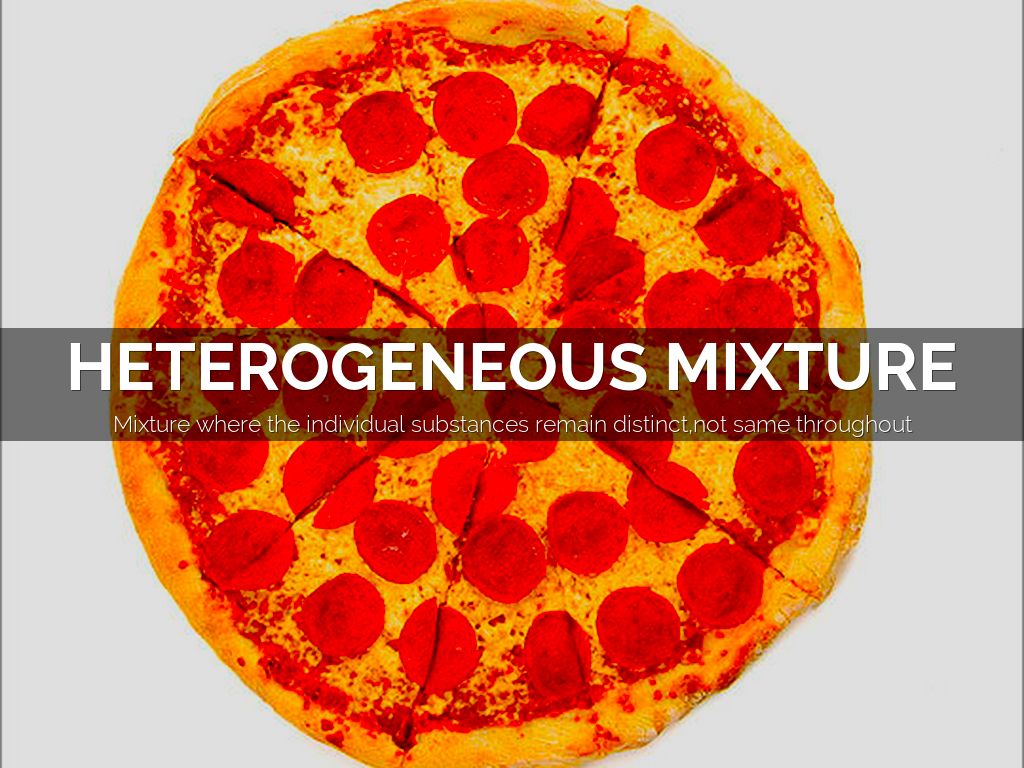
b)
sugar
c)
water
d)
ice
12.
__________ are made up of solutes and solvents.
a)
Solutions
b)
Suspensions
c)
Heterogeneous Mixtures
d)
Pure Substances
13.

The substance being dissolved is called the ________

a)

solvent

b)

solid

c)

solute

d)

solvate

14.

In which of the following do particles sit at the bottom

a)

Solution

b)

Suspension

c)

None of the above

d)

Colloid

15.

The properties of a compound are different from the elements that make them up.

a)

True

b)

False

16.
Something that takes up space and has mass.
a)
volume
b)
matter
c)
mass
d)
density
17.
Is sugar (C12H22O11) an element or a compound?
a)
Element
b)
Compound
18.

A substance that is made up of only one kind of atom is a(n)

a)

compound

b)

homogeneous mixtures

c)

element

d)

solution

19.
An element is a pure substance that can't be separated into anything more simpler by physical or chemical means. Gold is an element because it only contains gold atoms. Water is not an element because it contains hydrogen and oxygen atoms.
Gold is an element because it only contains gold atoms.
True or False?
a)
True
b)
False
20.

Which of these is an element?

a)

Salt (NaCl)

b)

Water (H20)

c)

Oxygen (O)

d)

Carbon Dioxide (CO2)

21.
A compound consists of two or more elements bound together.
a)
True
b)
False
22.

Both elements and compounds are pure substances.

a)

Agree

b)

Disagree

23.

Carbon is considered an element, while carbon dioxide is considered a compound. This is because carbon dioxide is ---

a)

a gas at room temperature.

b)

made of two different elements.

c)

given off by green plants.

d)

useful to human beings

24.
Element or Compound?
Au
a)
Element
b)
Compound
25.

Can be broken down into a simpler substance

a)

Elements

b)

Compounds

c)

Both

26.
Element or Compound?
Salt (NaCl)
a)
Element
b)
Compound
27.
What does it mean if a mixture is heterogeneous?
a)
you can see the different parts
b)
cannot tell one part from another
c)
very well blended
d)
made of elements
28.
What does it mean if a mixture is homogeneous?
a)
you can see the different parts
b)
cannot tell one part from another
c)
chunks of particles
d)
made of elements
29.
What type of mixture is this?
a)
heterogeneous 
b)
homogeneous
30.
What type of mixture is this?
a)
heterogeneous 
b)
homogeneous
31.
What type of mixture is this?
a)
heterogeneous 
b)
homogeneous
32.
What type of mixture is this?
a)
heterogeneous 
b)
homogeneous
33.

Which of the following is a pure substance?

a)

carbon

b)

pizza

c)

salad

d)

sand

34.
Two or more substances mingled together, but not chemically combined are known as a
a)
residue
b)
solution
c)
distillate
d)
mixture
35.

What is the smallest unit of matter? It is composed of protons and neutrons, held together in the nucleus, and electrons around the nucleus in different electron orbitals, which form an electron cloud.

a)

cell

b)

nucleus

c)

atom

d)

electron

36.

Chemistry is the study of

a)

Mass

b)

Space

c)

Matter

d)

Density

37.
What does it mean if a mixture is heterogeneous?
a)
you can see the different parts
b)
cannot tell one part from another
c)
very well blended
d)
made of elements
38.
What does it mean if a mixture is homogeneous?
a)
you can see the different parts
b)
cannot tell one part from another
c)
chunks of particles
d)
made of elements
39.

What is this?

a)

Element

b)

Compound

c)

Heterogeneous MIxture

d)

Homogeneous Mixture

40.
a)

Element

b)

Compound

c)

Homogeneous Mixture

d)

Heterogeneous MIxture

41.

What is it?

a)

Pure Substance

b)

Mixture

42.
a)

Pure Substance

b)

MIxture

43.

What is it?

a)

Pure Substance

b)

Mixture

44.
Elements and compounds are always ___.
a)
pure
b)
mixed
45.
What is a substance that is dissolved in another substance? 
a)
solution
b)
solute
c)
solvent
d)
compound
46.
What is a solvent?
a)
The substance that does the dissolving in a solution.
b)
The substance that is being dissolved in a solution.
c)
The mixing of different substances.
d)
The process in which neutral molecules lose or gain electrons
47.
air is a 
a)
compound
b)
element
c)
heterogeneous mixture
d)
solution
48.
salt water is a 
a)
compound
b)
element
c)
heterogeneous mixture
d)
solution
49.

When mixing a saltwater solution the water is the _____________ and the salt is the _____________

a)

water = solvent, salt = solute

b)

water = solute, salt = solvent

50.
Sugar water
a)
Heterogeneous
b)
Homogeneous
51.

The mass of a lead cube is 64 grams. This is an example of __________.

a)

physical intensive property

b)

physical extensive property

c)

chemical change

d)

physical change

52.
The melting point of ice is 00 C. This is an example of ________.
a)
physical intensive property
b)
physical extensive property
c)
Chemical change
d)
Chemical property
53.
Physical properties of a substance include _________
a)
color and odor
b)
melting and boiling points
c)
density 
d)
all of the choices are correct
54.
Which is an example of a physical property?
a)
ability to react with acid
b)
 color
c)
flammability
d)
ability to react with oxygen
55.
Which property is an example of a chemical property?
a)
The ability to burn
b)
The ability to dissolve
c)
The ability to evaporate
d)
The ability to melt
56.

Density: Chemical or Physical Property?

a)

Chemical Property

b)

Physical Property

57.

Flammability (burns): Chemical or Physical Property?

a)

Chemical Property

b)

Physical Property

58.

Solubility (dissolves): Chemical or Physical Property?

a)

Chemical Property

b)

Physical Property

59.

Properties that can be measured or observed without matter changing to an entirely different substance are called __________.

a)

Chemical Properties of Matter

b)

Physical Properties of Matter

c)

Physical Change

d)

Chemical Change

60.

Properties that can be measured or observed only when matter undergoes a change to become an entirely different kind of matter are called ___________.

a)

Evaporation

b)

Density

c)

Physical Properties Of Matter

d)

Chemical Properties of Matter

61.
Example for chemical property
a)
color
b)
hardness
c)
toxicity
d)
solubility
62.

Which of the following is an intensive property?

a)

Color

b)

mass

c)

volume

63.
Freezing point is an example of extensive property.
a)
True
b)
False
64.
Does NOT depend on the amount of matter you have
a)
extensive property
b)
intensive property
65.
All of these are examples of chemical properties except...
a)
Flammability
b)
Combusting
c)
Fizzing
d)
Boiling Point
66.

Ductility - the ability to be drawn out into a wire without breaking

a)

chemical property

b)

intensive physical property

c)

extensive physical property

67.

Ability to rust - the ability to form metal oxides (rust)

a)

chemical property

b)

intensive physical property

c)

extensive physical property

68.

Corrosiveness - the ability to eat away at or damage living tissue

a)

chemical property

b)

intensive physical property

c)

extensive physical property

69.

Malleability - the ability to be bent and forged

a)

chemical property

b)

intensive physical property

c)

extensive physical property

70.

Conductivity - the ability to transfer heat or electricity through something

a)

chemical property

b)

intensive physical property

c)

extensive physical property

71.

Hardness - the ability to resist being dented or scratched

a)

chemical property

b)

intensive physical property

c)

extensive physical property

72.

Reactivity - the ability of a substance to cause a chemical reaction

a)

chemical property

b)

intensive physical property

c)

extensive physical property

73.

Volume - the amount of space a substance takes up

a)

chemical property

b)

intensive physical property

c)

extensive physical property

74.

Melting point - the temperature at which a substance changes from a solid to a liquid

a)

chemical property

b)

intensive physical property

c)

extensive physical property

75.

Boiling point - the temperature at which a substance changes from a liquid to a gas

a)

chemical property

b)

intensive physical property

c)

extensive physical property

76.

Density - the ratio of mass to volume of a substance

a)

chemical property

b)

intensive physical property

c)

extensive physical property

77.

Organize these options into the right categories

Categorize the following

mass

density

volume

flammabiity

weight

solubility (ability to dissolve in water)

color

Intensive Property
Extensive Property
78.

Organize these options into the right categories

Categorize the following

weight

boiling point

density

height

Intensive Property
Extensive Property
79.

Organize these options into the right categories

Categorize the following

freezing point

softness

length

width

Intensive Property
Extensive Property
80.

Organize these options into the right categories

Categorize the following

conductivity

temperature

length

density

Intensive Property
Extensive Property
81.

Organize these options into the right categories

Categorize the following

color

temperature

area

length

Intensive Property
Extensive Property
82.
Which state of matter has a definite shape?
a)
solid
b)
liquid
c)
gas
83.

Define a liquid.

a)

Indefinite shape, indefinite volume

b)

Definite shape, definite volume

c)

Definite volume, indefinite shape

84.
The state of matter that has no definite size or shape is
a)
Solid
b)
Liquid
c)
Gas
85.

what are the states of matter

a)

solid, liquid, gas, and plasma

b)

solid, liquid, density, gas

c)

solid, gas, liter, plasma

86.
How many states of matter are there?
a)
4
b)
3.1415926535897932384626433832795028841971693993751058209749445923078164062862089986280348253421170679821480865132823066470938446095505822317253594081284811174502841027019385211055596446229489549303819644288109756659334461284756482337867831652712019091456485669234603486104543266482133936072602491412737245870066063155881748815209209628292540917153643678925903600113305305488204665213841469519415116094330572703657595919530921861173819326117931051185480744623799627495673518857527248
c)
3
d)
SPIDER-CAM
87.
Which physical property is measured in liters?
a)
color
b)
length
c)
mass
d)
volume
88.
Air is an example of a
a)
solid
b)
liquid
c)
gas
89.

Which set of properties, intensive or extensive, are based on the size of a sample?

a)

intensive

b)

extensive

90.

What kind of physical property is this? Color

a)

intensive

b)

extensive

91.

What kind of physical property is this? Temperature

a)

intensive

b)

extensive

92.

What kind of physical property is this? Energy

a)

intensive

b)

extensive

93.

What kind of physical property is this? Number of Atoms

a)

intensive

b)

extensive

94.
Something that takes up space and has mass.
a)
volume
b)
matter
c)
mass
d)
density
95.
Air
a)
Heterogeneous
b)
Homogeneous
96.
Pizza
a)
Heterogeneous
b)
Homogeneous
97.

All matter is made of what

a)

energy

b)

atoms

c)

electrons

d)

compounds

98.

What kind of physical property is this? Energy

a)

intensive

b)

extensive

99.
Helium is a ____________.
a)
liquid
b)
solid
c)
gas
100.
Sand is a ___________________.
a)
liquid
b)
solid
c)
gas
101.
Gasoline is a ________________.
a)
liquid
b)
solid
c)
gas
102.
______________ does not have a definite shape or volume.
a)
liquid
b)
solid
c)
gas