
Font size
 Worksheets
Evidence of Evolution and Cladograms Review
Total questions: 47
Worksheet time: 59mins

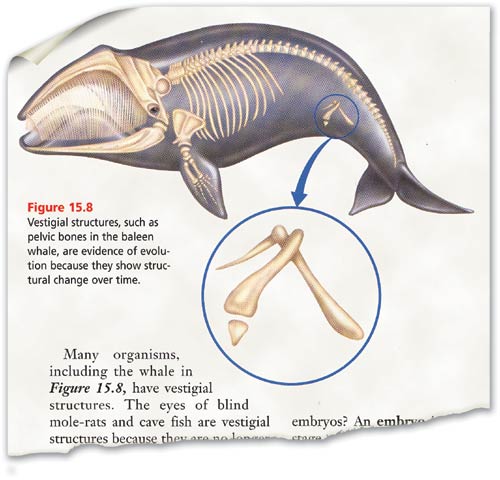
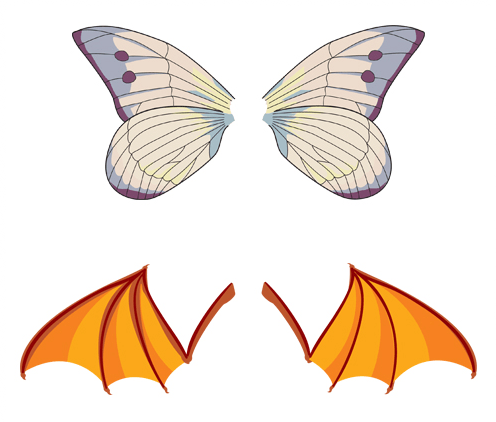
What is this an example of?
Homologous structure
Analogous structure
Vestigial organs
Functional adaption

The picture shows a/an ___________
homologous structure
vestigial structure
Analogous Structure
Same function different structure
Homologous Structure
Same structure different function
Comparative Embryology
Comparing embryological development of different species
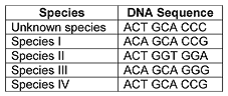
Biochemical Evidence
Comparing DNA and amino acid sequences of different species
Vestigial Structures
Structures in the body of an organism that no longer work.

What type of evidence is shown with the diagram above?
Molecular
Anatomical
Embryological
Fossil

Which of the pictures above would be examples of homologous structures? (pick 2)
1
2
3

Which of the following can be determined by observing the embryos shown in the diagram

What can the arm bones of humans and bats show us? That they...
.. shared an ancestor whom had that arm structure
... will eventually evolve into similar creatures
... share a gene pool
Scientists are studying a particular protein found in blood cells. Based on this, which animals are most closely related?
Dog: ARG - LYS - HIS - TYR
Rabbit: ARG - LYS - TYR - TYR
Elk: ARG - PRO - TYR - ARG
Dog & Rabbit
Rabbit & Elk
Dog & Elk



Two organisms that are closely related will have _________ differences in their DNA.
at least 20
No
More
Fewer

_________ structures are those that were useful to an ancestor of a present-day species, but are no longer useful.
ferruginous
vestigial
homologous
analogous

Opossum tails are used for gripping. Whales use their tales to propel them through the water. These are the same structure (a tail) with a different function. These structures are...
ferruginous
homologous
analogous
vestigial

Two species are said to be closely related based on the fact that they have a similar number of bones in their front legs. This is an example of...
structural evidence
embryological evidence
DNA evidence
Fossil evidence

A turtle's shell and the shell of a crab both act as protection. However, they have a different embryological origin. They are different structures with the same function. They are ________ structures
analogous
homologous
vestigial
ferruginous
Two species look very similar during the earliest stages of development. As they grow and change, they look similar for a very long time until they finally reach a stage where they develop structures unique to each species. We know these species are related due to _________ evidence.
embryological
structural
fossil
DNA

When looking at DNA evidence, scientists may count the number of bands (dark lines) of DNA. Species with the fewest number in common are __________ related.
most closely
most distantly

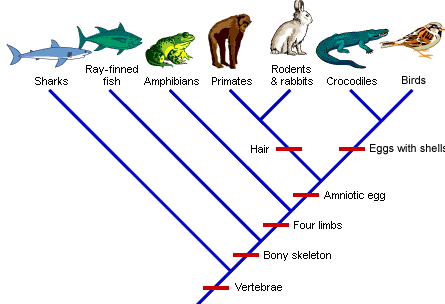
A cladogram is a branching tree diagram used to show evolutionary relationships.. The points on the diagram where branches meet represent...
time
a common ancestor
an extinct species
vertebrates
In a cladogram, the more recent species are at the top. The common ancestor of all the species is at the bottom. This means, as you go from top to bottom on a cladogram, you go further back in________.
embryology
DNA
the fridge
time

Penguins and Polar Bears both live in cold parts of the planet. They both need to stay warm to survive. To accomplish this, Penguins have thick feathers and Polar Bears have fur. Polar Bear fur and Penguin feathers are different structures with the same function. They are...
paralytic
mucigenous
homologous
analogous

In this cladogram, humans are most closely related to _______ and most distantly related to ________
birds, prosimians
amphibians, birds
insects, prosimians
prosimians, insects
Insect wings and bird wings are both used for flying. However, they grow out of very different groups of cells as the embryo develops. They are different structures with the same function. They are...
analogous
gregarious
homologous
homogenous

A scientist finds a fossil in a layer of rock known to be 75 million years old. In another layer of rock, further down, he finds another fossil that looks similar but is definitely different. Based on this fossil evidence, the second fossil may be the ________ of the first.
homologous
ancestor
embryo
DNA
Species change over time in response to pressures from their environment. They develop adaptations that help them get food and reproduce. This change over time is called...
common ancestor
development
evolution
adjustment
One species that existed long ago over time gave rise to multiple species. That original species is the _________________ of all the species that arose from it.
common ancestor
common location
common ground
commonality

The species indicated at point "1" is the common ancestor of...
A,B, and C only
B, C, and D only
Only D
A, B, C, and D

A, B, C, and D represent species that are...
extinct
existing today
ancestors of modern species
long dead

The species at point "1" is the common ancestor of...
B and C only
A and D only
A, B, and C
C and D only
Scientists are studying a particular protein found in blood cells. Based on this, which animals are most closely related?
Dog: ARG - LYS - HIS - TYR
Rabbit: ARG - LYS - TYR - TYR
Elk: ARG - PRO - TYR - ARG
Dog & Rabbit
Rabbit & Elk
Dog & Elk
What can the arm bones of humans and bats show us? That they...
.. shared an ancestor whom had that arm structure
... will eventually evolve into similar creatures
... share a gene pool
Which of the following can be determined by observing the embryos shown in the diagram
Which of the pictures above would be examples of homologous structures? (pick 2)
1
2
3
How does Pangaea support the Theory of Evolution? Select all that apply
It provides an explanation for why similar fossils are found on different continents
The movement of continents provides an example of a big change in environment that would cause evolutionary pressures that would drive species to evolve
It explains how the planet became warmer over the years
It provides evidence that continents are growing in size slowly

_______________, or selective breeding, is one way that humans impact evolution. One example is how the Belgian Blue cow has been bred to have greater muscle mass.
Artificial selection
Homologous

