
 Worksheets
Air Tech - Electrical Systems
Total questions: 37
Worksheet time: 19mins
A modern light aircraft has a ____ electrical system.
B.B.C
B.M.W
A.C
D.C
Electrical power is produced by the _____ when the engine is running and by the _____ when it is not running
alternator, generator
battery, alternator
generator, alternator
alternator, battery
Current runs through wires and the _______ to the unit that needs the power. Afterwards it runs to _______ through a _______.
starter motor, alternator, battery
ground wire, the bus bar, battery
bus bar, ground, ground wire
generator, battery, ground wire
What can the aircraft's battery as be known as?
alternator
accumulator
generator
bus bar
What is the length of time a battery can last based off?
ampere-hours
voltage
amp rating
resistance-hours
A battery with an ampere hour rating of 600 will last how long when running 10 amps an hour?
10hr
60hr
16hr
160hr
A Nicad battery is smaller, lighter and more efficient than a lead-acid battery.
true
false
What is the purpose of the aircraft accumulator? Choose all that apply
To store back up emergency electricity
To provide a continuous supply of electricity to the magnetos
To provide an initial electrical power source for the starter motor
To continue to charge to the alternator throughout flight
What is the alternator run off?
The battery
The engine
The magnetos
The camshaft
What is a GPU?
ground proximity unit
ground power unit
ground production undercarriage
general power undercarriage
What is the purpose of the GPU?
to stop the alternator overcharging the battery in flight
to conduct and distribute power around the electrical units
to aid with starting aircraft if battery is flat or capacity is too low
to measure the current flowing in the circuit
An alternator outputs _____ and a generator outputs ______
A.C, A.C
A.C, D.C
D.C, D.C
D.C, A.C
What does an inverter do?
changes A.C to D.C
steps A.C at one voltage up or down to another voltage
changes D.C to A.C
steps D.C at one voltage up or down to another voltage
What does a rectifier do?
changes A.C to D.C
steps A.C at one voltage up or down to another voltage
changes D.C to A.C
steps D.C at one voltage up or down to another voltage
What does a transformer do?
changes A.C to D.C
steps A.C at one voltage up or down to another voltage
changes D.C to A.C
steps D.C at one voltage up or down to another voltage
The alternator does not require a charged battery to start generating electricity.
true
false
What are disadvantages of the generator over an alternator?
select all that apply
It is heavier
It is larger
It produces less current per rpm
It requires a inverter to convert A.C to D.C
A generator is produced with a commutator to automatically produce ____
DC
AC
What is the purpose of the bus bar?
to prevent the battery from over heating and exploding
to prevent the battery from over cooling and exploding
to prevent the circuit breakers from popping
to prevent the alternator from over revving
What does an ammeter measure?
joules
ohms
amps
volts
What does a left-zero ammeter measure?
the charge into and out of the battery
the output of the alternator
the output of the battery
the charge into and out of the alternator
As more electrical services are switched on a left zero ammeter will move ....
left
stay on centre zero
right
stay of left zero
With the battery on but engine not running the centre zero ammeter will move .....
left of centre zero
stay on centre zero
right of centre zero
stay on left zero
With the battery on but engine not running the left zero ammeter will move .....
left
stay on centre zero
right
stay of left zero
What does a centre-zero ammeter measure?
the charge into and out of the battery
the output of the alternator
the output of the battery
the input into the battery
A fuse will _____ and a circuit breaker will _____ if there is a current overload
melt, pop
pop, melt
ignite, melt
pop, ignite
The radio should be left off for starting for what reason? Choose all that apply
the power can surge during start damaging the radio
the radio will cause electromagnetic flux to damage the magentos
the radio can produce a surge damaging the starter motor
the battery may be drained too much to start
What should you do if you notice insufficient charge to the battery?
pop the circuit breakers for all unnecessary equipment
turn on all lights to ensure you are visible to other aircraft
turn off unnecessary equipment to conserve the battery
turn the battery off then on again
How many times can you reset a circuit breaker?
0
1
2
3
An alternator...
provides power for electrical systems in an aircraft
provides power to the generator, which then powers the electrical systems
provides power only to the battery
allows DC power to be inverted into AC power
If a battery is rated at 40 Ampere hours, that means that it can...
support any system for 40 hours
support a system drawing 4 Amps for a maximum of 10 hours
support a system drawing 40 Amps for a maximum of 40 hours
support a system drawing 40 Amps for a maximum of 24 hours
A generator...
contains an electromagnet
spins a coil of wire inside a magnet
produces AC which is rectified to DC by diodes
contains a primary coil, secondary coil and an impulse coupling
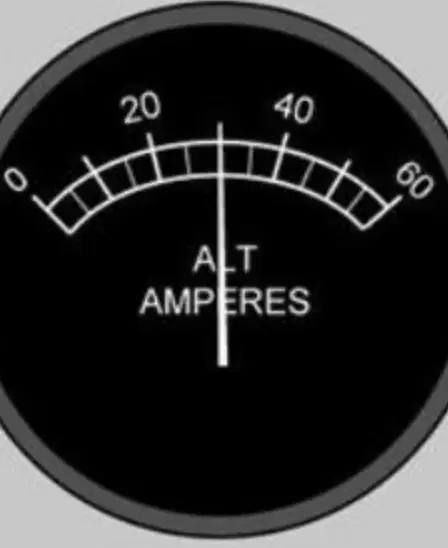
Looking at the picture, which statement is correct?
The battery is charged to 30 volts
There is 30 Amps of load on the alternator
The battery is charged to 30 Amps
The alternator is able to supply 30 Amps of current
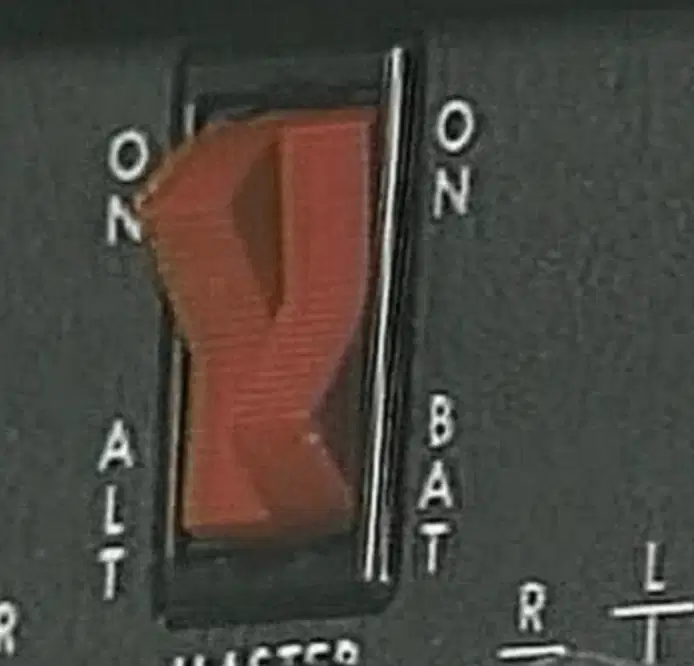
You are flying an aircraft on a cross country flight and the switches are in the position shown.
Which statement is correct?
There will be no power to the aircraft electrical systems
The alternator is supplying all power to the electrical systems
The battery is supplying all power to the electrical systems
This is the normal position of the switches for a cross country flight
A risk with turning the alternator switch off then back on in flight is that...
there may not be enough power in the battery to re-energise the windings in the alternator
it is likely to cause the battery to fail
it may cause the alternator to over-charge the battery
circuit breakers react badly to cycling an alternator
You are flying an aircraft that has a voltmeter and a centre zero ammeter. You notice that the ammeter reads -5 Amps and the voltmeter reads +8 Volts. What is the likely cause of this?
Alternator failure
Voltmeter failure
Battery failure
The master switch has been turned off
Your aircraft battery has a capacity of 20 Ampere hours. Your aircraft is presently drawing 2 Amps for the GPS, 1 Amp for the radio and 7 Amps for the MFD. If you alternator fails, what is the maximum time the battery power all of the above for?
20 hr
20 min
2 min
2 hr

