wayground logo

Free Printable Worksheets

Font size

S
M
L
XL
Worksheets

Speed, Acceleration, & Laws of Motion REVIEW

Total questions: 25

Worksheet time: 1hrs 29mins

Name
Class
Date
1.
What two measurements are necessary for calculating speed?
a)
Mass and time
b)
Temperature and mass
c)
Mass and distance
d)
Distance and time
2.
At 60 seconds, how far had this object traveled? 
a)
0 m
b)
10 m
c)
20 m
d)
40 m
3.
What is happening in this graph from point B to C?
a)
The object is going down a hill.
b)
The object is returning to its starting location.
c)
The object is slowing down.
d)
The object is staying still.
4.
What is happening in this graph from point A to B?
a)
The object is accelerating.
b)
The object is not moving.
c)
The object is decelerating.
d)
The object is moving at a constant speed.
5.
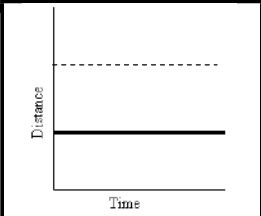
What does this graph represent?
a)
Constant speed
b)
Acceleration
c)
Not moving
6.
Velocity is both ____ and _____. 
a)
speed , direction 
b)
direction, mass
c)
volume, density 
d)
direction, magnitude 
7.
The SI unit for acceleration is
a)
mph
b)
ft/sec2
c)
m/s2
8.
Total distance divided by total time is
a)
average speed
b)
constant speed
c)
instantaneous speed
d)
acceleration
9.
Which one of Newton’s Laws of Motion best explains why the dishes do not move when the table cloth is removed?
a)
Newton's 1st Law
b)
Newton's 2nd Law 
c)
Newton's 3rd Law 
d)
Newton's Law of Biology
10.
What is the difference between mass and weight?
a)
mass is how much matter is in an object, and weight is the gravitational pull on that object
b)
mass and weight are the same
c)
weight affects how much mass is in an object
d)
weight is determined by how many atoms make up an object
11.
Which of the following shows the direction of the friction force?
a)
A
b)
B
c)
C
d)
D
12.
Which type of force(s) will cause a change in an object's motion?
a)
gravity
b)
zero net force
c)
balanced forces
d)
unbalanced forces
13.
What is the standard unit force is measured in?
a)
Newtons
b)
pounds
c)
grams
d)
meters
14.
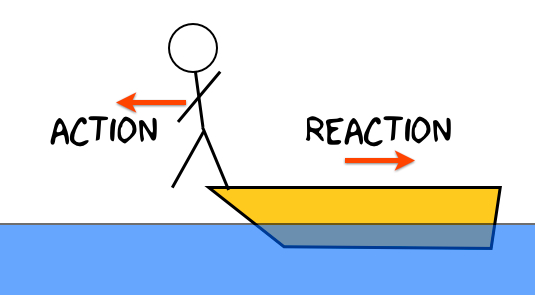
What law of motion does this picture represent?
a)
Newtons 1st law
b)
Newtons 4th law 
c)
Newtons 3rd law 
d)
Newtons 2nd law
15.
What is Newtons 2nd law of motion?
a)
Pancakes 
b)
Force= Mass multiplied by acceleration
c)
For every action there is a equal and opposite  re-action.
d)
Law of gravity 
16.
What is Newtons 2nd law of motion?
a)
Pancakes 
b)
Force= Mass multiplied by acceleration
c)
For every action there is a equal and opposite  re-action.
d)
Law of gravity 
17.

What is inertia?

a)

The resistance of any physical object to any change in its state of motion

b)

The amount of mass an object has

c)

A reaction in an object

d)

No one knows

18.

Which of the following has more inertia?

a)

Bowling ball

b)

Tennis ball

19.

The greater the force that is applied, the _____ the acceleration.

a)

greater

b)

lesser

20.

What equation is used to solve Newton's Second Law problems?

a)

F = ma

b)

M = Fa

c)

A = m / F

d)

F = m / a

21.

Newton's Third Law says that every time there is an action force, there is also a reaction force that is _____ in size and acts in the _____ direction.

a)

equal, opposite

b)

opposite, equal

c)

greater, different

d)

lesser, same

22.

Newton's Third Law says that forces must always occur in _____.

a)

pairs

b)

groups of 20 or more

c)

individual circumstances

d)

friction

23.

What will be the effect on the boy in the picture if the driver stops quickly?

a)

Because of inertia he will remain in the same position.

b)

He will be pushed back into the car seat.

c)

He will move from one side of the car seat to the other.

d)

He will move forward pressing against the seatbelt.

24.
In each of the following cases, determine where the car has no acceleration ?
a)
A car shortly after a stoplight turns green.
b)
A car approaching a red light
c)
A car with the cruise control set at 80 km/h
d)
A car moving down a ramp
25.
Acceleration describes how an object’s velocity is changing.  Which of the following scenarios provides the best example of an accelerating object?
a)
A car driving at a constant speed
b)
A book sitting on top of a high shelf
c)
A toy train traveling in a circle
d)
A toy boat floating in a bathtub