
 Worksheets
Instrument Ground Weather
Total questions: 24
Worksheet time: 18mins
Where do squall lines most often develop?
In an occluded front.
In a cold air mass.
Ahead of a cold front.
Which precipitation type normally indicates freezing rain at higher altitudes?
Snow.
Hail.
Ice pellets.
What is the expected duration of an individual microburst?
Two minutes with maximum winds lasting approximately 1 minute.
One microburst may continue for as long as 2 to 4 hours.
Seldom longer than 15 minutes from the time the burst strikes the ground until dissipation.
The presence of standing lenticular altocumulus clouds is a good indication of
a jet stream.
very strong turbulence.
heavy icing conditions.
Clouds, fog, or dew will always form when
water vapor condenses.
water vapor is present.
the temperature and dew point are equal.
Which of the following combinations of weather producing variables would likely result in cumuliform-type clouds, good visibility, rain showers, and possible clear-type icing in clouds?
Unstable, moist air, and no lifting mechanism.
Stable, dry air, and orographic lifting.
Unstable, moist air, and orographic lifting.
Which clouds have the greatest turbulence?
Towering cumulus.
Cumulonimbus.
Altocumulus castellanus.
Some of the characteristics you would expect to see with an unstable air mass are
nimbostratus clouds and good surface visibility.
turbulence and poor surface visibility.
turbulence and good surface visibility.
Maximum downdrafts in a microburst encounter may be as strong as
8,000 feet per minute.
7,000 feet per minute.
6,000 feet per minute.
What types of fog depend upon a wind in order to exist?
Steam fog and down slope fog.
Precipitation-induced fog and ground fog.
Advection fog and up slope fog.
The suffix 'nimbus,' used in naming clouds, means a
cloud with extensive vertical development.
rain cloud.
dark massive, towering cloud.
What are the characteristics of stable air?
Good visibility, steady precipitation, and stratus-type clouds.
Poor visibility, intermittent precipitation, and cumulus-type clouds.
Poor visibility, steady precipitation, and stratus-type clouds.
A high cloud is composed mostly of
ozone.
condensation nuclei.
ice crystals.
What are the requirements for the formation of a thunderstorm?
A cumulus cloud with sufficient moisture.
A cold front pushing into an area of moist, stable air.
Sufficient moisture, an unstable lapse rate, and a lifting action.
Which weather phenomenon signals the beginning of the mature stage of a thunderstorm?
The start of rain at the surface.
Growth rate of cloud is maximum
Strong turbulence in the cloud.
In what localities is advection fog most likely to occur?
Coastal areas.
Mountain slopes.
Level inland areas.
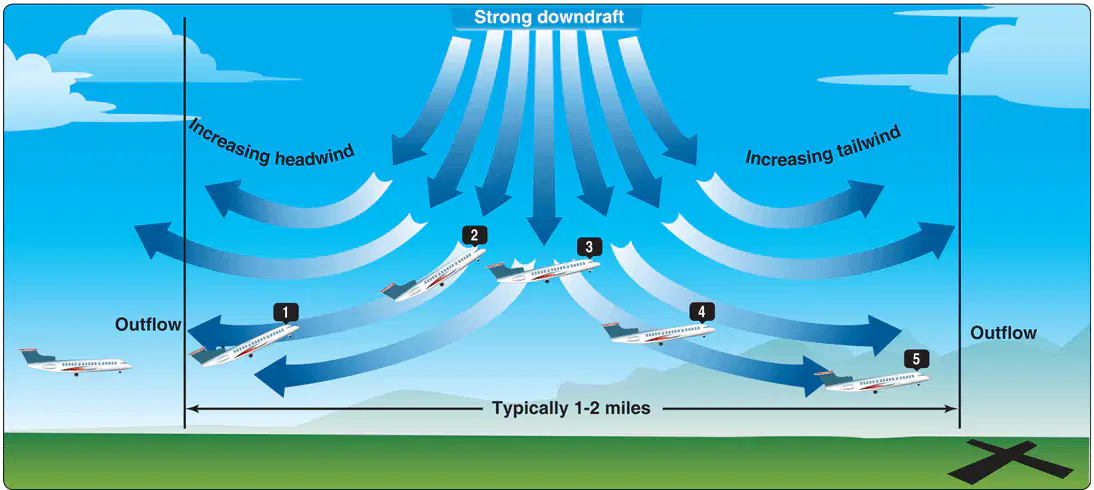
If involved in a microburst encounter, in which aircraft positions will the most severe downdraft occur?
4 and 5.
2 and 3.
3 and 4.

What effect will a microburst encounter have upon the aircraft in position 4?
Strong tailwind.
Strong updraft.
Significant performance increase.
Frontal waves normally form on
slow moving cold fronts or stationary fronts.
slow moving warm fronts and strong occluded fronts.
rapidly moving cold fronts or warm fronts.
If you fly into severe turbulence, which flight condition should you attempt to maintain?
Constant airspeed V(A).
Level flight attitude.
Constant altitude and constant airspeed.

What does the large red "L" mean?
Warm front
Low front
Low pressure
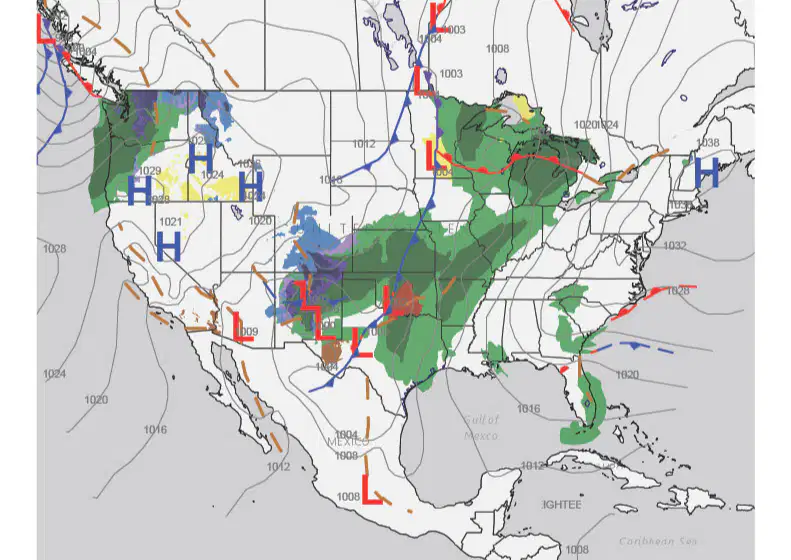
What does the blue "H" mean
High front
Cold front
High Pressure
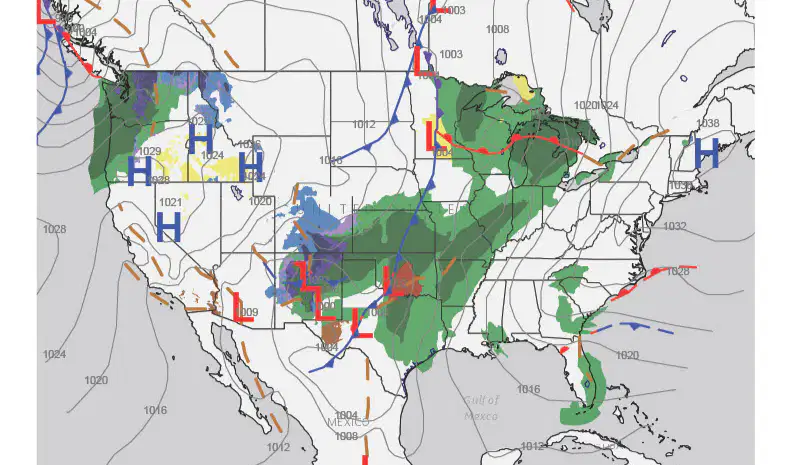
What are the blue lines with triangles mean?
Stationary Front
Cold Front
Warm Front
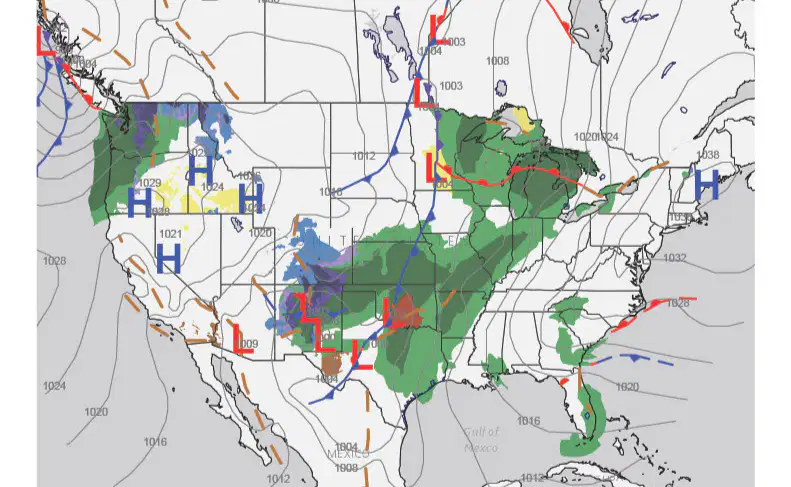
What do the red lines with semicircles mean?
Warm Front
Occluded Front
Low Pressure

