
Font size
 Worksheets
Geometric Optics
Total questions: 25
Worksheet time: 2hrs 5mins
A ray of light parallel to the optic axis of a concave mirror is reflected back
through the center of the sphere.
through the focal point.
parallel to the optic axis.
as if it came from the focal point.
The back surfaces of automobile/motorcycle headlights are curved
because inverted, real images of filaments shine brighter.
to concentrate light in one direction.
for structural reasons not related to optics
to get multiple images of the filament.
What type of image is formed when an object is placed at a distance of 1.5 focal lengths from a convex mirror?
erect and virtual
inverted and virtual
erect and real
inverted and real
Where is the image located when an object is placed 30 cm from a convex mirror with a focal length of 10 cm?
7.5 cm in back
15 cm in back
30 cm in back
7.5 cm in front
The critical angle for total internal reflection at an air-water interface is approximately 48degrees. In which of the following situations will total internal reflection occur?
light incident in water at 40 degrees
light incident in water at 55 degrees
light incident in air at 40 degrees
light incident in air at 55 degrees
A diverging lens has a focal length of 10 cm. Where is the image located when an object is placed 30 cm from the lens?
7.5 cm on the near side
15 cm on the near side
30 cm on the near side
7.5 cm on the far side

The concave spherical mirror of radius r shown above has focal point F and center of curvature C. An object is placed at a distance 2r from the mirror. Where will the image be formed?
Between C and the object
To the right of the object
Between F and the mirror
To the left of the mirror
Between F and C
A physics student places an object 6.0 cm from a converging lens of focal length 9.0 cm. What is the magnitude of the magnification of the image produced?
0.6
2.0
3.6
3.0
1.5
An object is placed in front of a converging thin lens at a distance from the center of the lens equal to half the focal length. Compared to the object, the image is
upright and smaller
inverted and smaller
upright and larger
inverted and the same size
inverted and larger

Which of the rays shown above is correct for this diverging mirror?
1
2
3
4
A ray of light in air (n = 1.0) is incident on glass (n = 1.5) at a small angle θa to the normal. The angle of the ray to the normal in the glass is θg . The speeds of light in air and the glass are va and vg , respectively. How do the values of the speed of light and the angle of the ray of light to the normal in air compare to those in the glass?
va > vg and θa > θg
va > vg and θa < θg
va < vg and θa > θg
va < vg and θa < θg
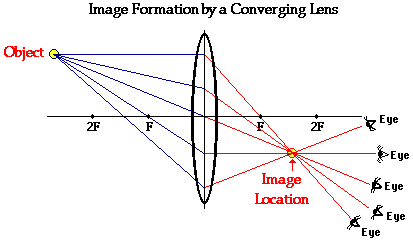
Which ray diagram shows a real image?


None of the above
Which lens represents the path light takes through a diverging lens?


The above lens is a type of ___.
diverging lens
converging lens
divergent lens
convergent lens

What type of lens is used in the shown instrument?
concave lens
convex lens
reflection lens
reduction lens
If an object is placed at a point 2F infront of a converging lens, Which of the following will describe the image correctly ?
Real
Inverted
Same Size
Beyond 2F
A dentist uses a small dental mirror to help magnify teeth in your mouth. What type of mirror is this?
a convex mirror
a concave mirror
a convex lens
a concave lens
If the angle of incidence is 25 degrees, the angle of reflection is
20 degrees
25 degrees
50 degrees
90 degrees
As indicated by the hands of the clock without numbers, the real time is 9:30. What is the time indicated inits image if the clock is placed in front of a plane mirror?
10:30
9:30
3:30
2:30

