wayground logo

Free Printable Worksheets

Font size

S
M
L
XL
Worksheets

Triangle Congruence Postulates by Rigid Transformations

Total questions: 63

Worksheet time: 1hrs 2mins

Name
Class
Date
1.

A flip is also called ___________.

a)

Translation

b)

Reflection

c)

Rotation

d)

Transformation

2.
A turn is also called a ___________.
a)
Translation
b)
Reflection
c)
Rotation
d)
Transformation
3.
A slide is also called a _________.
a)
Translation
b)
Reflection
c)
Rotation
d)
Transformation
4.
Translations, rotations, and reflections are three different types of what?
a)
Transformations
b)
Geometry
c)
Vectors
d)
Shapes
5.

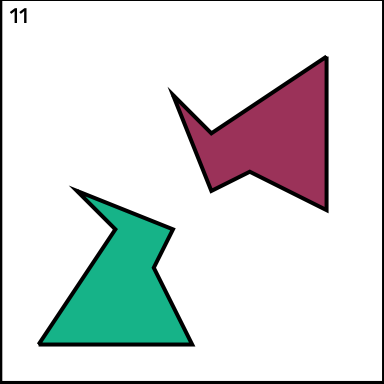
What transformation is shown?

a)

Reflection

b)

Rotation

c)

Translation

6.
Describe the Transformation
a)
Translation
b)
Reflection
c)
Rotation
7.

What transformation is this?

a)

Reflection

b)

Rotation

c)

Transformation

8.
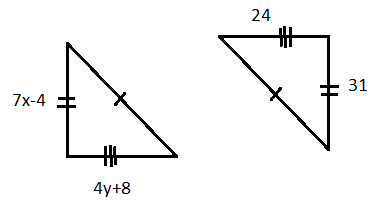
Solve for x
a)
5
b)
4
c)
3
d)
2
9.

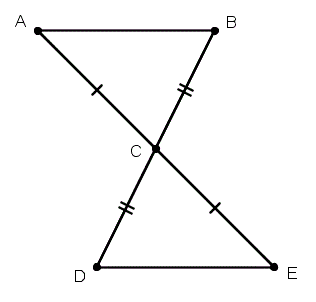
How are the triangles congruent? (Name a Postulate and Rigid Transformation).

a)

SAS by Rotation

b)

ASA by Rotation

c)

SAS by Reflection

d)

ASA by Reflection

10.

What congruency postulate proves the triangles' congruency, and by which rigid transformation?

a)

SAS by Rotation

b)

ASA by Rotation

c)

SAS by Reflection

d)

ASA by Reflection

11.

What postulate would prove triangle ∆NYQ is congruent to ∆PYQ?

Which rigid transformation would be used here?

a)

Reflection

b)
SAS
c)
SSS
d)
HL
e)

Rotation

12.

Find the value of x if AR is a perpendicular bisector of BC.

a)

1

b)

2

c)

3

d)

4

13.
What additional information is required for the 2 triangles to be congruent by SAS?
a)
A
b)
B
c)
C
d)
D
14.

Are these triangles congruent by SSS and, if so, using which rigid transformation?

a)

Yes, using reflection

b)

NO

c)

Yes, using rotation

15.
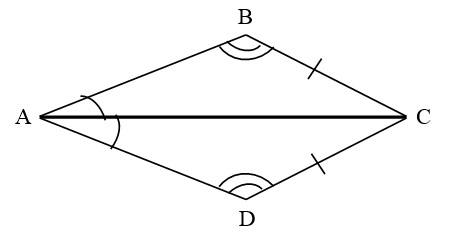
State if the two triangles are congruent.  If they are, state how you know.
a)
A
b)
B
c)
C
d)
D
16.

Are these triangles congruent? If so, by which postulate(s) and rigid transformation(s)?

a)

Yes, by AAS and reflection

b)

No

c)

Yes, by SSA and reflection

d)

Yes, by AAS and rotation

e)

Yes, by SSA and rotation

17.

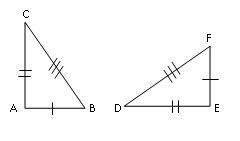
Which statement would make these 2 triangles congruent by SSS?

a)

DE AB\overline{DE}\ \cong\overline{AB}

b)

EDAB\overline{ED}\cong\overline{AB}

c)

BAED\overline{BA}\cong\overline{ED}

d)

CACE\overline{CA}\cong\overline{CE}

18.

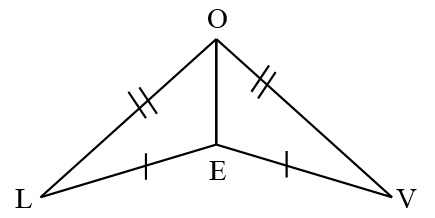
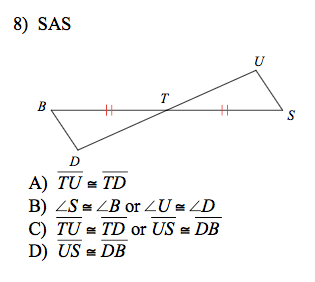
Name the postulate and rigid transformation that makes the triangles congruent.

a)
SSS
b)
SAS
c)
ASA
d)

Reflection

e)

Rotation

19.

If M is the midpoint of AB, then AM = MB. Which of the following "reasons" fits for the statement?

a)

Addition POE

b)

Def. of Midpoint

c)

Reflexive POE

d)

Symmetric

20.
If <1 and <2 are complementary, then m<1 + m<2 = 90
a)
Addition POE
b)
Subtraction POE
c)
Def of right angle
d)
Def of Complementary Angles
21.
Which of the following is NOT a triangle congruence criteria?
a)
SAS
b)
AAS
c)
SSA
d)
ASA
22.
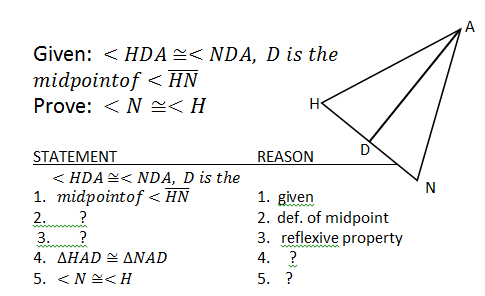
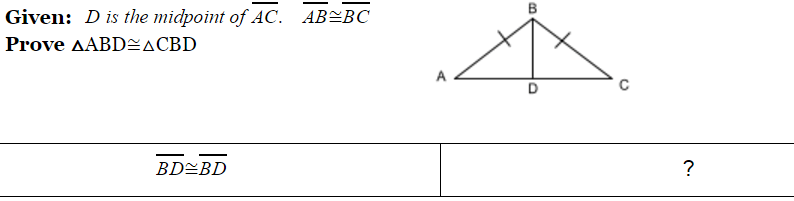
What is the "statement" for step 2 of the proof?
a)
AD=AD
b)
AD=DA
c)
HD=DN
d)
HA = AN
23.
What does CPCTC stand for?
a)
Congruent parts of congruent triangles are congruent
b)
Corresponding parts of congruent triangles are congruent
c)
Corresponding parts of corresponding triangles are corresponding
d)
Corresponding parts of congruent triangles are Canadian.
24.
AB = AB
a)
Reflexive POE
b)
Transitive POE
c)
Symmetric POE
d)
Distributive POE
25.
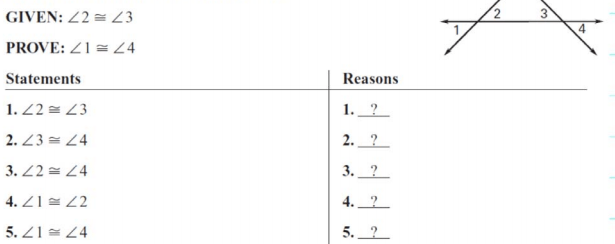
Which is the correct reason for statement 2 in the proof?
a)
Given
b)
Transitive Property
c)
Definition of Congruent Angles
d)
Vertical Angles are congruent.
26.
Which symbol means "perpendicular"?
a)
b)
c)
d)
27.
What additional information is required to prove the 2 triangles are congruent by SAS
a)
A)
b)
B)
c)
C)
d)
D)
28.
What is the justification (reason)?
a)
reflexive property
b)
definition of segment bisect
c)
definition of a midpoint
d)
substitution property
29.
IF <ABC ≅ <DEF, then m<ABC = m<DEF
a)
Reflexive POE
b)
Addition POE
c)
Def. of congruent angles
d)
Def. of right angles
30.
If X is between R & T on a line,
then RX + XT = RT
a)
Addition POE
b)
Substitution POE
c)
Angle Addition Post.
d)
Segment Addition Post.
31.
What is the reason?
a)
Definition of Complementary
b)
Definition of 180 
c)
Definition of supplementary
d)
Angle Addition
32.
Which property justifies the next step?
a)
Segment addition postulate
b)
Definition of an angle bisector
c)
Angle addition postulate
d)
Definition of right angles
33.
Identify the  missing statement or reason
a)
Reflexive Property
b)
Definition of Midpoint
c)
Given
d)
Vertical Angles Theorem
34.
Identify the  missing statement or reason
a)
Given
b)
Vertical Angles Theorem
c)
Definition of Angle Bisector
d)
Alternate Interior Angles Theorem
35.
Identify the  missing statement or reason
a)
Definition of Angle Bisector
b)
Alternate Interior Angles Theorem
c)
Reflexive Property
d)
Definition of Midpoint
36.
What would be the correct "given" statements for this diagram?
a)
T is the midpoint of segment BG and
∡B≅∡G
b)
∡B≅∡G and ∡A≅∡W
c)
T is the midpoint of segment BG and ∡A≅∡W
d)
T is the midpoint of segment AW and ∡A≅∡W
37.
Fill in the missing proofs.
a)
Transitive Property, SAS(Side-Angle-Side)
b)
Reflexive Property, SAS(Side-Angle-Side)
c)
Reflexive Property, Vertical Angles Thm.
d)
Transitive Property, SSS(Side-Side-Side)
38.
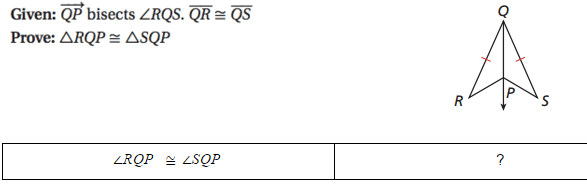
What is the "reason" for step 5 of the proof?
a)
Vertical Angle Theorem
b)
proof
c)
def. of angle bisector
d)
CPCTC 
39.
What is the "statement" for step 3 of the proof?
a)
HA=HA
b)
HA=AH
c)
MA=AM
d)
MA=MA
40.
What is the "statement" for step 3 of the proof? 
a)
∡EDA≅∡DCB
b)
∡AED≅∡BEC
c)
DE=CE
d)
∡AED≅∡CED
41.
What is the "reason" for step 4 of the proof?
a)
proof
b)
AAS
≅ Thrm
c)
ASA
≅ Thrm
d)
SAS
≅ Thrm
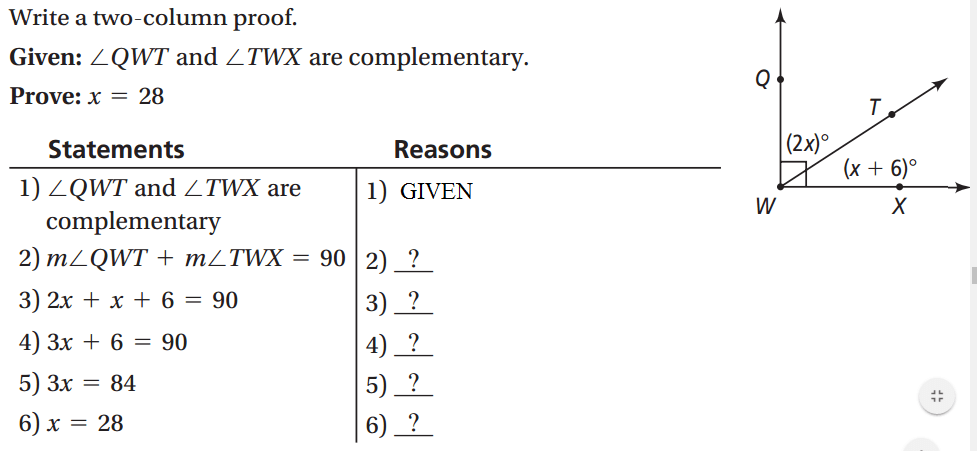
42.
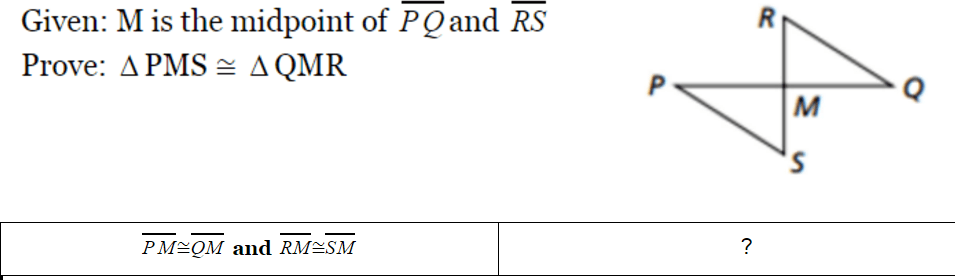
What is the REASON for Statement #2?
a)
Given
b)
Definition of Complementary Angles
c)
Substitution Property
d)
Reflexive Property of Congruence
43.

What is Reason B?

a)

Definition of Congruence

b)

Definition of Vertical Angles

c)

Reflexive Property

d)

Vertical Angle Theorem

44.

What is Reason C?

a)

Definition of Congruence

b)

Definition of Vertical Angles

c)

Reflexive Property

d)

Vertical Angle Theorem

45.

What is Reason D?

a)

SSS Congruence

b)

SAS Congruence

c)

ASA Congruence

d)

AAS Congruence

e)

HL Congruence

46.

What is Reason B?

a)

Definition of Congruence

b)

Definition of Equality

c)

Definition of Midpoint

47.

What is Reason D?

a)

Vertical Angle Theorem

b)

Reflexive Property

c)

Definition of Congruence

d)

Definition of Vertical Angles

48.

What is Reason C?

a)

SSS Congruence

b)

SAS Congruence

c)

ASA Congruence

d)

AAS Congruence

e)

HL Congruence

49.
Use the congruence statement to find the missing part of the statement
a)
WV
b)
WU
c)
VU
d)
WB
50.

Which of the following is a correct statement and reason for the proof shown?

a)

PQ\angle P\cong\angle Q ; SAS

b)

PQ\angle P\cong\angle Q ; CPCTC

c)

PQ\angle P\cong\angle Q ; SSS

d)

PQ\angle P\cong\angle Q ; SSA

51.

What statement and reason goes in the boxes labeled "1"?

a)

S: 2  1\angle2\ \cong\ \angle1  

R: Alt Int \angle  Thm

b)

S: 1  4\angle1\ \cong\ \angle4  

R: Alt Int \angle  Thm

c)

S: 2  4\angle2\ \cong\ \angle4  

R: Alt Int \angle  Thm

d)

S: 3  1\angle3\ \cong\ \angle1  

R: Alt Int \angle  Thm

52.

What statement and reason goes in the boxes labeled "2"?

a)

S: 3  4\angle3\ \cong\ \angle4  

R: Alt Int \angle  Thm

b)

S: 1  4\angle1\ \cong\ \angle4  

R: Alt Int \angle  Thm

c)

S: 2  4\angle2\ \cong\ \angle4  

R: Alt Int \angle  Thm

d)

S: 3  1\angle3\ \cong\ \angle1  

R: Alt Int \angle  Thm

53.

What statement and reason goes in the boxes labeled "3"?

a)

S: ZX  ZX\overline{ZX}\ \cong\ \overline{ZX}  

R: Reflexive PoC

b)

S: ZW  ZW\overline{ZW}\ \cong\ \overline{ZW}  

R: Reflexive PoC

c)

S: YX  YX\overline{YX}\ \cong\ \overline{YX}  

R: Reflexive PoC

d)

S: ZY  WX\overline{ZY}\ \cong\ \overline{WX}  

R: Opposite sides are \cong  

54.

What statement and reason goes in the boxes labeled "4"?

a)

S: ΔZYX  ΔXWZ\Delta ZYX\ \cong\ \Delta XWZ  

R: ASA

b)

S: ΔZYX  ΔXWZ\Delta ZYX\ \cong\ \Delta XWZ  

R: SAS 

c)

S: ΔZYX  ΔXWZ\Delta ZYX\ \cong\ \Delta XWZ  

R: AAS

d)

S: ΔZYX  ΔXWZ\Delta ZYX\ \cong\ \Delta XWZ  

R: SSS

e)

S: ΔZYX  ΔXWZ\Delta ZYX\ \cong\ \Delta XWZ  

R: HL

55.

What statement and reason goes in the boxes labeled "1"?

a)

S: BO  BO\overline{BO}\ \cong\ \overline{BO}  

R: Reflexive PoC

b)

S:   BH  BC\overline{BH}\ \cong\ \overline{BC}  

R: Opp sides are \cong  

c)

S: OH  OC\overline{OH}\ \cong\ \overline{OC}  

R: Opp sides are \cong  

d)

S: BO  BO\overline{BO}\ \cong\ \overline{BO}  

R: Transitive PoC

56.

What statement and reason goes in the boxes labeled "2"?

a)

S: ΔBHO  ΔBCO\Delta BHO\ \cong\ \Delta BCO  

R: ASA

b)

S: ΔBHO  ΔBCO\Delta BHO\ \cong\ \Delta BCO  

R: SAS 

c)

S: ΔBHO ΔBCO\Delta BHO\cong\ \Delta BCO  

R: AAS

d)

S: ΔBHO  ΔBCO\Delta BHO\ \cong\ \Delta BCO  

R: SSS

e)

S: ΔBHO ΔBCO\Delta BHO\cong\ \Delta BCO  

R: HL

57.

What statement and reason goes in the boxes labeled "1"?

a)

S: DO  HO\overline{DO}\ \cong\ \overline{HO}  

R: Def. of Segment Bisector

b)

S:   YT  DH\overline{YT}\ \cong\ \overline{DH}  

R: Opp sides are \cong  

c)

S: OH  OC\overline{OH}\ \cong\ \overline{OC}  

R: Given  

d)

S:  

YO  YO\overline{YO}\ \cong\ \overline{YO}  

R: Reflexive PoC

58.

What statement and reason goes in the boxes labeled "2"?

a)

S: YO  TO\overline{YO}\ \cong\ \overline{TO}  

R: Def. of Segment Bisector

b)

S:   YT  DH\overline{YT}\ \cong\ \overline{DH}  

R: Opp sides are \cong  

c)

S: OH  OC\overline{OH}\ \cong\ \overline{OC}  

R: Given  

d)

S:  

YO  YO\overline{YO}\ \cong\ \overline{YO}  

R: Reflexive PoC

59.

What statement and reason goes in the boxes labeled "3"?

a)

S:   YOD  HOT\angle YOD\ \cong\ \angle HOT  

R: Vertical Angle Thm

b)

S:   YOD  HOT\angle YOD\ \cong\ \angle HOT  

R: Alt Int Angle Thm

c)

S:   YOD  HOT\angle YOD\ \cong\ \angle HOT  

R: Reflexive PoC

d)

S:   O  O\angle O\ \cong\ \angle O  

R: Given

60.

What statement and reason goes in the boxes labeled "4"?

a)

S: ΔYOD  ΔTOH\Delta YOD\ \cong\ \Delta TOH  

R: ASA

b)

S: ΔYOD  ΔTOH\Delta YOD\ \cong\ \Delta TOH  

R: SAS 

c)

S: ΔYOD ΔTOH\Delta YOD\cong\ \Delta TOH  

R: AAS

d)

S: ΔYOD  ΔTOH\Delta YOD\ \cong\ \Delta TOH  

R: SSS

e)

S: ΔYOD ΔTOH\Delta YOD\cong\ \Delta TOH  

R: HL

61.

What statement and reason goes in the boxes labeled "1"?

a)

S: TDP & ADP are 90°\angle TDP\ \&\ \angle ADP\ are\ 90\degree  R: Def. of perpendicular

b)

S: TDP & ADP are 90°\angle TDP\ \&\ \angle ADP\ are\ 90\degree  R: Given 

c)

S: TDP & ADP are 180°\angle TDP\ \&\ \angle ADP\ are\ 180\degree  R: Def. of perpendicular

d)

S: D  D\angle D\ \cong\ \angle D  R: Reflexive PoC  

62.

What statement and reason goes in the boxes labeled "2"?

a)

S: PD  PD\overline{PD}\ \cong\ \overline{PD}  R: Reflexive PoC

b)

S: TD  AD\overline{TD}\ \cong\ \overline{AD}  R: Def of Segment Bisector

c)

S: TP  AP\overline{TP}\ \cong\ \overline{AP}  R: Opp. sides are \cong  

d)

S: PTD  PAD\angle PTD\ \cong\ \angle PAD  R: Alt. Int. Angle Thm.  

63.

What statement and reason goes in the boxes labeled "3"?

a)

S: ΔTDP  ΔADP\Delta TDP\ \cong\ \Delta ADP  

R: ASA

b)

S: ΔTDP  ΔADP\Delta TDP\ \cong\ \Delta ADP  

R: SAS 

c)

S: ΔTDP ΔADP\Delta TDP\cong\ \Delta ADP  

R: AAS

d)

S: ΔTDP  ΔADP\Delta TDP\ \cong\ \Delta ADP  

R: SSS

e)

S: ΔTDP ΔADP\Delta TDP\cong\ \Delta ADP  

R: HL