
 Worksheets
Unit 2 - Intro to Atoms Rw Quizizz
Total questions: 65
Worksheet time: 5hrs 50mins
What are the 3 subatomic particles of an atom?
shell, proton, electron
cloud, neutrons, protons
nucleus, protons, electrons
protons, neutrons, electrons
Which subatomic particle has a negative charge?
proton
neutron
electron
Which subatomic particle has a positive charge?
proton
neutron
electron
Which subatomic particle has a neutral or no charge?
proton
neutron
electron

What two parts of an atom make up the nucleus of the atom?
Electron and Protons
Neutron and Protons
Proton and Electrons

What is "a" in the picture?
Proton
Electron
Neutron
What is "b" in the picture?
Proton
Electron
Neutron
What is "c" in the picture?
Proton
Electron
Neutron
Who said. . . atoms cannot be divided?
Dalton
Thomson
Rutherford
Bohr
Chadwick
Who said. . . atoms cannot be created or destroyed?
Dalton
Thomson
Rutherford
Bohr
Chadwick
Who said. . . compounds are composed of atoms in a specific ratio?
Dalton
Thomson
Rutherford
Bohr
Chadwick
Who said. . . atoms contain smaller parts?
Dalton
Thomson
Rutherford
Bohr
Chadwick
Who said. . . there are negative charges scattered through a ball of positive charges?
Dalton
Thomson
Rutherford
Bohr
Chadwick
Who said. . . electrons have almost no mass?
Dalton
Thomson
Rutherford
Bohr
Chadwick
Who said. . . atoms are mostly empty space?
Dalton
Thomson
Rutherford
Bohr
Chadwick
Who said. . . positively charged particles are called protons?
Dalton
Thomson
Rutherford
Bohr
Chadwick
Who said. . . electrons have a specific amount of energy and move in specific orbits?
Dalton
Thomson
Rutherford
Bohr
Chadwick
Who said. . . that electrons move around the nucleus like the planets move around the sun?
Dalton
Thomson
Rutherford
Bohr
Chadwick
Who said. . . there was another particle in the nucleus called the neutron?
Dalton
Thomson
Rutherford
Bohr
Chadwick
Who's discovery helped complete the modern atomic theory?
Dalton
Thomson
Rutherford
Bohr
Chadwick


What did Neils Bohr's model look like?


Who's atomic model does this image represent (plum pudding / Chocolate chip cookie)?
Bohr
Rutherford
Thomson
Dalton


This is a picture of the first scientist who created the atomic theroy. Who is this?
Dalton
Thomson
Rutherford
Bohr
Chadwick


Using the diagram, what phrase best describes it?
Pure Element
Two Compounds
Mixture of a Compound and a Molecule
Mixture of Two Elements
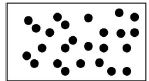
Using the diagram, what phrase best describes it?
Pure Element
Pure Compound
Mixture of a Compound and an Element
Mixture of Elements
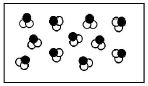
Using the diagram, what phrase best describes it?
Pure Element
Pure Compound
Mixture of a Compound and a Molecule
Mixture of Elements

Which element is this?
Nickel
Neon
Sodium
Nitrogen
Which Bohr model represents Be?


Which Bohr model represents Neon?


Which two elements make up water, H2O?
Hydrogen & Oxygen
Hydrogen & Helium
Osmium & Helium
Oxygen & Helium
Label the box from the Periodic Table correctly by moving the labels from below to the correct locations on the picture.
Atomic Number
Atomic Mass
Electron Configuration
Move the labels to the correct location on the box from the Periodic Table.
Equals the # of Protons
Equals the # of Protons PLUS Nuetrons
Adds up to the # of electrons
Label the box from the Periodic Table correctly by moving the labels from below to the correct locations on the picture.
Atomic Number
Atomic Mass
Electron Configuration
Move the labels to the correct location on the box from the Periodic Table.
Equals the # of Protons
Equals the # of Protons PLUS Nuetrons
Adds up to the # of electrons
Which element has atomic number 20?
Calcium (Ca)
Sodium (Na)
Iron (Fe)
Potassium (K)
Which element has atomic number 47?
Silver (Ag)
Gold (Au)
Copper (Cu)
Zinc (Zn)
What is the atomic number of Krypton (Kr)?
36
18
54
20
Select the correct electron configuration of Carbon (C).
2-4
2-8-15-2
12.011
6
The electron configuration for Iron (Fe) is:
4-3
2-8-14-2
2-8-18-18-7
2-4-8
Identify the element with the configuration 2-8-6.
Sulfur
Oxygen
Magnesium
Phosphorus
Identify the element in Period 3 that has 5 electrons in its last energy level (valence electrons).
Phosphorus
Sulfur
Sodium
Magnesium
Find the atomic mass of Iron (Fe).
55.85 u
63.55 u
24.30 u
40.08 u
Which has a greater atomic mass: Na or K?
K (Potassium)
Na (Sodium)
Li (Lithium)
Mg (Magnesium)
Which has a lower atomic mass: He or Li?
He (Helium)
Li (Lithium)
Na (Sodium)
K (Potassium)
Order from lowest to highest atomic mass: Carbon (C), Nitrogen (N), Oxygen (O).
Carbon (C), Nitrogen (N), Oxygen (O)
Oxygen (O), Nitrogen (N), Carbon (C)
Nitrogen (N), Carbon (C), Oxygen (O)
Oxygen (O), Carbon (C), Nitrogen (N)
Beryllium (Be) has 4 protons. How many neutrons does it have?
5 neutrons
3 neutrons
4 neutrons
6 neutrons
Which period (row) does the element Sodium belong to?
Period 1
Period 2
Period 3
Period 4

