
NEW
Font size
 Worksheets
DNA replication Quiz
Total questions: 20
Worksheet time: 1hrs 14mins
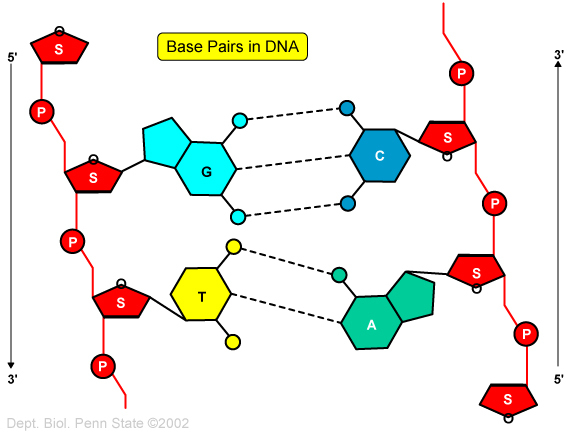
Match he nucleotide with its complementary nucleotide. (DNA to DNA).
Adenine -
Thymine
Guanine
Cytosine
Match he nucleotide with its complementary nucleotide. (DNA to DNA).
Cytosine-
Thymine
Guanine
Adenine
CAT TCA CTG
Phases: Which is the first step?
DNA Helicase unwinds original DNA strand
RNA Primase lays down RNA primer for new nucleotide bases.
DNA polymerase builds new strands by bring in new nucleotide bases.
Ligase knits together fragments on lagging strand
Phases: Which is the second step?
DNA Helicase unwinds original DNA strand
RNA Primase lays down RNA primer for new nucleotide bases.
DNA polymerase builds new strands by bring in new nucleotide bases.
Ligase knits together fragments on lagging strand

Each DNA molecule created contain one NEW strand and one OLD strand
True
False
Which of the following is a reason for DNA replication in skin cells?
to produce identical daughter skin cells
to enable the skin cells to make more proteins
to allow the skin cells to adapt to a changing environment
to ensure daughter skin cells will have higher genetic diversity
For a new liver cell to form, DNA replication is necessary because it ensures that the newly formed cell has which of the following?
two copies of the original cell’s DNA
an identical copy of the original cell’s DNA
a rearranged copy of the original cell’s DNA
only the best parts of the original cell’s DNA
Which nucleotides are present in DNA?
A, C, G, S
A, C, G, P
A, C, G, T
A, C, G, U
What is the structure of DNA?
triple helix
single strand
double helix
square shape
What is the shape of DNA?
circle
triangle
double helix
square
What is the function of DNA in cells?
synthesize proteins
provide energy for cellular processes
regulate cell division
store and transmit genetic information
What is the process of DNA replication?
DNA replication is the process by which a single-stranded DNA molecule is copied to produce two identical DNA molecules.
DNA replication is the process by which RNA is copied to produce two identical RNA molecules.
DNA replication is the process by which a double-stranded DNA molecule is copied to produce two identical DNA molecules.
DNA replication is the process by which a double-stranded RNA molecule is copied to produce two identical RNA molecules.
RNA also has nitrogen base of _
Guanine
Uracil
Thymine
What does Chargaff's rule state?
A pairs with T and C pairs with U
A pairs with G and T pairs with C
A pairs with T and C pairs with G
A pairs with C and G pairs with U

This image is of what?
lipid
nucleotide
amino acid
DNA
What is the macromolecule that DNA belongs to?
lipid
protein
carbohydrate
nucleic acid

