
 Worksheets
Emergency Splinting
Total questions: 33
Worksheet time: 17mins
What should always be done before moving a suspected fracture?
Apply ice
Splint the fracture
Call for help
Elevate the limb
Without proper immobilization, what can occur?
Increased damage and hemorrhage
Faster healing
Reduced pain
Improved mobility
What is used in a rapid form immobilizer?
Styrofoam chips sealed in airtight sleeve
Cotton pads
Metal rods
Plastic sheets
Splint where the athlete lies and avoid ______ them.
moving
lifting
shaking
twisting
Splint one joint above and one below ______.
fracture
sprain
bruise
cut
What is a challenge when splinting around the shoulder?
It is easy and requires no support
It is difficult but doable with sling and swathe
It cannot be done
Lower arm and wrist fractures should be splinted in the position of forearm ______ and supported by sling.
flexion
extension
rotation
abduction
Hand and finger fractures/dislocations should be splinted with tongue depressors, roller gauze, and/or ______ splints.
aluminum
plastic
wooden
rubber
What is required for fractures of the ankle?
Splinting of the whole leg
Splinting of the foot and knee
Splinting of the spine
No splinting required
Fractures involving the knee, thigh, or hip require splinting of the whole leg and one side of the ____.
trunk
arm
head
foot
What is the best method for splinting and moving the spine and pelvis?
Using a regular board
Using a spine board
Without any board
Using a knee brace
What is the purpose of using an arm sling as shown in the images?
To support and immobilize an injured arm
To enhance arm strength
To improve blood circulation in the arm
To increase flexibility of the arm
What should be done if placing an athlete on a spine board is required?
Call EMS
Call family
Call coach
Call friends
When placing an athlete on a spine board, the head and neck must be maintained in alignment with the _______.
long axis of the body
shoulders
pelvis
legs
Who must be responsible for the head and neck at all times when placing an athlete on a spine board?
One person
Two people
The entire team
The coach
What primary emergency care must be provided when placing an athlete on a spine board?
Maintain breathing
Treat for shock
Maintain position of athlete
All of the above
Who gives the command to roll the athlete onto the board?
The assistant
The captain at the head
The coach
The medical officer
Fill in the blank: Head and neck continue to be ______ once on the board.
stabilized
ignored
loosened
strained
What should remain in place for a football player with shoulder pads on?
Helmet
Shoes
Gloves
Knee pads
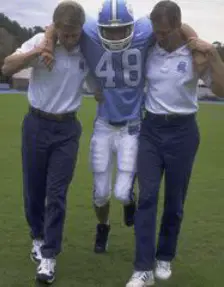
What is the purpose of an ambulatory aid?
To provide support or assistance to injured individuals to walk
To diagnose injuries
To perform surgery
To provide medication
How should support be provided when using ambulatory aid?
On one side only
On both sides by individuals of equal height
By a single individual
Without any support

Fill in the blank: Stretcher carrying is considered the _______ and safest mode of transport for injured athletes.
best
quickest
cheapest
most uncomfortable
What special consideration is required for pool extraction when moving and transporting injured athletes?
Athletic trainer should be able to swim or have water safety/lifeguard training
Rescue tube should always be available
Both A and B
None of the above
Fill in the blank: If the athlete is far from the edge, entering the _______ will be necessary.
water
field
track
stadium
What should you do when no injuries to the head or neck are suspected while moving an injured athlete in water?
Approach from the front
Approach from behind and use a rescue tube
Do not use a rescue tube
Call for help immediately.
Why is it important to keep the athlete calm while moving towards the edge of the pool?
To prevent panic and ensure safety
To increase their swimming speed
To improve their focus on the race
To help them conserve energy
What equipment is required if an athlete must come out of the water?
Life jacket
Spine board and at least 2 rescuers
First aid kit
Oxygen mask
What is the first step when approaching an athlete with a suspected head or neck injury in the water?
A) Approach quickly to save time
B) Approach slowly to avoid disrupting the water
C) Approach from behind
D) Approach with a loud noise
When is a crutch or cane required?
When there is a need for additional support while walking
When you want to increase your walking speed
When you are trying to improve your posture
When you want to carry extra weight
What can result from faulty mechanics or improper fitting of a crutch or cane?
Increased risk of falls
Improved mobility
Enhanced posture
Reduced muscle strain
How far should crutches be placed from the outer margin of the shoe?
6 inches
5 inches
10 inches
15 inches
Where should the top of the crutch base fall in relation to the armpit?
2 - 3 fingers below
At the same level
2 - 3 fingers above
Directly under the armpit
At what degree of flexion should the hand brace be positioned to place the elbow?
0 degrees
30 degrees
45 degrees
60 degrees

