
 Worksheets
Introduction to Anatomy and Physiology
Total questions: 31
Worksheet time: 16mins
What is anatomy?
The study of plants
The study of diseases of the human body
The study of functions of living organisms
The study of the form and structure of the parts of an organism.
What is physiology?
The study of plants
The study of diseases of the human body
The study of functions of living organisms
The study of the form and structure of the parts of an organism.
Put in order from most simple to most complex:
cells, tissues, organs, organ systems, human body.
Cells, organs, tissues, organ systems, human body.
human body, cells, tissues, organs, organ systems.
tissues, organs, organ systems, cells, human body.
One function of cells is to provide ATP to body tissues.
True
False
Human cells do the following: (select all that are correct)
take in food and oxygen
eliminate waste
move and adapt to the environment
Use photosynthesis
perform special functions/each cell has a job
Mitosis results in egg and sperm cells
True
False
Mitosis is the process that results in cell replication and cell turn over
True
False
What is the body's ability to regulate its internal environment?
metabolism
homeostasis
digestion
sweating
What is the term used to describe chemical reactions constantly going on within the body's cells that result in growth, repair, energy release, use of food and secretions?
metabolism
homeostasis
digestion
sweating
Most homeostasis works on this system where conditions exceed a "set point" limit and trigger a reaction to restore the condition.
positive feedback system
negative feedback system
Define anabolism.
buildup of complex materials from simpler ones such as food and oxygen
breakdown/changing of complex materials into simpler ones. Release of energy and carbon dioxide
Define catabolism.
buildup of complex materials from simpler ones such as food and oxygen
breakdown/changing of complex materials into simpler ones. Release of energy and carbon dioxide
Tissue type: Covers the interior and exterior body surfaces. It forms a protective barrier. Found in the lining of blood vessels, lining of respiratory system, lining of digestive tract, outer skin covering.
Epithelial
Nervous
Connective
Muscle
Tissue type: Provides support for the body and connects its parts. Found: bone, cartilage, tendons, ligaments, fat, blood and lymph.
Epithelial
Nervous
Connective
Muscle
Tissue Type: Receives and transmits nerve impulses throughout the body. Found: Brain, spinal cord, nerves
Epithelial
Nervous
Connective
Muscle
Tissue Type: Composed of cells that can contract. Enables movement. Found: attached to bones for movement, found in organs (example heart) and the arteries and veins.
Epithelial
Nervous
Connective
Muscle
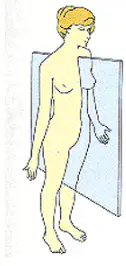
Name this plane
Sagittal
Coronal/frontal
Transverse
Which plane divides the body into front and back?
Sagittal
Coronal/frontal
Transverse
Which plane divides the body into top and bottom portions?
Sagittal
Coronal
Transverse
Midsagittal divides the body into equal parts, right and left
True
False
Which organ is in the thoracic cavity?
Heart
stomach
bladder
brain
What structure separates the thoracic from abdominal cavity?
stomach
intestines
liver
diaphragm
Which organ is in the pelvic cavity?
heart
bladder
liver
lungs
Meiosis
Sexual reproduction (4 different daughter cells)
Asexual reproduction
(2 identical daughter cells)
Front/in front of
Cranial
Caudal
Dorsal/posterior
Ventral/Anterior
Skull or head end
Cranial
Caudal
Ventral/Anterior
Dorsal/Posterior
Tail or tail end
Cranial
Caudal
Anterior/Ventral
Posterior/Dorsal
Toward the midline
Lateral
Medial
Superior
Inferior
Upper or above
Lateral
Medial
Superior
Inferior
Farther from the point of attachment
Proximal
Distal
Superficial
Deep
Toward the surface
Proximal
Distal
Superficial
Deep

