
 Worksheets
DSHS Midterm Exam 2024
Total questions: 70
Worksheet time: 54mins
In a (a) Democracy the citizens vote directly on laws supporting Rousseau's belief of popular sovereignty.
In a (a) Democracy the citizens vote indirectly on laws supporting Locke's belief of Consent of the Governed.
What are the three terms that can be used interchangeably to describe a type of government in which citizens choose delegates (representatives) to make decisions for them in government?
Indirect Democracy, Representative Democracy and Republic
Direct Democracy, Representative Democracy and Republic
Constitutional Monarchy, Representative Democracy and Republic
Indirect Democracy, Representative Democracy and Oligarchy
The Great Compromise created a _________________ legislature.
Unicameral
Bicameral
Tricameral (three branches of gov.)
One House
In a direct democracy, all eligible citizens could vote on laws and (a) ruled.

Using the graphic, which system of government concentrates all power within the central government.
Unitary
Confederal
Federal
Using the graphic, which system of government concentrates the majority of power within the state governments and creates a weak central/federal government.
Unitary
Confederal
Federal
Using the graphic, which system of government divides power between the state governments and central/federal government.
(Federal gov. prevails when there are any disputes)
Unitary
Confederal
Federal
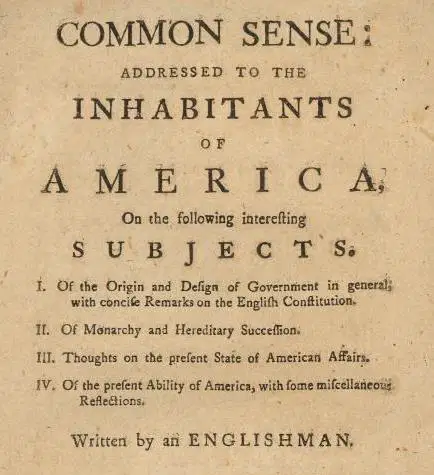
What was a main argument of Common Sense?
The colonists were petty in their complaints about the king.
The colonies should declare immediate independence from the king.
Taxes are a natural part of life.
A council should be created to work with the king.
Which of the following Enlightenment Philosophers believed in the idea of Consent of the Governed and unalienable rights (life, liberty and property)?
John Locke
Baron De Montesquieu
Thomas Hobbes
Jean Jacques Rousseau
" Because men agree to enter into society to preserve their natural rights to life, liberty, and property, whenever the government attempts to take away or destroy the life, liberty, or property of the people, the government put itself in a state of war with the people and the people are released from any further obedience to the government "
- Two Treatise of Government
Which Enlightenment Philosopher is being quoted?
John Locke
Baron De Montesquieu
Thomas Hobbes
Jean Jacques Rousseau
"When in the Course of human events, it becomes necessary for one people to dissolve the political bands which have connected them with another..."
-The Declaration of Independence, 1776
What does it mean to "dissolve political bands"?
Get rid of the relationship politically between the Colonies and Great Britain
Getting rid of British rule while still enjoying the benefits of being a colony
Establishing a Constitutional Monarchy in America rather than an Absolute Monarchy
Establishing an Absolute Monarchy in America rather than an Constitutional Monarchy
The Great Compromise was a compromise between--
The Virginia Plan wanted representation based on--
The New Jersey Plan wanted representation in government based on--

Congress is made up of two houses, which one is based on population?
Congress is made up of two houses, which one has equal representation of 2 representatives per state?
Who was happy with the Virginia plan?
Small States with a small population
Large States with a big population
What kind of states supported the New Jersey Plan?
For the Great Compromise, how is the number of Senators determined?
What do the separation of powers guarantee?
That government is not all powerful by distributing power
That government is strong enough to overpower the states
State sovereignty
How does the Supremacy Clause resolve conflicts between federal and state laws?
By allowing state laws to override federal laws
By stating that the Constitution and federal laws take precedence over state laws
By requiring conflicts to be resolved by the Supreme Court
By leaving it to individual states to decide
Which system of government does the United States operate under?
(a)
Which philosopher suggested the idea that if a government fails to fulfill its purpose (to protect people's rights) in a social contract, the people have the right to overthrow it?
Jean Jacques Rousseau
John Locke
Thomas Hobbes
Baron de Montesquieu
“We hold these truths to be self-evident, that all men are created equal, that they are endowed by their Creator with certain unalienable rights, that among these are life, liberty, and the pursuit of happiness.”
This quotation from the Declaration of Independence reflects beliefs mainly derived from
Jean Jacques Rousseau’s idea of direct democracy
John Locke’s ideas
Montesquieu’s views
Thomas Hobbes’ theory of the state of nature

Which of the following correctly lists the systems of governments from MOST power held by the central government to the LEAST power held by the central government?
Federal, unitary, confederate
Unitary, federal, confederate
Confederate, unitary, federal
All of their central government have the same amount of power
What term describes the legal system that requires all citizens be treated fairly?
Separation of Powers
Bill of Rights
Due Process of Law
Popular Sovereignty
Who is the Father of the United States Constitution?
George Washington
James Madison
Thomas Jefferson
Alexander Hamilton
The Magna Carta accomplished which of the following?
Limited powers of the king
Self Government
Declaring Independence
All of these are true

1. We hold these truths to be self-evident:
2 that all men are created equal,
3 that they are endowed by their Creator with certain unalienable Rights,
4. that among these are Life, Liberty and the pursuit of Happiness.
5. that to secure these rights, Governments are instituted among Men, deriving their just powers from the consent of the governed,
6. that whenever any Form of Government becomes destructive of these ends, it is the Right of the People to alter or to abolish it, and to institute new Government, laying its foundation on such principles and organizing its powers in such form, as to them shall seem most likely to effect their Safety and Happiness.
Which two lines reveal the social contract theory?
Lines 1 and 2
Lines 5 and 6
Lines 4 and 5
Lines 3 and 4
Which of the following accurately defines rule of law ?

Why did the founding fathers structure the government in this manner? Refer to the diagram below.
to divide power among three levels of government
to allow for changes to the Constitution as time passes and the country grows
to establish a bicameral government
to prevent any one branch from becoming more powerful than the others
Which branch of government has the power to confirm judges or justices and to impeach them?
Presidential
Legislative
Executive
Judicial
How does the judicial branch check on the power of Congress and the President?
vetoing legislation (law) that is passed by Congress and signed by the President
declaring acts of Congress (legislation) or presidential actions (executive orders) to be unconstitutional
issuing warrants
issuing court restraints
Congress has the power to make laws for the nation. Who has the power to approve (sign) or veto new legislation?
state governors
United States citizens
the Chief Justice of the Supreme Court
the President of the United States
Which of the following examples illustrates the system of checks and balances?
The President calls for a special meeting of the Cabinet.
The President signs a tax bill, even though the Congress recommends that he not sign it.
The President entertains the Queen of England.
The President vetoes a bill, but Congress overrides his veto.

Supreme Court justices (judges) are appointed by . . .
the United Nations.
Congress.
a special committee.
the President.
The President of the United States nominates a new ambassador to Canada. His nomination must be approved by . . .
the Vice President.
the Supreme Court.
Congress.
the Department of Homeland Security.
Which of the following choices from the list below correctly completes this statement: The President checks Congress by
proposing legislation (laws)
preparing an annual budget for the Supreme Court to approve
signing or vetoing legislation (laws) that Congress has passed
refusing to confirm judges and justices
what branch can declares war?
executive
legislative
judicial
What document made it clear that the colonies wanted to separate from Great Britain?
(a)
What document protects individual rights from a stronger central government?
The Bill of Rights
The Constitution
The Articles of Confederation
Magna Carta
What do you call a change to the Constitution?
amendment
introduction
preamble
articles
Why did the Founding Fathers include an amendment process in the Constitution?
To make the Constitution more complicated
To give power to a small minority
To allow future generations to update the Constitution
To prevent any changes to the Constitution
What does the term 'living document' mean in relation to the Constitution?
The Constitution is a historical artifact
The Constitution is outdated
The Constitution can be changed
The Constitution can walk and breathe
How many members are in the House of Representatives?
Which article of the Constitution creates Congress?
Which article of the Constitution creates Executive Branch?
Which article of the Constitution creates Judicial Branch?
Who casts votes if there is a tie in the Senate?
(Leader of the Senate)
President pro tempore
Which Constitutional "plan" created the House of Representatives and Senate?
How long are the elected terms of members of the Senate?
How long are the elected terms of members of the House of Representatives?
How many members are in the Senate?
Representatives represent their (a) .
Senators represent their (a) .
The Legislative Branch (a) laws.
The Executive Branch (a) laws.
The Judicial Branch (a) laws.
The 25th amendment established Presidential succession.
What is the correct order of Presidential succession below?
Vice President, Speaker of the House, President Pro Tempore and Cabinet members
Vice President, President Pro Tempore, Speaker of the House and Cabinet members
Vice President, President Pro Tempore, Speaker of the House and Secretary of State
Vice President, President Pro Tempore, Speaker of the House and Secretary of Treasury
What is the Necessary and Proper Clause also known as?
The Elastic Clause
The Supremacy Clause
The Commerce Clause
The Establishment Clause
What is a key difference between the Necessary and Proper Clause and the Supremacy Clause?
The Necessary and Proper Clause deals with state powers, while the Supremacy Clause deals with federal powers.
The Necessary and Proper Clause allows Congress to make laws, while the Supremacy Clause establishes the Constitution as the supreme law of the land.
The Necessary and Proper Clause is part of the Bill of Rights, while the Supremacy Clause is not.
The Necessary and Proper Clause is used to interpret treaties, while the Supremacy Clause is not.
Which landmark Supreme Court case established the power of judicial review?
Roe v. Wade
Marbury v. Madison
Dred Scott v. Sandford
Brown v. Board of Education
"Judicial Review " means that the United States Supreme Court can _____.
Impeach a member of Congress
Override a President's veto
Declare a law unconstitutional
Change a law passed by Congress
Constitutional protection against unfair governmental actions and laws is--
voting rights
due process
freedom of religion
Bill of Rights

Which amendment led to this decision giving citizens the right to remain silent?
1st
5th
10th
14th
Which statement accurately summarizes the impact of the Gideon v. Wainwright (1963) decision?
It incorporated the 4th Amendment to state and local governments
It required that police officers inform suspects under arrest of the 5th and 6th Amendment rights
It incorporated the right to legal counsel, as protected under the 6th Amendment, to state and local governments
It increased states' power to restrict freedom of speech when it is shown to increase danger to public safety
What are the three qualifications to become President?
1. 30 Years Old
2. Natural Born Citizen
3. Live in the U.S. for 14 years
1. 35 Years Old
2. Natural Born Citizen
3. Live in the U.S. for 14 years
1. 30 Years Old
2. Naturalized Citizen
3. Live in the U.S. for 14 years
1. 30 Years Old
2. Natural Born Citizen
3. Live in the U.S. for 10 years
The amendment which formally established the 2 term limit for POTUS in ____________.
The 20th
The 22nd
The 26th
The 25th
Which of the following statements best compares and contrasts the Louisiana State Constitution with the U.S. Constitution?
The LA State Constitution includes more specific provisions regarding state taxation than the U.S. Constitution
Both Constitutions grant the power to declare war exclusively to the executive branch
Unlike the U.S. Constitution, the LA State Constitution does not provide for a bicameral legislature
The U.S. Constitution emphasizes state sovereignty more explicitly than the LA State Constitution

