Wayground logo

Free Printable Worksheets

Font size

S
M
L
XL
Worksheets

7.2 Electromagnetic Spectrum

Total questions: 30

Worksheet time: 59mins

Name
Class
Date
1.
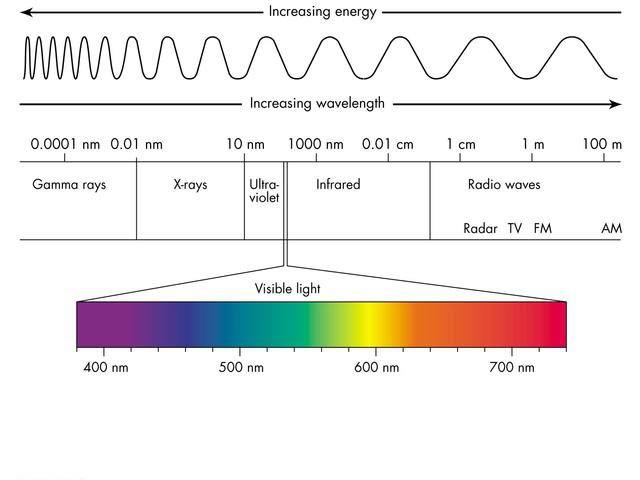
True or false: as you move along the spectrum, radio to gamma waves, the wavelengths decrease in size (get smaller)
a)
true
b)
false
2.
A wave with a large wavelength will have a ______ frequency and _____ energy
a)
high, low
b)
high, high
c)
low, high
d)
low, low
3.
Select the correct order of waves on the EMS from the longest wavelength to the shortest wavelength
a)
Radio, Micro, Infra, Visible, Ultra, X-ray, Gamma
b)
Gamma, X-ray, Ultra, Vis, Infra, Micro, Radio
c)
Vis, Micro, Infra, Ultra, X-ray, Gamma, Radio
d)
Micro, Radio, Vis, Infra, Ultra, X-ray, Gamma
4.
Which has the LONGEST wavelength and, therefore, the lowest frequency/energy
a)
Gamma Rays
b)
Radio Waves
c)
Visible Light
d)
Infrared rays
5.
Which has the SHORTEST wavelength and, therefore, the highest frequency/most energy
a)
Radio waves
b)
Ultraviolet Rays
c)
Gamma Rays
d)
X-rays
6.
Which section of the spectrum is the ONLY one we can see?
a)
X-rays
b)
Visible Light
c)
Gamma Rays
d)
Ultraviolet Rays
7.
How are electromagnetic waves different from other waves? 
a)
They have very short wavelengths 
b)
They transmit energy instead of matter 
c)
They can travel through empty space
d)
They can change direction by reflection 
8.
Which of the following electromagnetic waves has the lowest energy?
a)
gamma ray
b)
infrared wave
c)
visible light wave
d)
microwave
9.
High frequency waves have _________ wavelengths.
a)
varying
b)
long
c)
the same
d)
short
10.
The distance between two crests or two troughs of a wave is called:
a)
frequency
b)
amplitud
c)
wavelength
d)
hertz
11.
The height of the wave from the rest position is known as the _____________.
a)
amplitude
b)
crest
c)
trough
d)
wavelength
12.
Which electromagnetic waves have the highest frequencies and the shortest wavelengths?
a)
microwaves
b)
visible light
c)
gamma rays
13.
Electromagnetic waves that help your body produce vitamin D are called?
a)
ultraviolet rays
b)
x-rays
c)
gamma rays
14.
The electromagnetic spectrum includes the complete range of electromagnetic waves placed in order of:
a)
increasing amplitutde
b)
increasing wavelength
c)
increasing frequency
15.
Which of the following has frequencies higher than ultraviolet rays?
a)
visible light
b)
infrared rays
c)
x-rays
16.
Which electromagnetic waves help doctors detect broken bones inside your body?
a)
gamma rays
b)
x-rays
c)
ultraviolet rays
17.

What is the correct order of the visible light spectrum starting with the longer wavelength?

a)

Red, yellow, orange, blue, violet, indigo

b)

Violet, indigo, blue, green, yellow, orange, red

c)

Green, yellow, blue, indigo, red, orange

d)

Red, orange, yellow, green, blue, indigo, violet

18.

Which color has the longest wavelength?

a)

Yellow

b)

Red

c)

Green

d)

Purple

19.

Which color waves have the shortest wavelength?

a)

red

b)

yellow

c)

green

d)

violet

20.

What happens to frequency when wavelength decreases?

a)

stays the same

b)

decreases

c)

increases

d)

There is no relationship between wavelength & frequency.

21.

Which wave has the longest wavelength?

a)

Wave 1

b)

Wave 2

22.

Which wave has the HIGHEST frequency?

a)

Wave 1

b)

Wave 2

23.
The frequency of infrared waves is..
a)
1012 Hz
b)
1020 Hz
c)
104 Hz
d)
1015 Hz
24.

The unit for frequency is:

a)

Hertz (Hz)

b)

Meters (m)

c)

Centimeters (cm)

d)

Inches (In)

25.

The unit for wavelength is:

a)

Hertz (Hz)

b)

Meters (m)

c)

Centimeters (cm)

d)

Inches (In)

26.

In waves, frequency is

a)

How frequent something happens

b)

The speed of wavelength

c)

How many waves pass by a point in 1 second

27.

The _______ of a wave is how many waves pass a given point every second.

a)

Frequency

b)

Wavelength

c)

Amplitude

28.

Using the picture, which letter represents visible light?

a)

A

b)

B

c)

C

d)

D

29.

Using the picture, which letter represents gamma waves?

a)

A

b)

B

c)

C

d)

D

30.

Which two waves shown here have the same wavelength?

a)

A and B

b)

A and C

c)

B and C

d)

C and D