
 Worksheets
Constitution Review2
Total questions: 72
Worksheet time: 36mins
Which group supported ratification of the Constitution for a stronger central government?
Anti-Federalists
Federalists
The Great Compromise was between large and small states. What is the key word for this compromise?
process
representation
slavery
weak central government
The Great Compromise addressed disagreements over federal representation by —
creating a bicameral legislature
enumerating the powers of the central government
giving veto power to the executive
establishing three branches of government
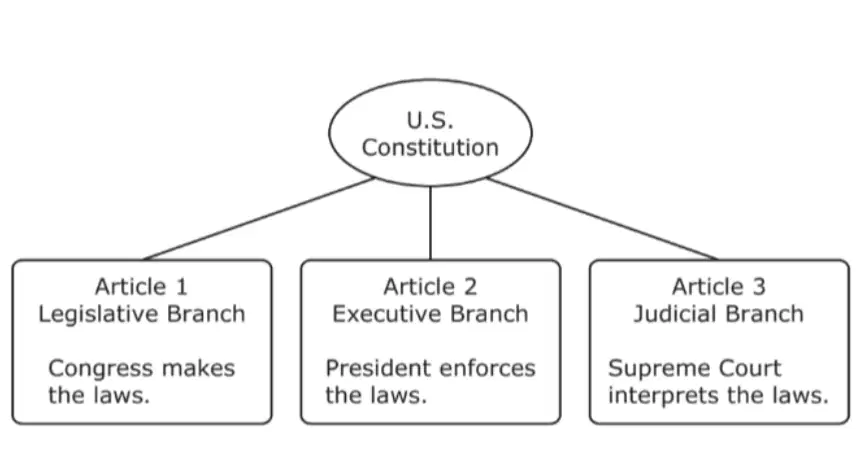
Which government principle is illustrated in this diagram?
Federalism
Popular sovereignty
Republicanism
Separation of powers
Why did the Constitutional Convention agree to the Three-Fifths Compromise?
To settle debates over the issue of counting the enslaved population for representation
To settle debates over the issue of abolishing the importation of enslaved people
To create a government based on the principle of federalism
To create a government with a bicameral legislature
Why was "The Great Compromise" so important?
It created the Senate and the House of Representatives.
Smaller states seceded.
Larger states had all the power in the government.
People never argued again.
Why was "The Great Compromise" so important?
It created the Senate and the House of Representatives.
Smaller states seceded.
Larger states had all the power in the government.
People never argued again.
Which principle means the state governments and the federal government share power?
federalism
popular sovereignty
limited government
separation of powers
With which of the following ideas would Federalists most likely have agreed on?
A Bill of Rights should be included in the Constitution
Having a stronger central government will make the country stronger & more stable
The 3/5th Compromise will make the country more fair and equal
Everyone should be able to vote
Why did Anti-Federalists demand a Bill of Rights be added to the Constitution?
to strengthen the authority of the federal government
to Improve the organization of the judicial branch
to give each state equal amounts of power
to protect individual freedoms from the federal government
Which documents are in the correct chronological order?
Declaration of Independence, Northwest Ordinance, The Constitution
Northwest Ordinance, Declaration of Independence, The Constitution
The Constitution, Northwest Ordinance, Declaration of Independence
Declaration of Independence, Constitution, Northwest Ordinance
When a territory gained _______ free adult people, it could write a Constitution and apply to the U.S. government to become a state
5,000
50,000
60,000
Any number of


What does it mean to Ratify?
Suggestion
Approve
Veto
Marriage
Who starts the proposal of Amending the U.S. Constitution?
2/3 of State
2/3 of Congress
3/4 of States
3/4 of Congress
What does Amending mean?
Approve
Reject
Suggest
Change


Which historic document had the greatest influence on the first ten amendments to the U.S. Constitution?
The English Bill of Rights
The Mayflower Compact
The Fundamental Orders of Connecticut
The Articles of Confederation

Which amendment guarantees that you will have a lawyer to represent you, that you can have a jury, and that you can face the person accusing you of a crime?
The 4th amendment
The 5th amendment
The 6th amendment
the 7th amendment

Which right best completes the diagram?
The right to bear arms
Freedom to speak without fear of punishment
Protection from cruel and unusual punishment
Freedom of the press to report on court proceedings
What does the Bill of Rights protect?
The Constitution
Individual Rights
The President and Vice President
The X-Men
When the federal government and state government share power, it's called...
Teamwork
Limited Government
Separation of Powers
Federalism
According to the principle of Checks and Balances system, which branch of government is the MOST powerful?
The Legislative Branch
The Executive Branch
The Judicial Branch
They are all equal in power.
People who make and enforce laws on the behalf of the people:
Royalty
Representatives
Federalists
Police
Federalism means that the Federal government shares power with:
The People
Congress
State Governments
Local Governments
The principle that states each branch of government has the ability to limit the power of the other branches.
checks and balances
federalism
popular sovereignty
separation of powers
A government in which people rule, the authority of the government comes from the people.
Checks and Balances
Popular Sovereignty
Federalism
Separation of Powers
This idea calls for the people to exercise to delegate their power by electing or voting for their political representation.
Limited Government
Separation of Powers
Republicanism
Federalism
This is the idea that everyone, citizens and powerful leaders alike, must obey the law.
Federalism
Republicanism
Limited Government
Popular Sovereignty

Slavery was allowed in southern states, which, at the time, bordered the Northwest Territory. If a slave were to run away from the South and make it to the Northwest Territory, would that slave be considered a free person?
No, the NW Ordinance specifically said they would be returned if bounty hunters came looking for them.
Yes, slavery was outlawed unless that person had committed a crime
No, a person can never be truly free from the constraints of society.
Yes, once any person entered the NW Territory, they would be issued citizenship papers.
What is the primary purpose of the U.S. Constitution's amendment process?
To allow the President to make laws
To adapt to changing times and needs
To increase the power of the federal government
To limit the rights of citizens
Explain how the Great Compromise addressed the issue of representation in Congress during the Constitutional Convention of 1787.
It established a unicameral legislature with equal representation for all states.
It created a bicameral legislature with representation based on population in both houses.
It created a bicameral legislature with equal representation in the Senate and population-based representation in the House.
It allowed states to choose their own method of representation.
Analyze how the principle of checks and balances is reflected in the U.S. Constitution.
The President can veto laws passed by Congress.
Congress can declare war without any restrictions.
The Supreme Court can create new laws.
The President can appoint judges without Senate approval.
Identify one way in which the U.S. Constitution addresses the colonial grievance of "no taxation without representation."
By allowing states to print their own money
By establishing a federal income tax
By granting Congress the power to levy taxes with representation
By abolishing all taxes
Explain how the Bill of Rights addresses the colonial grievance of unfair trials.
By allowing the government to hold secret trials
By guaranteeing the right to a speedy and public trial
By eliminating the jury system
By allowing only judges to decide cases
Analyze the role of popular sovereignty in the U.S. Constitution.
It allows the President to make all decisions without input from Congress.
It ensures that the government derives its power from the consent of the governed.
It gives the Supreme Court the power to overrule state laws.
It allows Congress to pass laws without presidential approval.
Evaluate how the principle of individual rights is protected in the U.S. Constitution.
By allowing the government to censor the press
By ensuring that citizens have rights that cannot be infringed upon by the government
By giving the President the power to limit free speech
By allowing Congress to pass laws that restrict individual freedoms
Why is the freedom of the press considered vital in a constitutional republic?
It allows the government to control information.
It ensures that citizens are informed and can hold the government accountable.
It restricts the ability of individuals to express their opinions.
It allows only government-approved news to be published.
The introduction to the Constitution is called the ___.
Articles of Confederation
Declaration of Independence
Bill of Rights
Preamble
The Preamble lists the ___ of the United States Constitution.
grievances
unalienable rights
purposes
weaknesses
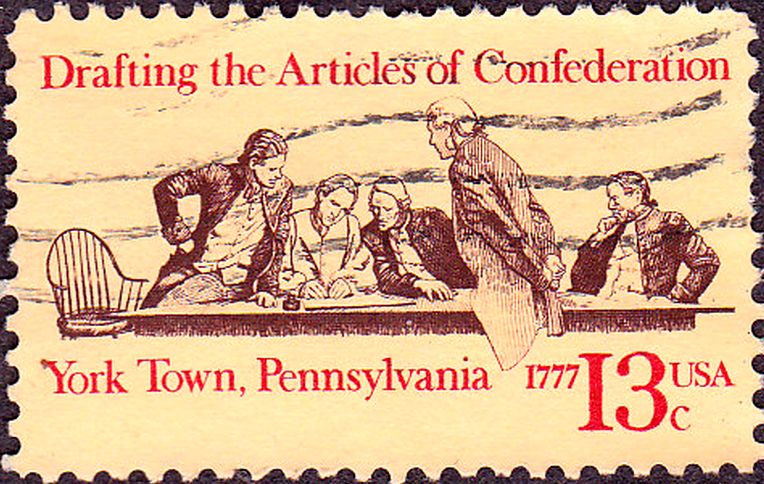
Before the Constitution, the Articles of Confederation created a ______central government.
weak
strong
stable
big
The first three words of the preamble, "We the people..." established the principle of _______________________.
consent of the governed
separation of powers
checks and balances
natural law
What is the name of the first written plan of government for the newly independent U.S.A.?
Common Sense
Treaty of Paris
Declaration of Independence
Articles of Confederation

Under the Articles of Confederation, which was NOT a power given to the federal government?
declare war
raise taxes
borrow money
make treaties

After Shay's Rebellion, the Congress met to try to fix the Articles of Confederation. What document did they create instead that fixed the weaknesses in the Articles?
The United States Constitution
The Mayflower Compact
The English Bill of Rights
They didn't change the Articles

What two groups argued during the efforts to ratify the new US Constitution?
Federalists and Republicans
Democrats and Republicans
Federalists and Anti-Federalists
the Northerners and the Southerners
The Federalist wanted
Small independent governemnts
A strong Republic ruled by a centralized government
An agrarian society
The planter class to gain more power
Who wrote the Constitution?
Anti Federalist
Federalists
Whigs
Republicans
What was the main concern of the Anti-Federalists?
The lack of a strong central government
The potential for government tyranny and lack of individual rights
The need for a national bank
The expansion of the United States
Which document did the Anti-Federalists demand to be added to the Constitution?
The Declaration of Independence
The Articles of Confederation
The Bill of Rights
The Federalist Papers
What was the name of the papers written to support the Constitution?
Lubbock Avalanche Journal
Federalist Papers
Anti-Federalist Papers
Pentagon Papers
What right is NOT included in the 8th Amendment?
Excessive Bail shall not be required
No excessive fines imposed
No double Jeopardy
No cruel or unusual punishment
what is the 8th amendment
the The Eighth Amendment to the United States Constitution states
Excessive bail shall not be required, nor excessive fines imposed, nor cruel and unusual punishments inflicted.”
his amendment prohibits the federal government from imposing unduly harsh penalties on criminal defendants, either as the price for obtaining

