wayground logo

Free Printable Worksheets

Font size

S
M
L
XL
Worksheets

Unit 1.2 Review 24-25

Total questions: 49

Worksheet time: 25mins

Name
Class
Date
1.
The ligament that runs along the outside of the knee, providing lateral stability, is called:
a)
MCL
b)
LCL
c)
PCL
d)
ACL
2.
The ligament that is on the anterior side of the body, connecting the femur to the tibia
a)
MCL
b)
LCL
c)
PCL
d)
ACL
3.
Why is it important to assess and maintain range of motion in individuals, especially those with limited mobility?
a)
To increase muscle mass
b)
b) To prevent joint injuries
c)
To reduce cardiovascular risk
d)
To promote relaxation
4.
Which joint movement is described as decreasing the angle between two bones?
a)
Flexion
b)
Extension
c)
Abduction
d)
Adduction
5.
Which term refers to the maximum distance a joint should be extended or flexed to perform a movement effectively?
a)
Flexibility
b)
Range of Motion
c)
Extension limit
d)
Joint capacity
6.
What does ROM stand for in the context of human movement?
a)
Range of Muscles
b)
Range of Motion
c)
Rotation of Movement
d)
Repetition of Motion
7.
Which type of muscle tissue is striated and under voluntary control?
a)
Skeletal muscle
b)
Cardiac muscle
c)
Smooth muscle
d)
Involuntary muscle
8.
Which type of muscle tissue is found in the walls of the heart?
a)
Skeletal muscle
b)
Cardiac muscle
c)
Smooth muscle
d)
Striated muscle
9.
The ligament that connects the femur and tibia on the inner side of the knee and helps stabilize the joint is:
a)
ACL
b)
MCL
c)
PCL
d)
LCL
10.
What is the primary function of the sliding filament theory in muscle contraction?
a)
a) To generate ATP
b)
b) To maintain body temperature
c)
c) To shorten muscle fibers
d)
d) To increase blood flow
11.
Which molecule serves as the primary energy source for muscle contraction in the sliding filament theory?
a)
a) Glucose
b)
b) ATP
c)
c) Oxygen
d)
d) Carbon dioxide
12.
Which of these connects bones to bones?
a)
Ligament
b)
Tendon
c)
Muscles
d)
Glomerulus
e)
Cartilage
13.
Which of these connects a muscle to a bone?
a)
tendon
b)
ligament
c)
yellow cartilage
d)
hyaline cartilage
e)
Bowman's capsule
14.
Which group of joints did we study?
a)
fibrous
b)
synovial
c)
cartilaginous
d)
honkey-tonk
15.
What is C?
a)
ligament
b)
tendon
c)
capsule
d)
muscle
e)
yellow cartilage
16.
Where do you find a ball-and-socket joint?
a)
between the ribs
b)
shoulders
c)
base of the thumb
d)
top of the spine/under the skull
e)
human bodies do not have this type of joint
17.
Where do you find a pivot joint?
a)
hips
b)
head of the radius rotates inside a ligamentous ring that secures it to the ulna
c)
base of the thumb
d)
top of the spine/under the skull
e)
human bodies do not have this type of joint
18.
Where do you find a saddle joint?
a)
hips
b)
wrist
c)
base of the thumb
d)
top of the spine/under the skull
e)
human bodies do not have this type of joint
19.
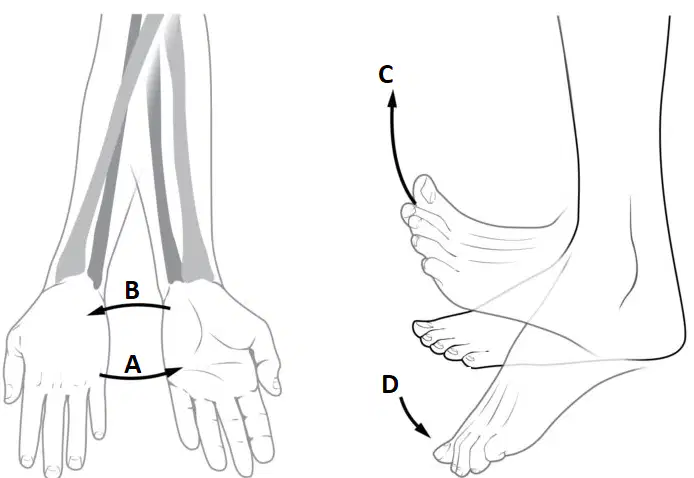
Which of these movements shows plantar flexion?
a)
A
b)
B
c)
D
d)
C
e)
Both A and C show plantar flexion
20.
Which type of muscle tissue is striated and involuntary?
a)
Skeletal
b)
Cardiac
c)
Smooth
21.
Which of these joints have multiaxial movement?
a)
gliding
b)
hinge
c)
ball and socket
d)
pivot
22.
When one is moving a limb away from the median plane of the body along the frontal plane, it is called
a)
abduction
b)
adduction
c)
inversion
d)
dorsiflexion
23.
The hip joint, like the shoulder joint, is a ________ joint
a)
pivot
b)
hinge
c)
saddle
d)
ball and socket
24.
Which of the following muscle type is not striated?
a)
skeletal muscle
b)
smooth muscle
c)
cardiac muscle
25.
Movement away from the midline of the body
a)
rotation
b)
flexion
c)
abduction
d)
adduction
26.
Moving a bone around its own axis, with no other movement
a)
rotation
b)
flexion
c)
abduction
d)
adduction
27.
An unbending movement around a joint in a limb (as the knee or elbow) that increases the angle between the bones of the limb at the joint
a)
flexion
b)
plantar flexion
c)
extension
d)
dorsiflexion
28.
Movement toward the midline of the body
a)
flexion
b)
abduction
c)
extension
d)
adduction
29.
What type of KT taping is shown here
a)
Ligament Correction
b)
Lymphatic Drainage
30.
What type of KT taping is shown here
a)
Ligament Correction
b)
Lymphatic Drainage
31.
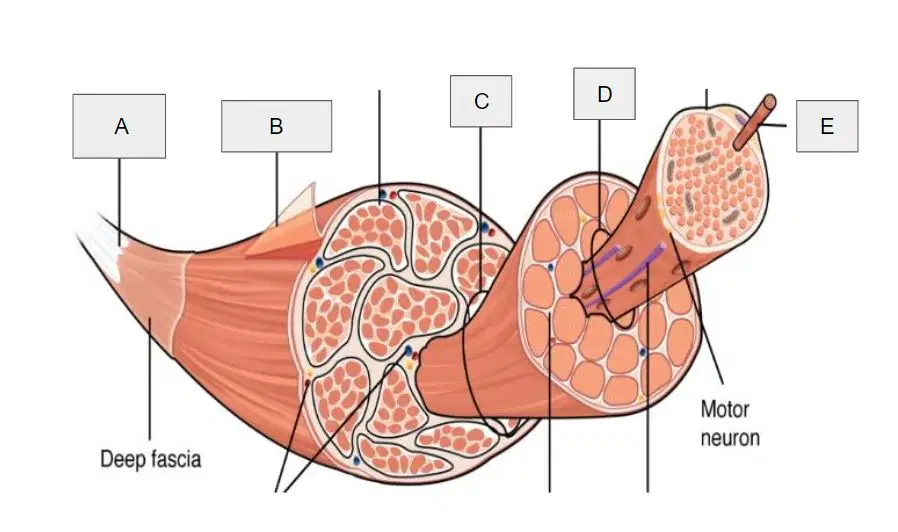
What is A?
a)
Tendon
b)
Myofibril
c)
Endomysium
d)
Muscle Fibril
e)
Perimysium
32.
What is C?
a)
Tendon
b)
Myofibril
c)
Endomysium
d)
Fascicle
e)
Perimysium
33.
What is D?
a)
Tendon
b)
Myofibril
c)
Muscle Fiber
d)
Fascicle
e)
Perimysium
34.
What is E?
a)
Tendon
b)
Myofibril
c)
Muscle Fiber
d)
Fascicle
e)
Perimysium
35.
During muscle contraction, what happens to the sarcomere length according to the sliding filament theory?
a)
a) Sarcomeres stay the same length
b)
b) Sarcomeres elongate
c)
c) Sarcomeres shorten
d)
d) Sarcomeres oscillate
36.
Which neurotransmitter is released at the neuromuscular junction to stimulate muscle contraction in the sliding filament theory?
a)
a) Serotonin
b)
b) Dopamine
c)
c) Acetylcholine
d)
d) Norepinephrine
37.
What is the role of ATP in the sliding filament theory of muscle contraction?
a)
a) It binds to myosin to form cross-bridges
b)
b) It breaks down muscle fibers
c)
c) It causes muscle relaxation
d)
d) It triggers the release of calcium ions
38.
What happens to the thin filaments (actin) during muscle contraction in the sliding filament theory?
a)
a) They remain stationary
b)
b) They slide past the thick filaments (myosin)
c)
c) They detach from the Z lines
d)
d) They expand and become thicker
39.
What is the sliding filament theory primarily associated with?
a)
a) Muscle contraction
b)
b) Nerve impulse transmission
c)
c) Blood circulation
d)
d) Bone growth
40.
During muscle contraction, which of the following filaments slide past each other?
a)
a) Actin and myosin
b)
b) Actin and troponin
c)
c) Myosin and troponin
d)
d) Actin and tropomyosin
41.
What ion is released from the sarcoplasmic reticulum to trigger muscle contraction?
a)
a) Sodium (Na+)
b)
b) Potassium (K+)
c)
c) Calcium (Ca2+)
d)
d) Chloride (Cl-)
42.
Which two ligaments are on the sides of the knee? 
a)
ACL and PCL 
b)
MCL and LCL 
c)
MCL and ACL 
d)
ACL and LCL 
43.

The anterior cruciate ligament:

a)

Prevents anterior sliding of the tibia 

b)

Prevents anterior sliding of the femur

c)

Limits flexion of knee 

d)

Prevents adduction of the tibia

44.

Which of the following joints is classified as a hinge joint?

a)

Elbow

b)

Shoulder

c)

Hip

d)

Wrist

45.

What is the primary function of synovial fluid in joints?

a)

To provide nutrients to the joint

b)

To lubricate the joint

c)

To connect bones

d)

To store calcium

46.

Which muscle type is responsible for involuntary movements in the digestive system?

a)

Skeletal muscle

b)

Cardiac muscle

c)

Smooth muscle

d)

Striated muscle

47.

Which type of joint is characterized by a fluid-filled cavity that allows for free movement?

a)

Fibrous joint

b)

Cartilaginous joint

c)

Synovial joint

d)

Fixed joint

48.

What is the role of the myosin head during muscle contraction?

a)

To bind to actin and pull the filaments

b)

To release calcium ions

c)

To store energy

d)

To provide structural support

49.

Which of the following movements is an example of flexion?

a)

Bending the elbow

b)

Straightening the knee

c)

Moving the arm away from the body

d)

Rotating the head