
Font size
 Worksheets
Weather and Climate Unit Review
Total questions: 32
Worksheet time: 29mins
What is the difference between weather and climate?
Weather is short-term atmospheric conditions, while climate is long-term.
Weather is long-term atmospheric conditions, while climate is short-term.
Weather and climate are the same.
Weather is the study of stars.
What TWO factors determine an area’s climate?
Temperature and precipitation
Wind and humidity
Latitude and longitude
Altitude and ocean currents
This weather factor helps meteorologists better predict the weather and measures the amount of water vapor needed to reach saturation.
Humidity
Temperature
Pressure
Wind speed
When dew forms on grass and other surfaces in the morning, what process of the water cycle is this?
Evaporation
Condensation
Precipitation
Transpiration
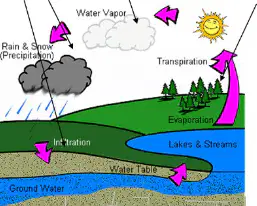
What process is happening at point B in the diagram?
Evaporation
Condensation
Precipitation
Transpiration
Match the natural disaster with its description.
Hurricane
Forms over warm water
Tornado
Spinning column of air
Earthquake
Sudden shaking of the ground
Tsunami
Large wave caused by earthquake
Volcano
Mountain that spews ash and lava
A 'dome' of water that accompanies a hurricane.
Storm Surge
Tsunami
Flood
Tidal Wave
Match the air mass with the description.
a) warm and dry
continental tropical
b) moist and warm
maritime tropical
c) moist and cold
maritime polar
d) cold and dry
continental polar
Match the front.
Stationary Front
Cold air and warm air meet and stay put
Warm Front
Warm air slides over cold air
Cold Front
Cold air pushes warm air up
Occluded Front
Two cold fronts overtake a warm front

Which air mass would be classified as Maritime Polar (mP)?
purple
green
blue
yellow
red
Which air mass would be classified as Maritime Tropical (mT)?
purple
green
blue
yellow
red
Which air mass is warmer?
red
yellow
Match the natural disaster with its characteristics.
drought
long time without rain
wildfire
uncontrolled fire in the forest
flood
the overflow of rivers or too much rain
landslide or avalanche
the movement of land or snow down
blizzard
snow storm
Katrina, Michael and Sandy are names of
hurricanes
tornadoes
floods
Which natural disaster occurs when magma forms within the Earth's mantle and works its way up?
Wildfire
Volcano
Tsunami
Earthquake
Snowstorms with high winds, low temperatures, and driving snow.
Avalanche
Tsunami
Blizzard
Earthquake

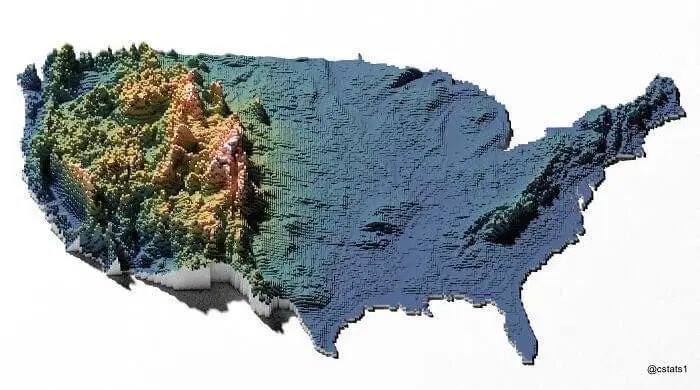
How does higher altitude affect climate?
The higher you go above sea level, the colder it gets.
Higher altitudes lead to increased humidity.
Higher altitudes result in warmer temperatures.
Higher altitudes have no effect on climate.

At which point in the diagram are you likely to find a hot, dry desert climate?
point W
point X
point Y
point Z

Which location would be considered windward?
Location A
Location B
Location C
Location D

What is the dessert side of the mountain called in the rain shadow effect?
lieward
luward
leeward
lowward
The table below classifies statements about patterns that happen in the sky. How should each column of the table be labeled to make the table correct?
Climate
Weather

What type of front is currently passing over Dallas, TX? (a)
What type of front will pass over Savannah, GA? (a)
Cold Front
Stationary Front
Occluded Front
Warm Front

Match the following weather front symbol to its name.

cold front

warm front

occluded front

stationary front
How does salt water from the ocean end up as fresh water in precipitation?
Runoff leaves salt in the soil
Precipitation leaves salt in the clouds
Evaporation leaves salt in the ocean
Condensation leaves salt in the water vapor
What is the primary energy source that drives the Earth’s water cycle between the atmosphere, oceans, and land?
Wind
Sunlight
Ocean currents
Rotation of Earth
the gaseous state of water that travels in a continuous cycle is
snow
the water cycle
water vapor
transpiration
Match the following.
Sublimation
Solid water transforms into water vapor
Transpiration
Water vapor is released from plants
Infilitration
Water soaks into the ground
Accumulation
Water collects in lakes and river
Condensation
Water vapor turns back into a gas
What three ways does water get back into the atmosphere?
Sublimation, Condensation, Evaporation
Evaporation, Transpiration, Sublimation
Transpiration, Precipitation, Accumulation
Infiltration, Sublimation, Evaporation

