wayground logo

Free Printable Worksheets

Font size

S
M
L
XL
Worksheets

Physical Science Review Game

Total questions: 272

Worksheet time: 5hrs 53mins

Name
Class
Date
1.

Waves transfer _______.

a)

particles

b)

matter

c)

energy

2.

_______ is the distance between waves, measured from one crest to the next crest.

a)

Wavelength

b)

Frequency

c)

Amplitude

3.

The _______ is the highest point on a transverse wave, and the ____ is the lowest point.

a)

Trough, Crest

b)

Crest, Trough

c)

Compression, Rarefaction

d)

Rarefaction, Compression

4.

The _______ is the size or height of a wave, measured from the equilibrium to the crest or trough.

a)

Amplitude

b)

Wavelength

c)

Frequency

5.

The _______ of a wave is how many waves pass a given point every second.

a)

Frequency

b)

Wavelength

c)

Amplitude

6.

Frequency is measured in _______.

a)

Hertz (Hz)

b)

Meters per second

c)

Meters

d)

Newtons

7.

In a longitudinal wave, a ____ is an area where the particles are spread apart and a ____ is an area where the particles are close together.

a)

crest, trough

b)

compression, rarefaction

c)

rarefaction, compression

d)

trough, crest

8.

Examples of ________ waves include visible light, xrays, ultraviolet, and radio waves.

a)

transverse

b)

longitudinal

9.

Waves that can travel through empty space are called _____ waves. Waves that require a medium to travel, such as air or water, are called _____ waves.

a)

mechanical, electromagnetic

b)

electromagnetic, mechanical

c)

crest, trough

d)

compressional, rarefactional

10.

In the diagram of a compressional wave, A is showing a ___ while B is showing a ___.

a)

compression, rarefaction

b)

trough, crest

c)

rarefaction, compression

d)

crest, trough

11.

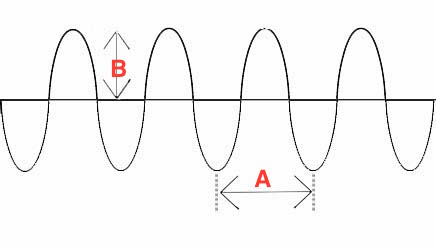
In this diagram of a transverse wave, A is showing the wave's _____ and B is showing the wave's _____.

a)

amplitude, trough

b)

amplitude, crest

c)

wavelength, trough

d)

wavelength, crest

12.

In this diagram of a transverse wave, C is showing the wave's _____ and D is showing the wave's _____.

a)

crest, amplitude

b)

trough, amplitude

c)

crest, wavelength

d)

trough, wavelength

13.
What property of the wave is represented by the letter "B"?
a)
amplitude
b)
crest
c)
trough
d)
wavelength
14.
The highest point on a wave is:
a)
the crest
b)
the trough
c)
the top
d)
the coast 
15.
The lowest point on a wave is the:
a)
Amplitude
b)
Crest
c)
Trough
d)
Wavelength
16.
The number of wavelengths that pass a point each per second is:
a)
frequency
b)
period
c)
longitudinal 
d)
transverse wave 
17.
The type of waves that require medium to pass:
a)
Mechanical Waves
b)
Electromagnetic Waves
18.
When the frequency of a wave increases, what happens to the wavelength?
a)
The wavelength is not directly affected by the frequency of a wave.
b)
The wavelength increases.
c)
The wavelength decreases.
d)
More specific information is needed to form a conclusion about the wavelength.
19.
A mechanical wave cannot travel through...
a)
a vacuum(empty space).
b)
water.
c)
air. 
d)
glass.
20.
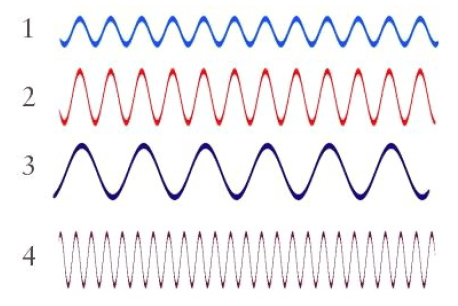
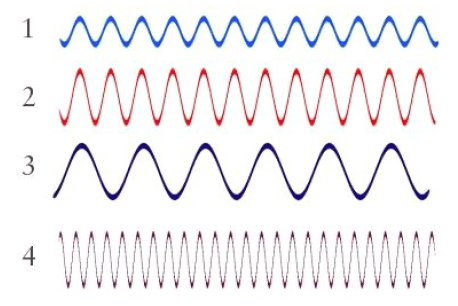
Which wave in the diagram has the greatest frequency?
a)
1
b)
2
c)
3
d)
4
21.
Which wave in the diagram has the greatest wavelength?
a)
1
b)
2
c)
3
d)
4
22.
Which of the following can sound travel through?
a)
solid
b)
liquid
c)
gas
d)
all of the above
23.
When a wave strikes and object and bounces off. (example echo)
a)
medium
b)
refraction
c)
reflection
d)
interference
24.
When a wave bends as it passes through at an angle from one medium to another.(example: pencil in a glass of water-)
a)
medium
b)
refraction
c)
reflection
d)
interference
25.

The momentum of an object depends upon the object's ___________&_____________.

a)

size and shape

b)

mass and speed

c)

mass and veloctiy

d)

mass and energy

26.

Determine the momentum of 1000-kg car moving northward at 20 m/s......... p=m*v

a)
20000 N
b)
20000 Joules
c)
20000 Kg * m/s
d)
20000 kg * m/s north
27.
The definition of momentum is
a)
Mass in Motion
b)
The size of an object
c)
The velocity of an object
d)
A comparison between two objects
28.
The equation to calculate momentum is
a)
p=mv
b)
p=1/2mv2
c)
p=mgh
d)
p=mg
29.
In any collision (crash) the ______ is ALWAYS constant
a)
Total Momentum
b)
total speed
c)
total Velocity
d)
Energy
30.
A 0.250 kg cart moving at 0.400 m/s has how much momentum?
a)
0.1 kg-m/s
b)
1 kg-m/s
c)
10 kg-m/s
d)
100 kg-m/s
31.
When the speed of an object is doubled, its momentum
a)
remains unchanged in accord with the conservation of momentum.
b)
doubles
c)
quadruples
d)
decreases
32.
Which object listed below has the greatest momentum?
a)
A 0.05 kg object rolling at 0.2 m/s.
b)
A 0.15 kg object rolling at 2 m/s.
c)
A 0.15 kg object rolling at 1 m/s
d)
A 0.4 kg object rolling at 2 m/s.
33.
A runner has a momentum of 670 kg m/s and is traveling at a velocity of 9 m/s. What is his mass?
a)
74.4 kg
b)
6030 kg
c)
0.0134 kg
d)
80 kg
34.
A 2 kg cart has a momentum of 16 kg m/s. What is its velocity?
a)
8 m/s
b)
32 m/s
c)
0.125 m/s
d)
18 m/s
35.
The total momentum before a collision is _________ the total momentum after a collision.
a)
equal to 
b)
less than 
c)
more than
d)
It depends on the type of collision
36.
Both mass and velocity are _______________ proportional to momentum.
a)
Directly
b)
Inversely
37.
Which of the following has the least amount of momentum?
a)
An ant walking along the ground
b)
An ant at rest
c)
An elephant walking
d)
An elephant running
38.
Energy due to motion is ____________ energy. 
a)
Potential 
b)
Energy
c)
Kinetic
d)
Friction
39.
__________ is stored energy. 
a)
Potential
b)
Kinetic
c)
None of the above 
d)
All of the above 
40.
A basketball is being held in the hands of a player.
a)
Potential
b)
Kinetic
41.
What kind of energy is in an acorn hanging from an oak tree?
a)
Potential
b)
Kinetic
42.
What kind of energy is in a waving hand?
a)
Potential
b)
Kinetic
43.
At which point is kinetic energy greatest?
a)
W
b)
X
c)
Y
d)
Z
44.
At which point is potential energy greatest?
a)
W
b)
X
c)
Y
d)
Z
45.
Which 2 letters have the most kinetic energy
a)
W & Y
b)
X & Z
46.
Which is the best example that something has kinetic energy?
a)
a. a car parked on a steep hill 
b)
b. a tennis ball rolling across the court
c)
c. a picture hanging on the wall 
d)
d. a piece of coal before it's burned 
47.
What kind of energy is in a rock at the edge of a cliff?
a)
Potential
b)
Kinetic
48.
What kind of energy is in a moving skateboard?
a)
Potential
b)
Kinetic
49.
Girl serving a volleyball
a)
Potential
b)
Kinetic
50.

Momentum is represented with which letter?

a)

b

b)

m

c)

v

d)

p

51.

What is the unit for momentum?

a)

m/s

b)

kg

c)

N

d)

kg* m/s

e)

J

52.

Momentum is always conserved.

a)

True

b)

False

53.
Which has more momentum: a car stopped at a red light or a bike moving at 15 mph?
a)
car
b)
bike
c)
they are equal
d)
cannot determine using the info provided
54.
Energy can not be created or destroyed, only converted from one form to another.
a)
true
b)
false
55.
How are covalent bonds explained?
a)
When one atom takes the other atom's electron
b)
When the atom shares an electron with an another atom
c)
When the two nucleus merge
d)
When the neutrons leave the nucleus
56.
What is the correct formula for this molecule?
a)
NH
b)
N3H
c)
NH3
d)
NH4
57.
Ionic bonds exist between a metal with a non-metal.
a)
True
b)
False
58.
Magnesium (Mg) and Oxygen (O) form an ________ bond.
a)
Ionic
b)
Covalent
c)
Metallic
d)
Nothing
59.

Valence electrons are transferred

a)

Ionic bonds

b)

Covalent bonds

60.

Valence electrons are shared

a)

Ionic bonds

b)

Covalent bonds

61.

The chemical bond between a non-metal and another non-metal will be a ________ bond.

a)

metal

b)

ionic

c)

covalent

d)

polar

62.
Elements in Group 1 lose one electron to form ions with a(n) _________________ charge.
a)
1+
b)
2+
c)
0
d)
1-
63.
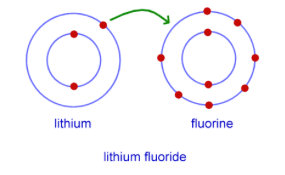
What type of bond is this?
a)
ionic
b)
covalent
64.
How many electrons are needed in the outer energy levels of an atom to be stable?
a)
2
b)
4
c)
6
d)
8
65.
What is a valence electron?
a)
The sum of neutrons and protons.
b)
The # of electrons in the last shell.
c)
A type of bond.
d)
A popular compound.
66.
Where are metals located on the periodic table?
a)
Blue
b)
Green
c)
Red
67.
Where are the nonmetals located on the periodic table? 
a)
Blue
b)
Red
c)
Green
68.
Atoms that gain electrons become...
a)
negatively charged
b)
positively charged
c)
remain neutrally charged
d)
21
69.

What type of bond involves the sharing of electrons between atoms?

a)

covalent bond

b)

ionic bond

c)

metallic bond

d)

transfer bond

70.

What is the goal of the Lewis Dot Structure?

a)

To determine the electron position.

b)

To show the element's valence electrons & bonding capabilities.

c)

To find the atomic mass of an element.

d)

To search for the number of electrons in an individual atom.

71.

How many valence electrons should Oxygen have in its Lewis dot model?

a)

5

b)

6

c)

7

d)

8

72.

How many valence electrons should Magnesium have in its Lewis dot model?

a)

1

b)

2

c)

3

d)

4

73.

Ionic Bonds

a)

metal with nonmetal

b)

nonmetal with nonmetal

74.

Covalent Bonds

a)

metal with nonmetal

b)

nonmetal with nonmetal

75.

Cl2

a)

Ionic Bond

b)

Covalent Bond

76.

CaCl

a)

Ionic Bond

b)

Covalent Bond

77.

NH3

a)

Ionic Bond

b)

Covalent Bond

78.

NaO

a)

Ionic Bond

b)

Covalent Bond

79.

Cl2

a)

Metal with Nonmetal

b)

Nonmetal with Nonmetal

80.

CaCl

a)

Metal with Nonmetal

b)

Nonmetal with Nonmetal

81.

NaO

a)

Metal with Nonmetal

b)

Nonmetal with Nonmetal

82.

NH3

a)

Metal with Nonmetal

b)

Nonmetal with Nonmetal

83.
Subatomic particle with a charge of 0
a)
neutron
b)
proton
c)
electron
d)
quark
84.

Subatomic particles with a negative charge

a)

Electrons

b)

Neutrons

c)

Protons

d)

Quarks

85.
Subatomic particles with a positive charge
a)
neutrons
b)
atomic mass
c)
protons
d)
isotopes
86.

These are found in the nucleus and have a neutral charge.

a)

proton

b)

electron

c)

neutron

87.
These will determine what element an atom is. 
a)
number of neutrons
b)
number of electrons
c)
number of atoms 
d)
number of protons 
88.

In an atom, the number of protons is equal to the number of ____________.

a)

energy levels

b)

neutrons

c)

neurons

d)

electrons

89.
An atom of the element with atomic number 6 always has _____.
a)
six protons in its nucleus
b)
an atomic mass of six
c)
more than six neutrons
d)
six electron clouds
90.
How many electrons does potassium K contain? (click to see image)
a)
19
b)
39
c)
20
d)
40
91.
How many protons are in this element?
a)
79
b)
196
c)
117
d)
Cannot be determined
92.

How many electrons does an Iodine atom have?

a)

53

b)

126

c)

73

d)

179

93.

How many neutrons does an Oxygen atom have?

a)

8

b)

16

c)

24

d)

7.999

94.
How many protons are in Beryllium?
a)
4
b)
9
c)
5
d)
2
95.
What is atomic number?
a)
Number of protons in an atoms 
b)
Number of neutrons in an atom
c)
Mass of an atom
d)
Charge on an atom
96.
Which subatomic particles are found in the nucleus of an atom?
a)
Protons and Electrons
b)
Protons and Neutrons
c)
Neutrons and Electrons
d)
Protons, Neutrons and Electrons
97.
The total number of protons and neutrons in an atom is called the...
a)
Atomic number
b)
Proton number
c)
Mass number
d)
Weight number
98.
What element is represented in this Bohr Model? 
a)
Carbon
b)
Hydrogen
c)
Aluminum
d)
Lithium
99.
The Modern Periodic Table of Elements is arranged by
a)
atomic mass
b)
atomic number
c)
valence electrons
d)
number of isotopes
100.
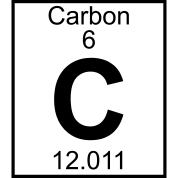
What does the 6 represent?
a)
atomic mass
b)
atomic number
c)
element name
d)
chemical symbol 
101.
What does 12.011 represent?
a)
atomic mass
b)
atomic number
c)
element name
d)
chemical symbol 
102.
These are found on the Periodic Table.
a)
Compounds
b)
Elements
c)
Mixtures
103.

the basic structural unit of matter

a)

atom

b)

matter

c)

element

d)

nucleus

104.

the positively charged subatomic particle contained in the nucleus of an atom

a)

proton

b)

neutron

c)

electron

d)

matter

105.

a subatomic particle, contained in the nucleus of an atom, having the same mass as a proton but no electrical charge

a)

proton

b)

neutron

c)

electron

d)

matter

106.

a negatively charged subatomic particle that orbits the nucleus of an atom

a)

proton

b)

neutron

c)

electron

d)

matter

107.

one or two letters that represent the name of an element

a)

element name

b)

element symbol

c)

atomic number

d)

atomic mass

108.

a grouping of elements based on similar properties, arranged by columns in the periodic table; also known as a group

a)

family

b)

period

c)

row

d)

isotope

109.

a row on the Periodic Table of Elements

a)

family

b)

period

c)

row

d)

isotope

110.
Most of the mass of an atom is found it its _____.
a)
electron cloud
b)
nucleus
c)
atomic number
d)
empty space
111.
Which is an electron?
a)
A
b)
B
c)
C
112.
What is the number of protons that the element in this image contain?
a)
14
b)
7
c)
15
d)
18
113.

Which color on the image of the periodic table corresponds with the metalloids.

a)

bright yellow

b)

gold

c)

teal

d)

light blue

114.

The periodic table is mostly comprised of what type of element?

a)

Metals

b)

Nonmetals

c)

Metalloids

115.

Which elements are to the LEFT of the zigzag?

a)

metals

b)

nonmetals

c)

metalloids

116.

Which elements are colored red?

a)

nonmetals

b)

metals

c)

metalloids

117.
All of these properties describe metals except...
a)
malleable
b)
conductors
c)
brittle 
d)
shiny
118.
What does this graph represent?
a)
Constant Speed
b)
Acceleration
c)
Deacceleration
d)
Not moving
119.
What two measurements are necessary for calculating speed?
a)
Mass and time
b)
Temperature and mass
c)
Mass and distance
d)
Distance and time
120.

How long does it take a car to travel 40m at 12m/s?

a)

4.8 s

b)

480 s

c)

3.33 s

d)

33.3 s

121.
Which graph shows: a car slowing down and coming to a stop.
a)
A
b)
B
c)
C
d)
D
122.

the unit of acceleration is

a)

(m/s2)

b)

jouls

c)

m

d)

s

123.

A negative acceleration means that your object is  

a)

constant

b)

speeding up

c)

at rest

d)

slowing down

124.

A positive acceleration means that your object is

a)

at rest

b)

speeding up

c)

moving

d)

slowing down

125.

When is an object under uniform acceleration?

a)

none of the following

b)

when the direction is straight

c)

when the velocity change is constant per unit time

d)

when the time is constant

126.

A bus starts from rest and accelerates to 14 m/s in 4 s. What is the average acceleration of the bus?

a)

3.5 m/s2

b)

5.9 m/s2

c)

10.5 m/s2

d)

24 m/s2

127.

What is the acceleration during the first 5 seconds?

a)

2 m/s2

b)

4 m/s2

c)

5 m/s2

d)

10 m/s2

128.

A change in speed and/or direction...

a)

Speed

b)

Velocity

c)

Acceleration

d)

Force

129.

Distance over time (m/s)

a)

Speed

b)

Velocity

c)

Acceleration

d)

Halogen

130.

Speed in a given direction...

a)

Speed

b)

Velocity

c)

Acceleration

d)

Nebula

131.

What are the units of measurement for acceleration?

a)

m/s

b)

Newtons

c)

Kilograms (kg)

d)

m/s2

132.

A runner crossed the 1 mile marker of a race running at a speed of 9 miles per hour. She crossed the finish line running at a speed of 9.8 miles per hour. Did the runner change her velocity?

a)

Yes

b)

No

133.

The formula for calculating speed is...(x means multiply; / means divide)

a)

time x distance

b)

distance x speed

c)

distance / time

d)

time / distance

134.

Speed = _______________

a)

Distance + time

b)

Distance – time

c)

Distance x time

d)

Distance / time

135.

At what speed would a car have to move in order to travel 20 kilometers in 2 hours.

a)

5 km/hr

b)

10 km/hr

c)

20 km/hr

d)

40 km/hr

136.

A helicopter flies west 200 miles in 2 hours. What is its velocity?

a)

99 mph

b)

100 mph south

c)

400 mph south

d)

297 mph south

137.

What two things must you know to determine speed?

a)

distance and direction

b)

direction and time

c)

speed and direction

d)

time and distance

138.

Basic SI unit of length or distance is:

a)

Meter

b)

Seconds

c)

Grams

d)

Minutes

139.

Using the graph, which person finished the race first?

a)

Biker

b)

Runner

c)

Walker

d)

All of these finished at the same time.

140.

A rocket travels 500 meters in 5 seconds. What was the speed of the rocket?

a)

300 m/s

b)

200 m/s

c)

100 m/s

d)

50 m/s

141.

Chase drove for 4 hours and went 240 miles. What was Chase's speed?

a)

100 mph

b)

75 mph

c)

60 mph

d)

45 mph

142.

Using which point shows the object at speeding UP?

a)

from A to B

b)

from C to D

c)

from D to E

d)

from E to F

143.

The formula for Speed is...

a)

Speed = distance/ time

b)

Speed = time/ distance

144.

Paul drives at a speed of 80 km/h for a distance of 200 km. Find the time taken.

a)

2.5 hours

b)

3.5 hours

c)

2 hours

d)

3 hours

145.

Paul runs at 200m/min for 30min. Find the distance covered.

a)

6000m

b)

6500m

c)

5000m

d)

5500m

146.
A golf ball accelerates off a tee at 15m/s2, changing its velocity from 0m/s to 50 m/s down the fairway. How long did it take the golf ball to accelerate?
a)
750 seconds
b)
35 seconds
c)
0.3 seconds
d)
3.3 seconds
147.
A roller coasters accelerates from an initial velocity of of 6.0 m/s to a final velocity of 70 m/s over 4 seconds.  What's the acceleration?
a)
24 m/s2
b)
18 m/s2
c)
16 m/s2
d)
16 m/s
148.

The distance traveled divided by the time interval during which the motion occurred.

a)

Motion

b)

Movement

c)

Distance

d)

Speed

149.

the rate at which speed or velocity changes

a)

acceleration

b)

average speed

c)

motion

d)

reference point

150.

speed of an object in a particular direction

a)

motion

b)

velocity

c)

speed

d)

acceleration

151.

when an object changes its position compared to a reference point.

a)

acceleration

b)

speed

c)

motion

d)

reference point

152.

total distance traveled divided by total time taken to travel that distance

a)

velocity

b)

motion

c)

acceleration

d)

average speed

153.

the rate at which speed or velocity changes

a)

acceleration

b)

average speed

c)

motion

d)

reference point

154.

A runner crossed the 1 mile marker of a race running at a speed of 9 miles per hour. She crossed the finish line running at a speed of 9.8 miles per hour. Did the runner change her velocity?

a)

Yes

b)

No

155.

A runner crossed the 1 mile marker of a race running at a speed of 9 miles per hour. She crossed the finish line running at a speed of 9.8 miles per hour. This is an example of...

a)

positive acceleration

b)

negative acceleration

c)

no acceleration

156.

A snake slithered across the sidewalk in between two sign posts. At the first sign post his speed was 1.2 m/s. At the second sign post his speed was 1.2 m/s. Did the snake change velocity?

a)

Yes

b)

No

157.

A snake slithered across the sidewalk in between two sign posts. At the first sign post his speed was 1.2 m/s. At the second sign post his speed was 1.2 m/s. This is an example of...

a)

positive acceleration

b)

negative acceleration

c)

no acceleration

158.

The formula for calculating speed is...(x means multiply; / means divide)

a)

time x distance

b)

distance x speed

c)

distance / time

d)

time / distance

159.

A snake slithered across the sidewalk in between two sign posts. At the first sign post his speed was 1.2 m/s. At the second sign post his speed was 1.2 m/s. Did the snake change velocity?

a)

Yes

b)

No

160.

when an object changes its position compared to a reference point.

a)

acceleration

b)

speed

c)

motion

d)

reference point

161.

total distance traveled divided by total time taken to travel that distance

a)

velocity

b)

motion

c)

acceleration

d)

average speed

162.
Speed equals distance divided by
a)
time
b)
velocity
c)
size
d)
motion
163.
The rate at which velocity changes is called
a)
speed
b)
direction
c)
acceleration
d)
motion
164.
A train that travels 100 kilometers in 4 hours is traveling at what average speed?
a)
50 km/h
b)
100 km/h
c)
2 km/h
d)
25 km/h
165.
Which graph shows: a car slowing down and coming to a stop.
a)
A
b)
B
c)
C
d)
D
166.
Polar bears are extremely good swimmers.  If a polar bear is swimming with an average of 2.6 m/s, how far will it have traveled after 120 seconds?
a)
46.2 m
b)
120 m
c)
312 m
d)
456.3 m
167.
Tree sloths are the slowest moving mammals.  On average, their velocity is 0.743 m/s.  How long does it take a tree sloth moving at this velocity to travel 22.3 m?
a)
16.6 s
b)
30.0 s
c)
0.03 s
d)
143.7 s
168.
Niagara Falls is a good example of
a)
Kinetic energy being transformed into potential energy
b)
Potential energy being transformed into kinetic energy
c)
Energy being created
d)
Energy being destroyed
169.
 The law of conservation of energy states that when one form of energy is converted into another,
a)
Energy is destroyed in the process
b)
Energy is created in the process
c)
No energy is destroyed in the process
d)
Energy is lost in the process
170.
Which energy-conversion process occurs whenever coal is burned at a power station?
a)
chemical to nuclear
b)
chemical to sound
c)
chemical to electrical
d)
mechanical to electrical
171.
When energy moves from one form to another it is said to be _________________
a)
Transformed
b)
Eliminated
c)
Lost.
d)
Created 
172.
Which has the most kinetic energy?
a)
a basketball rolling down a hill
b)
a bus stopped at the top of a hill
c)
a dump truck driving down a hill
d)
a golf ball sitting at the top of the hill
173.
Which is an example of chemical energy?
a)
a horse pulling a cart
b)
a dog digesting food
c)
a marching band in a parade
174.
The energy associated with motion is called
a)
Kinetic energy
b)
Elastic potential energy
c)
Gravitational potential energy
d)
Nuclear energy
175.
An example of something that stores chemical energy is
a)
lightning
b)
a microwave
c)
a match
176.
Light is an example of _________
a)
thermal energy
b)
radiant energy
c)
mechanical energy
d)
nuclear energy
177.
When you rub your hands together on a cold day, you use friction to convert
a)
Mechanical energy into thermal energy
b)
Thermal energy into nuclear energy
c)
Nuclear energy into electrical energy.
d)
Electrical energy into radiant energy
178.
Which of the following has kinetic energy?
a)
a rock poised for a fall
b)
an archer's bow that is drawn back
c)
a rolling bowling ball
179.
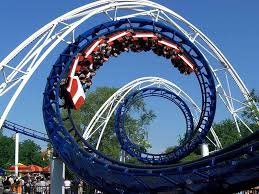
When riding a roller coaster, you go up and down many hills. When do you have the maximum potential energy? 
a)
at the top of the hill
b)
as you go down each hill
c)
at the bottom of the each hill
d)
as you go up each hill
180.
Potential energy that depends on height is called
a)
Kinetic energy
b)
Elastic potential energy
c)
Nuclear energy
d)
Gravitational potential energy
181.
When you swing a bat and hit a baseball, the ball flies into the outfield. What happens to the energy you used to swing the bat?
a)
It disappears
b)
It remains in the bat.
c)
It is transferred to the baseball.
d)
It is converted into potential energy.
182.
The energy in a battery is _______ energy.
a)
kinetic
b)
potential
c)
mechanical
d)
nuclear
183.

What is Energy?

a)

The ability to do anything

b)

The ability to cause change

c)

The investigation of nature

d)

A fact of life

184.

What is an example of kinetic energy?

a)

A bird sitting in a tree

b)

A bouncy ball on the table

c)

A car driving on the highway

d)

A book on shelf

185.

What is an example of potential energy?

a)

A bowling ball rolling down a lane

b)

A car parked in a lot

c)

An apple falling from a tree

d)

Sunlight heating up the atmosphere

186.

Energy cannot be created or destroyed.

a)

True

b)

False

187.

Total energy will always change in a system of objects.

a)

True; energy is destroyed due to friction

b)

False; energy cannot be destroyed, only transferred.

188.

What is an example of sound energy?

a)

A thermometer heating up

b)

Solar panels generating electricity

c)

A guitar string being plucked

d)

A machine in an assembly line

189.

What is nuclear energy?

a)

Energy in the nucleus of an atom

b)

Energy in the particles of an object

c)

Energy that is carried by electromagnetic waves

d)

Energy in a system of objects

190.

Which of the following show a change from kinetic energy to potential energy?

a)

A sled sliding up a hill

b)

A ball that is thrown into the air

c)

A car driving down a hill

d)

A rubber band being stretched

191.

What transformation occurs in a toaster?

a)

Electrical to radiant

b)

Electrical to thermal

c)

Thermal to mechanical

d)

Solar to electrical

192.

What type of energy transformation occurs when a piece of wood burns?

a)

Electrical energy is released as radiant energy

b)

Stored chemical energy is released as thermal energy

c)

Mechanical energy is stored as chemical energy

d)

No transformation occurs

193.

Energy can be transformed into many different forms:

a)

True

b)

False

194.
Energy due to motion is ____________ energy. 
a)
Potential 
b)
Energy
c)
Kinetic
d)
Friction
195.
The faster an object moves, the ________ kinetic energy it has. 
a)
more
b)
less
c)
none of the above
d)
all of the above 
196.
What kind of energy is in a rock at the edge of a cliff?
a)
Potential
b)
Kinetic
197.
What kind of energy is in a moving skateboard?
a)
Potential
b)
Kinetic
198.
What kind of energy is in a stretched rubber band?
a)
Potential
b)
Kinetic
199.
What kind of energy is in a waving hand?
a)
Potential
b)
Kinetic
200.
At which point is kinetic energy greatest? 
a)
W
b)
X
c)
Y
d)
Z
201.

Which Apple has the greatest Gravitational Potential Energy?

a)

Apple A

b)

Apple B

c)

Apple C

d)

Apple D

202.

A lamp that plugs into a wall socket draws energy, which flows through a thin wire in the bulb, causing it to heat up until it glows. What energy transformations are taking place?

a)

Chemical → light → electrical

b)

Mechanical → sound → light

c)

Thermal → solar → electrical

d)

Electrical → thermal → light

203.

Turning the handle makes a current that causes the light bulb to glow. What are the energy transformations that happen in this hand generator?

a)

Thermal → solar → light

b)

Mechanical → electrical → light

c)

Electrical → mechanical → light

d)

Solar → light → electrical

204.

When energy enters a system and then comes out of the system later, the law of conservation of energy states that–

a)

some of the energy that entered the system will remain in the system.

b)

the energy will always create a change in the properties of the parts of the system.

c)

the form of energy that comes out of the system must be the same form that entered.

d)

the amount of energy coming out of the system must equal the energy that entered the system.

205.

In which of the following scenarios would this energy transformation be observed?

chemical → light → heat

a)

Plucking a guitar string

b)

Lighting a match

c)

Turning on a fan

d)

Starting a car

206.

Which of the following is a form of potential energy?

a)

sound energy

b)

chemical energy

c)

mechanical energy

d)

thermal (heat) energy

207.

The law of conservation of energy states ___.

a)

electrical energy can be transformed into other forms

b)

energy can be created and destroyed

c)

energy is never created nor destroyed

d)

what goes up must come down

208.

During energy transformations, energy is never ___.

a)

released as heat

b)

used to increase an object's potential energy

c)

created or destroyed

d)

completely transformed

209.

A baseball is hit into the air with a bat. When does baseball have the greatest gravitational potential energy?

a)

when it hits the ground

b)

when it reaches its highest point

c)

when it leaves the bat

d)

when the mechanical and kinetic energies of the baseball are equal

210.

___ is energy stored by things that stretch or compress.

a)

Gravitational potential

b)

Elastic kinetic energy

c)

Chemical kinetic energy

d)

Elastic potential energy

211.

Calculate the gravitational potential energy of the object.

GPE = mgh

mass: 50

gravity: 10

height: 6

a)

5320J

b)

300J

c)

66J

d)

3000J

212.

Calculate the kinetic energy.

KE=12mv2KE=\frac{1}{2}mv^2  

mass: 200

velocity: 5

a)

2,500J

b)

250J

c)

500,000J

d)

none of the above

213.

What type of energy is stored in a battery?

a)

electrical

b)

thermal

c)

radiant

d)

chemical

214.

Which energy transformation occurs in a toaster?

a)

electrical → thermal

b)

chemical → thermal

c)

nuclear → electrical

d)

thermal → electrical

215.

A battery converts what type of energy to another?

a)

electrical → thermal

b)

chemical → electrical

c)

kinetic → nuclear

d)

light → heat

216.

Energy transformations occur when ___.

a)

a chemical reaction takes place

b)

energy changes from one form to another

c)

energy is created through conduction

d)

two forces slide together that are touching

217.

Which items would have this energy transformation: chemical → mechanical

a)

a candle burning

b)

eating a big breakfast before a race

c)

a ball bouncing

d)

using a hairdryer

218.

Which of the following is not a source of stored chemical energy that can be turned into a form of kinetic energy?

a)

a battery in a toy car

b)

food

c)

the nucleus of an atom

d)

fossil fuels

219.
The Electrical Energy of the stove is transferred to _____ Energy.
a)
Solar
b)
Thermal
c)
Potential
d)
Electrical
220.
Some students observing a classroom device being used, noticed the below energy transformations. 
Electrical → Mechanical → Sound
Which device were the students most likely observing?
a)
A triple beam balance measuring an object’s mass.
b)
A pencil sharpener plugged into a wall outlet.
c)
A projector displaying a diagram on the screen.
d)
A working flashlight used to light up a dark corner.
221.
The diagram shows a circuit with the bulb glowing. How does the energy change as it moves from inside the battery, along the wires, and through the light bulb?
a)
electrical → light → chemical
b)
light → electrical → chemical
c)
chemical → electrical → light
d)
chemical → light → electrical
222.

The process of changing energy from one form to another.

a)

transmission

b)

transportation

c)

transformation

223.

The law of conservation of energy states that energy can neither be destroyed nor created. According to this law which of these equations is correct?

a)

E=mc2

b)

KE = PE

c)

Energy in = energy out

d)

Energy in = power in

224.

When water falls through a dam and turns a turbine connected to a generator, electricity is produced. The electricity is used to light a home. Which shows the energy transformation?

a)

electrical➡light➡mechanical

b)

chemical➡mechanical➡electrical

c)

mechanical➡chemical➡light

d)

mechanical➡electrical➡light

225.

What kind of energy is being shown in the picture?

a)

Light

b)

Gravitational

c)

Potential

d)

Kinetic

226.

As the ball is dropped, the potential energy decreases while the kinetic energy increases however the amount of energy stays the same.

a)

True

b)

False

227.

Which position has the highest potential energy?

a)

1

b)

2

c)

4

d)

6

228.
Which type of energy transformation occurs when a flashlight shines?
a)
chemical → thermal → electrical
b)
chemical → electrical → light
c)
thermal → chemical → light
d)
chemical → electrical → chemical
229.
Which kind of energy change occurs when a candle is burning?
a)
Chemical to light.
b)
Light to electrical.
c)
Solar to heat.
d)
Chemical to electrical.
230.
What is the energy transformation?
a)
Electrical to Electromagnetic
b)
Mechanical to Electrical
c)
Electrical to Thermal
d)
Kinetic to Sound
231.
A television works by transforming electrical energy into what other kinds of energy?
a)
Light, thermal, and sound
b)
Thermal, chemical, and solar
c)
Sound, mechanical, and electrical
d)
Light, chemical, and mechanical
232.
The picture shows a microwave oven. As a microwave oven is operated, electrical energy is transformed into all of the following types of energy EXCEPT —
a)
Solar
b)
Light
c)
Thermal
d)
Mechanical
233.

PCl5 + ___ H2O → ___ HCl + H3PO4

a)

4, 5

b)

1, 6

c)

3, 8

d)

2,2

234.

__ Al + __ FeO → Al2O2 + __ Fe

a)

1, 1, 2

b)

2,1,2

c)

2, 2, 2

d)

2,4,2

235.
 Mg  +  ___ HCl  →   MgCl2  +   H2
a)
1
b)
2
c)
3
d)
4
236.
Which side of a chemical equation is the reactant side?
a)
Left (before the yields sign)
b)
Right (after the yields sign)
237.
Which side of a chemical equation os the product side?
a)
Left (before the yields sign)
b)
Right (after the yields sign)
238.
Which problem is balanced?
a)
PbO2 + 2H2
b)
SO2 + H20 --> H2SO4
c)
2Na + 2H2O --> 2NaOH + H2
239.
Balance this equation.
_SnO+_H2-->_Sn +_H2O
a)
1,1,2,1
b)
1,2,1,1
c)
1,2,1,2
d)
1,2,2,1
240.
Balance this equation.
_CF+ _Br-- _CBr+ _F2
a)
2,1,2,1
b)
1,2,2,1
c)
1,2,1,2
d)
2,2,2,2
241.
What is the little number after an element in a chemical equation called.
Example: H2
a)
Coefficient 
b)
Subscript
c)
Atom
d)
Equation
242.
What does the Law of Conservation of Mass state?
a)
Matter cannot be gained or lost in a chemical reaction.
b)
Matter can only be lost in a chemical reaction.
c)
Matter can only be gained in a chemical reaction.
d)
Matter can be gained and lost in a chemical reaction. 
243.
Is the equation balanced?: 2H2O + O2 --> 4MgO + 3Fe
a)
Yes
b)
No
244.
Balance this equation
_Al +_HCl --> _H+_AlCl3
a)
2, 6, 3, 2
b)
it is already balanced
c)
4, 12, 3, 4
d)
2, 1, 4, 5
245.
Balance this equation.
_CH4 + _O--> _CO+ _H2O
a)
1,2,1,1
b)
2,1,2,1
c)
1,2,1,2
d)
0,2,0,2
246.
Balance this equation.
_CF+ _Br-- _CBr+ _F2
a)
2,1,2,1
b)
1,2,2,1
c)
1,2,1,2
d)
2,2,2,2
247.
Is this equation balanced?
a)
yes
b)
no
c)
Not enough information
248.
How many atoms of aluminum are on each side of the following equation: 4Al + 3O--> 2AlO3
a)
2
b)
6
c)
1
d)
4
249.
When balancing equations a ____ can be placed to the left of a formula of a substance to make the equations balanced
a)
charge
b)
subscript
c)
random number
d)
coefficient
250.
How many atoms of carbon (C) are in C6H12O6?
a)
3
b)
6
c)
12
d)
24
251.

The two sides of a chemical equation are called?

a)

Reactants (left) and Products (right)

b)

Ingredients (left) and Product (right)

c)

Cations and Anions

d)

Reactants (left) and Results (right)

252.
How many atoms are there TOTAL in:
H2SO4
a)
6
b)
5
c)
7
d)
3
253.
4Si + S8 --> 2Si2S4
a)
Synthesis
b)
Decomposition
c)
Single displacement
d)
Double displacement
254.
3Ca + 2AlCl3 --> 3CaCl2 + 2Al
a)
Synthesis
b)
Decomposition
c)
Single diplacement
d)
Double displacement
255.
3KOH + H3PO4 --> K3PO4 + 3H2O
a)
Synthesis 
b)
Decomposition
c)
Single displacement
d)
Double displacement
256.
2Pb(NO3)2 --> 2PbO + 4NO2 + O2
a)
Synthesis 
b)
Decomposition
c)
Single displacement
d)
Combustion
257.
3Mg + N2 --> Mg3N2
a)
Synthesis 
b)
Decomposition
c)
Single displacement
d)
Combustion
258.
2NO2 --> N2 + 2O2
a)
Synthesis
b)
Decomposition
c)
Single displacement
d)
Combustion
259.
P4 + 3O--> 2P2O3
a)
Synthesis 
b)
Decomposition
c)
Single displacement
d)
Combustion
260.
Fe + H2SO4 --> Fe2(SO4)3 + H2
a)
Synthesis (combination)
b)
Decomposition
c)
Single replacement
d)
Combustion
261.
Which reaction type is the following: C5H10O4 + O2 --> CO2 + H2O
a)
Decomposition
b)
Single Replacement
c)
Combustion
d)
Double Replacement
262.
Which of the following is the general formula for a decomposition reaction?
a)
A + B  → AB
b)
AB → A + B
c)
AB + C → AC + B
d)
AB + CD → AC + BD
263.
When balancing equations a ____ can be placed to the left of a formula of a substance to make the equations balanced
a)
charge
b)
subscript
c)
random number
d)
coefficient
264.
What coefficient should be used to make the following equation balanced?
N2+O2--> _NO 
a)
1
b)
2
c)
3
d)
4
265.
Balance this equation:
 __Li + __Cl2 -> __LiCl
a)
2Li + Cl2 -> 4LiCl2
b)
2Li + Cl2 -> LiCl2
c)
2Li +  Cl2 -> 2LiCl
266.
C4H12 + O2 --> CO2 + H2O
a)
Synthesis
b)
Combustion
c)
Single Replacement
d)
Double Replacement
267.
H2SO4 + Fe -->H2 + FeSO4
a)
Synthesis
b)
Decomposition
c)
Single Replacement
d)
Double Replacement
268.
PbCl2 + AgNO3 ---> Pb(NO3)2 + AgCl 
a)
Synthesis
b)
Decomposition
c)
Single Replacement
d)
Double Replacement
269.
NH3 + HCl ---> NH4Cl 
a)
Synthesis
b)
Decomposition
c)
Single Replacement
d)
Double Replacement
270.
Which chemical reaction switches 2 elements?
a)
Double Replacement
b)
Single Replacement
c)
Combustion
d)
Decomposition
271.
Which chemical reaction takes place when 2 substances react to form a single product?
a)
Decomposition
b)
Double Replacement
c)
Single Replacement
d)
Synthesis
272.
At the end of chemical reactions, what is the total mass of the reactants compared to the total mass of the products?
a)
the product is doubled
b)
the product is half the mass of the reactants
c)
the mass is the same
d)
the mass changes depending on the reaction