
 Worksheets
Bio A Exam Review Part 1 of 2
Total questions: 47
Worksheet time: 24mins
Name
Class
Date
1.
Select the term that best matches the following definition:
The amount of solute (solids) dissolved in the solvent (liquid)
a)
Concentration
b)
Passive transport
c)
Active Transport
d)
Osmosis
2.
Select the term that best matches the following definition:
The process when materials move across the membrane requiring energy
a)
Concentration
b)
Passive transport
c)
Active Transport
d)
Osmosis
3.
Select the term that best matches the following definition:
The diffusion of water through a selectively permeable membrane
a)
Concentration
b)
Passive transport
c)
Active Transport
d)
Osmosis
4.
Select the term that best matches the following definition:
The motion of particles from high concentration to low concentration directly through the lipid bilayer. No energy needed
a)
Passive Diffusion
b)
Facilitated Diffusion
c)
Osmosis
d)
Active Transport
5.
Select the term that best matches the following definition:
This type of surrounding solution has a lower concentration of solute than the inside of the cell. This results with water entering the cell.
a)
Hypotonic solution
b)
Hypertonic solution
c)
Isotonic solution
6.
Select the term that best matches the following definition:
This type of surrounding solution has a higher concentration of solute than the inside of the cell. This results with water exiting the cell.
a)
Hypotonic solution
b)
Hypertonic solution
c)
Isotonic solution
7.
Select the term that best matches the following definition:
This type of surrounding solution has the same concentration of solute as the inside of the cell. There is no net gain of water on either side.
a)
Hypotonic solution
b)
Hypertonic solution
c)
Isotonic solution
8.
Select the term that best matches the following definition:
The process of taking material into the cell by means of infolding, or pockets, of the cell membrane. Requires energy.
a)
Active Transport
b)
ATP
c)
Endocytosis
d)
Exocytosis
9.
If a cell contains 50% water and the environment contains 50% water, then water will______
a)
a. Move in and out of the cell equally
b)
b. Move into the cell
c)
c. Move out of the cell
d)
d. No movement of water would occur
10.
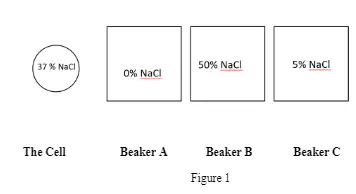
According to figure 1, which solution would cause no change in the size of the cell?
a)
Beaker A
b)
Beaker B
c)
Beaker C
d)
None of these
11.
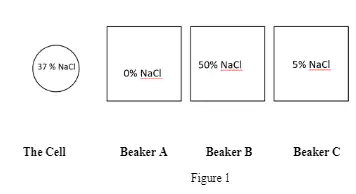
According to figure 1, in which beaker/s would the water diffuse into the cell? You may choose more than 1!
a)
Beaker A
b)
Beaker B
c)
Beaker C
d)
None of these
12.
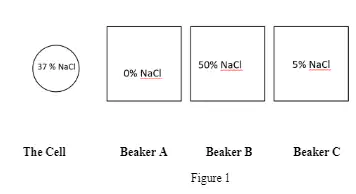
According to figure 1, what would happen to the cell if placed in beaker B?
a)
a. the cell would shrink
b)
b. the cell would swell
c)
c. it would stay the same
d)
d. the salt would leave
13.
If cells are placed in a strong sugar solution, water will _____.
a)
a . pass from the sugar solution to the cells
b)
b. stay in the cell
c)
c. pass from the cells to the sugar solution
d)
d. pass back and forth
14.
Active transport is used when
a)
a. the cell needs to move molecules from a low concentration to a high concentration.
b)
b Molecules are too big to use diffusion.
c)
c. Molecules are too small for diffusion.
d)
d. the cell needs to move molecules from a high concentration to a low concentration.
15.
Placing wilted lettuce in cold water will make it crisp again. Which statement best describes what happens to restore the lettuce to its original condition?
a)
a. Water left the lettuce cells by diffusion.
b)
b. Osmosis caused salts to enter the lettuce cells.
c)
c. Water entered the cells of the lettuce by osmosis.
d)
d. Salts in the leaf caused water to leave the cells.
16.
Elodea, a freshwater plant, is being viewed under a microscope. Which would most likely occur if salt water were placed on the cells?
a)
The Elodea cells would swell.
b)
The Elodea cells would shrink.
c)
The Elodea cells would complete mitosis.
d)
The Elodea cells would perform active transport.
17.
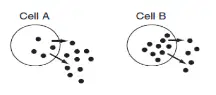
The pictures below show two different cellular processes. Use the information in the pictures to answer the following question.
Which cell represents active transport?
a)
Cell A because active transport requires energy to move molecules from an area of high concentration to an area low concentration.
b)
Cell A because active transport uses ATP to move molecules from high to low concentration
c)
Cell B because active transport moves molecules from an area of high concentration to an area of low concentration.
d)
Cell B because active transport moves molecules against the concentration gradient.
18.
Sidewalks are sometimes salted to melt ice and snow. What does this salting do to the plants along the sidewalk?
a)
It causes the plants to swell, due to loss of water.
b)
It causes the plants to turn greener, due to the presence of the salt.
c)
It causes the plants to shrivel up, due to loss of water.
d)
It causes the plants to grow faster, due to the increase of salt along the roadside
19.
Allows for substances to move into and out of the cell
a)
Cell Membrane
b)
Cell Wall
c)
Nucleus
d)
Ribosome
20.
Function: Protection and strength of plant cell
a)
Cell Membrane
b)
Cell Wall
c)
Nucleus
d)
Ribosome
21.
Controls all operations within the cell. Contains DNA.
a)
Nucleus
b)
Ribosome
c)
Lysosome
d)
Cytoplasm
22.
The jelly like fluid surrounding the cell's organelles
a)
Nucleus
b)
Ribosome
c)
Lysosome
d)
Cytoplasm
23.
Cleans the cell with digestive enzymes
a)
Nucleus
b)
Ribosome
c)
Lysosome
d)
Cytoplasm
24.
Makes proteins - free floating in cytoplasm.
a)
Cell Membrane
b)
Cell Wall
c)
Nucleus
d)
Ribosome
25.
Makes lipids (fat), detoxifies
a)
Cell Wall
b)
Nucleus
c)
Rough ER
d)
Smooth ER
26.
Modifies, sorts, and packages proteins/lipids
a)
Rough ER
b)
Smooth ER
c)
Golgi Body
d)
Central Vacuole
27.
Performs photosynthesis
a)
Smooth ER
b)
Golgi Body
c)
Chloroplast
d)
Mitochondria
28.
Converts glucose into ATP cellular energy. Powerhouse of the cell.
a)
Rough ER
b)
Golgi Body
c)
Chloroplast
d)
Mitochondria
29.

Which of the following best represents energy conversion during cellular respiration?
a)
a
b)
b
c)
c
d)
d
30.
Glucose is a product for _________________ and a reactant for __________________
a)
photosynthesis; cellular respiration
b)
cellular respiration; photosynthesis
c)
photosynthesis; photosynthesis
d)
cellular respiration; cellular respiration
31.
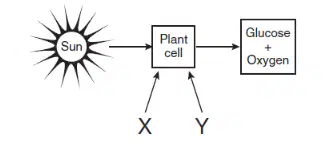
Two substances, X and Y, are used by a plant cell in a process that forms the products shown below. What substances are represented by X and Y?
a)
water and carbon dioxide
b)
water and oxygen
c)
nitrogen and oxygen
d)
carbon dioxide and nitrogen
32.
Glycolysis provides a cell with a net gain of
a)
2 ATP molecules.
b)
18 ATP molecules.
c)
4 ATP molecules.
d)
36 ATP molecules.
33.
Unlike photosynthesis, cellular respiration occurs in
a)
animal cells only.
b)
all but plant cells.
c)
plant cells only.
d)
both animal and plant cells.
34.
Which of the following molecules are produced during photosynthesis and later used as reactants in cellular respiration?
a)
oxygen and carbohydrates
b)
lipids and proteins
c)
carbohydrates and lipids
d)
proteins and oxygen
35.
Cellular respiration uses one molecule of glucose to produce
a)
2 ATP molecules.
b)
36 ATP molecules.
c)
30 ATP molecules.
d)
48 ATP molecules.
36.

Which of the following best describes the chemical equation shown below?
a)
Respiration: lipids and water are used and carbon dioxide and glucose are produced.
b)
Respiration: glucose and oxygen are used and carbon dioxide and water are produced. _
c)
Photosynthesis: carbon dioxide and water are used and glucose and oxygen are produced.
d)
Photosynthesis: proteins and oxygen are used and carbon dioxide and water are produced.
37.
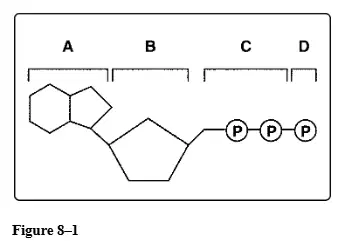
Look at Figure 8-1. All of the following are parts of an ADP molecule EXCEPT
a)
structure A.
b)
structure C.
c)
structure B.
d)
structure D.
38.
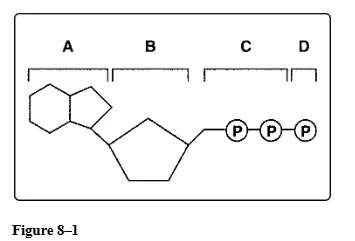
Which structures shown in Figure 8-1 make up an ATP molecule?
a)
A and B
b)
A, B, C, and D
c)
A, B, and C
d)
C and D
39.
Energy is released from ATP when
a)
a phosphate group is added.
b)
ATP is exposed to sunlight.
c)
adenine bonds to ribose.
d)
a phosphate group is removed.
40.
Leaf cells have more chloroplasts than cells in other parts of the plant. Why?
a)
Greater exposure to nutrients
b)
Larger surface area contributes to transpiration
c)
Increased availability of sunlight
d)
Allows for more water transport
41.
In the carbon cycle, atmospheric carbon dioxide is converted into organic (living) material by which process?
a)
cellular respiration
b)
photosynthesis
c)
decomposition
d)
transpiration
42.
The carbon (in the carbon dioxide) that we breathe out has come originally from our
a)
food
b)
cells
c)
skin
d)
diaphragm
43.
By what process is CO2 removed from the atmosphere?
a)
respiration
b)
photosynthesis
c)
combustion
d)
decomposition
44.
If carbon dioxide is completely removed from a plant’s environment, what would you expect to happen to the plant’s production of high-energy sugars?
a)
More sugars will be produced.
b)
Carbon dioxide does not affect the production of high-energy sugars in plants.
c)
The same number of sugars will be produced but without carbon dioxide.
d)
No sugars will be produced.
45.
An experiment is set up to determine how various colors of light affect the growth of algae:
Identical algae cultures are exposed to red, green, or yellow light. This experiment could be monitored by measuring the amount of which substance produced by the algae?
a)
carbon dioxide
b)
hydrogen
c)
oxygen
d)
nitrogen
46.
Plants are ...
a)
autotrophs and producers
b)
autotrophs and consumers
c)
heterotrophs and producers
d)
heterotrophs and consumers
47.
Animals are ...
a)
autotrophs and producers
b)
autotrophs and consumers
c)
heterotrophs and producers
d)
heterotrophs and consumers
100 %

