wayground logo

Free Printable Worksheets

Font size

S
M
L
XL
Worksheets

Advanced Gas Laws and Thermodynamics Quiz

Total questions: 113

Worksheet time: 2hrs 36mins

Name
Class
Date
1.
What is the definition of temperature?
a)
A measure of how much energy a substance contains
b)
A measure of how hot or cold something feels
c)
The amount of heat in a substance
d)
The average kinetic energy of the molecules in a substance
2.
Which container has the highest temperature?
a)
Container A
b)
Container B
c)
Container C
d)
It is not possible to determine from the information provided
3.
Which equation represents the kinetic energy (EK) of a particle?
a)
EK = mv^2
b)
EK = 1/2mv^2
c)
EK = m^2v^2
d)
EK = 1/2mv
4.
What is the relationship between the kinetic energy of particles and temperature?
a)
As kinetic energy increases, temperature increases
b)
As kinetic energy decreases, temperature increases
c)
Kinetic energy and temperature are unrelated
d)
As kinetic energy increases, temperature decreases
5.
Which of the following is NOT a property of temperature?
a)
Measure of how hot or cold something feels
b)
Quantitative measurement
c)
Average kinetic energy of molecules
d)
Potential energy of molecules
6.
Which of the following is NOT a way to increase the temperature of a substance?
a)
Increasing the velocity of the particles
b)
Increasing the mass of the particles
c)
Decreasing the kinetic energy of the particles
d)
All of the above can increase temperature
7.
In a closed system, if the temperature of a gas increases, what is the most likely effect on the pressure of the gas?
a)
Pressure decreases
b)
Pressure remains constant
c)
Pressure increases
d)
Pressure fluctuates randomly
8.
Which of the following statements best explains the relationship between temperature and the state of matter?
a)
Higher temperatures favor solid states
b)
Lower temperatures favor gaseous states
c)
Temperature influences molecular motion and state transitions
d)
Temperature has no effect on state of matter
9.
What happens to the internal energy of a substance when it undergoes a phase change at constant temperature?
a)
Internal energy decreases
b)
Internal energy increases
c)
Internal energy remains constant
d)
Internal energy fluctuates
10.
What is the primary factor that determines the direction of heat flow between two objects?
a)
The mass of the objects
b)
The temperature difference between the objects
c)
The specific heat capacity of the objects
d)
The phase of the substances
11.
Which of the following statements about absolute zero is true?
a)
It is the temperature at which all molecular motion ceases.
b)
It can be reached in practice.
c)
It is equivalent to 0 degrees Celsius.
d)
It is the highest temperature possible.
12.
During a phase change from liquid to gas, what happens to the potential energy of the molecules?
a)
It decreases
b)
It remains constant
c)
It increases
d)
It fluctuates
13.
What is the effect of increasing the mass of a particle on its kinetic energy, assuming velocity remains constant?
a)
Kinetic energy decreases
b)
Kinetic energy remains constant
c)
Kinetic energy increases
d)
Kinetic energy becomes negligible
14.
How does the concept of heat differ from temperature?
a)
Heat is a measure of molecular motion, while temperature is the transfer of energy.
b)
Heat is the transfer of energy, while temperature is a measure of molecular motion.
c)
Heat and temperature are the same concept.
d)
Heat is a qualitative measure, while temperature is quantitative.
15.
What is the specific heat capacity of a substance defined as?
a)
The heat required to change its phase
b)
The heat required to raise the temperature of 1kg of the substance by 1K
c)
The total energy contained within the substance
d)
The energy lost during evaporation
16.
Which of the following best describes the relationship between absolute temperature and average kinetic energy of molecules?
a)
They are inversely proportional.
b)
They are directly proportional.
c)
They are unrelated.
d)
They are equal at all temperatures.
17.

Convert 37°F to K.

(a)  

18.

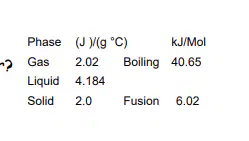
A 200 g sample of water at -20.0°C is heated to water vapor at 140.0°C. How much heat was absorbed?

(a)  

19.
In the equation Q=mcΔT, what does 'm' represent?
a)
The mass of the substance
b)
The specific heat capacity
c)
The change in temperature
d)
The total energy
20.
If the volume of a gas is doubled while the temperature remains constant, what happens to the pressure?
a)
It doubles
b)
It halves
c)
It remains the same
d)
It quadruples
21.
Which of the following best describes Archimedes' principle?
a)
An object will float if it displaces more water than its weight
b)
An object will sink if it displaces less water than its weight
c)
The buoyant force on an object is equal to the weight of the fluid displaced
d)
Both A and C
22.
What is calorimetry primarily used for?
a)
Measuring pressure
b)
Measuring heat transfer
c)
Measuring volume
d)
Measuring density
23.
If 500 J of heat is added to a 4g substance and its temperature rises by 5°C, what is its specific heat?
a)
10 J/°C
b)
25 J/°C
c)
50 J/°C
d)
100 J/°C
24.
What is latent heat?
a)
Heat required to change temperature
b)
Heat required to change phase
c)
Heat lost during cooling
d)
Heat gained during heating
25.
What happens to temperature during a phase change?
a)
Increases steadily
b)
Decreases steadily
c)
Remains constant
d)
Fluctuates
26.
Which of the following is an example of conduction?
a)
Boiling water
b)
Heating a metal rod
c)
Sun warming the Earth
d)
Air circulating in a room
27.
What is the significance of the critical point on a phase change diagram?
a)
It indicates the temperature at which a substance can exist as a solid
b)
It indicates the temperature and pressure at which the liquid and gas phases become indistinguishable
c)
It indicates the maximum pressure a substance can withstand
d)
It indicates the boiling point of a substance
28.
What is the principle of conservation of energy in calorimetry?
a)
Energy can be created and destroyed
b)
Energy can only be transformed from one form to another
c)
Energy is always lost in a closed system
d)
Energy is always gained in a closed system
29.
How does the specific heat of water compare to that of metals?
a)
Higher than metals
b)
Lower than metals
c)
Equal to metals
d)
Varies with temperature
30.
What is the formula for calculating heat transfer using specific heat?
a)
Q = mcΔT
b)
Q = mΔT/c
c)
Q = cΔT/m
d)
Q = mΔT
31.
Why is water often used as a coolant in industrial processes?
a)
It has a low specific heat
b)
It has a high specific heat
c)
It is inexpensive
d)
It evaporates quickly
32.
What role does temperature difference play in heat transfer?
a)
No role
b)
Greater difference increases transfer rate
c)
Lesser difference increases transfer rate
d)
It only affects conduction
33.
What is thermal energy?
a)
Energy due to motion of particles
b)
Energy stored in chemical bonds
c)
Energy due to gravitational forces
d)
Energy due to magnetic fields
34.
What is the relationship between thermal energy and the kinetic energy of particles in a substance?
a)
Directly proportional
b)
Inversely proportional
c)
No relationship
d)
Exponential relationship
35.
What is entropy, and why is it important in thermodynamics?
a)
A measure of energy efficiency
b)
A measure of disorder and randomness
c)
A measure of temperature
d)
A measure of pressure
36.
What is the heat absorbed by 150 g of water when heated from 25°C to 75°C? (Specific heat of water = 4.18 J/g°C)
a)
3000 J
b)
6000 J
c)
9000 J
d)
12000 J
37.
Calculate the heat required to vaporize 200 g of water at 100°C. (Latent heat of vaporization = 2260 J/g)
a)
226000 J
b)
452000 J
c)
680000 J
d)
900000 J
38.
What is the pressure at a depth of 20 m in seawater (density = 1025 kg/m³)?
a)
200 kPa
b)
300 kPa
c)
400 kPa
d)
500 kPa
39.
Calculate the buoyant force on an object weighing 50 N in air and 30 N in water.
a)
10 N
b)
20 N
c)
30 N
d)
50 N
40.
What is the heat absorbed by 250 g of water when heated from 10°C to 90°C? (Specific heat of water = 4.18 J/g°C)
a)
8400 J
b)
10000 J
c)
12000 J
d)
15000 J
41.
What is the heat required to melt 200 g of ice at 0°C? (Latent heat of fusion = 334 J/g)
a)
66800 J
b)
33400 J
c)
100000 J
d)
50000 J
42.
What is the pressure exerted by a fluid at a depth of 15 m in a liquid with a density of 1200 kg/m³?
a)
180 kPa
b)
120 kPa
c)
150 kPa
d)
200 kPa
43.
If 500 J of heat is added to 10 kg of a substance and its temperature rises by 10°C, what is its specific heat?
a)
5 J/g°C
b)
10 J/g°C
c)
15 J/g°C
d)
20 J/g°C
44.
A hydraulic system is used to lift a car weighing 1200 kg. If the small piston has a diameter of 5 cm, what must be the diameter of the large piston to lift the car? (Assume g = 9.81 m/s²)
a)
10 cm
b)
15 cm
c)
20 cm
d)
25 cm
45.
A hydraulic system consists of two connected cylinders. Cylinder A contains oil (density =750 kg/m³) and Cylinder B contains water. If the height of the oil column is 2 m and the height of the water column is 4 m, calculate the pressure exerted at the bottom of Cylinder B.
a)
16.67 kPa
b)
49.05 kPa
c)
53.9 kPa
d)
80.50 kPa
46.
A metal sphere has a volume of 0.2 m³. What is the buoyant force on the sphere when submerged in seawater, where the density of seawater is 1025 kg/m³? (Use g = 9.8 m/s².)
a)
1980 N
b)
2009 N
c)
2120 N
d)
2190 N
47.
A 0.5 m³ block of ice is placed in a bucket of water. If the block displaces 0.4 m³ of water, what is the volume of the ice submerged under the water’s surface?
a)
0.1 m³
b)
0.4 m³
c)
0.5 m³
d)
0.2 m³
48.
An object has a mass of 4 kg and a volume of 0.004 m³. It is placed in a liquid with a density of 800 kg/m³. Compare the buoyant force in this liquid with the buoyant force in water.
a)
Buoyant force is greater in the liquid
b)
Buoyant force is equal in both
c)
Buoyant force is greater in water
d)
Buoyant force is zero in both
49.
A steel ball (density = 8000 kg/m³) weighs 40 N in air and 36 N when submerged in water. What is the volume of the steel ball?
a)
500 cm³
b)
408 cm³
c)
358 cm³
d)
228 cm³
50.
What is the definition of a fluid?
a)
A substance that cannot be compressed
b)
A substance that maintains a fixed shape
c)
A substance that flows and deforms under an applied shear force
d)
A substance that is always solid at room temperature
51.
What is density?
a)
The mass per unit volume of a substance
b)
The pressure per unit area of a substance
c)
The viscosity of a fluid
d)
The acceleration due to gravity
52.
What is the definition of pressure in fluid mechanics?
a)
The force acting perpendicular to a surface per unit area
b)
The flow rate of a fluid through a given cross-sectional area
c)
The viscosity of a fluid
d)
The buoyant force acting on an object in a fluid
53.
What is Pascal's Principle?
a)
Pressure applied to an enclosed fluid is transmitted equally in all directions
b)
The buoyant force on an object immersed in a fluid is equal to the weight of the fluid displaced
c)
The velocity of a fluid increases as it flows through a constriction
d)
The relationship between the viscosity of a fluid and its flow rate
54.
What does Archimedes' Principle state?
a)
The buoyant force on an object immersed in a fluid is equal to the weight of the fluid displaced
b)
Pressure applied to an enclosed fluid is transmitted equally in all directions
c)
The velocity of a fluid increases as it flows through a constriction
d)
The relationship between the viscosity of a fluid and its flow rate
55.
What is the definition of buoyancy?
a)
The ability of an object to float in a fluid
b)
The resistance of a fluid to flow
c)
The force exerted by a fluid on an object
d)
The speed of fluid flow
56.
Which statement best describes Bernoulli's Principle?
a)
Pressure in a fluid decreases as its velocity increases
b)
Pressure in a fluid increases with depth
c)
The buoyant force is equal to the weight of the fluid displaced
d)
Viscosity is the measure of a fluid's resistance to flow
57.
What does viscosity measure?
a)
The density of a fluid
b)
The resistance of a fluid to flow
c)
The buoyant force acting on an object
d)
The speed of sound in a fluid
58.
What characterizes laminar flow?
a)
Irregular and chaotic fluid motion
b)
Smooth and orderly fluid motion
c)
High turbulence and mixing
d)
High velocity and low pressure
59.
What is turbulent flow?
a)
Flow with smooth and parallel layers
b)
Flow characterized by chaotic changes in pressure and velocity
c)
Flow that occurs at low velocities
d)
Flow that is incompressible
60.
What does the Reynolds number indicate?
a)
The density of a fluid
b)
The type of flow (laminar or turbulent)
c)
The viscosity of a fluid
d)
The pressure difference in a fluid
61.
What is surface tension?
a)
The force exerted by a fluid on an object
b)
The cohesive force at the surface of a liquid
c)
The pressure exerted by a fluid at a given depth
d)
The resistance of a fluid to flow
62.
What does capillary action refer to?
a)
The ability of a fluid to flow through narrow spaces
b)
The pressure difference in a fluid
c)
The buoyant force acting on an object
d)
The resistance of a fluid to flow
63.
What is a hydraulic system?
a)
A system that uses fluid pressure to perform work
b)
A system that measures fluid velocity
c)
A system that reduces fluid viscosity
d)
A system that increases fluid temperature
64.
What does the continuity equation express?
a)
The conservation of mass in fluid flow
b)
The relationship between pressure and velocity
c)
The effect of gravity on fluid motion
d)
The relationship between temperature and viscosity
65.

If the temperature of a liquid is increased, what happens to its viscosity?

a)

Viscosity increases

b)

Viscosity decreases

c)

Viscosity remains constant

d)

Viscosity fluctuates

66.
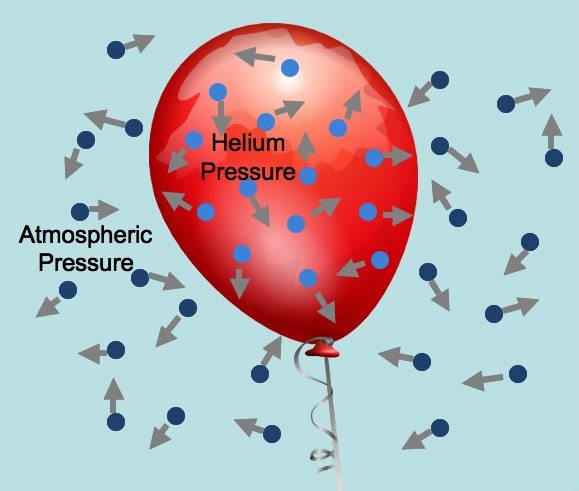
What causes pressure?
a)
The walls of the container
b)
The vacuum in the container
c)
The collisions of the particles
d)
Atmospheric pressure acting on the outside walls
67.

At what temperature would the Celsius and the Fahrenheit reading be the same?

a)

-10°

b)

-20°

c)

-30°

d)

-40°

68.

Room temperature is often identified as 68℉. What temperature is this on the Kelvin scale?

a)

263.16 K

b)

273.16 K

c)

283.16 K

d)

293.16 K

69.

How much heat energy is required to raise the temperature of 100 g of water from 20C20^\circ\text{C} to 80C80^\circ\text{C} ? (Specific heat capacity of water = 4.18J/gC4.18 \, \text{J/g}^\circ\text{C} )

a)

25,080J25,080 \, \text{J}

b)

16,720J16,720 \, \text{J}

c)

20,900J20,900 \, \text{J}

d)

18,760J18,760 \, \text{J}

70.

Calculate the total heat energy required to convert 100 g of ice at 10C-10^\circ\text{C} to water at 20C20^\circ\text{C} . (Specific heat capacity of ice = 2.1J/gC2.1 \, \text{J/g}^\circ\text{C} , Latent heat of fusion for water = 334J/g334 \, \text{J/g} , Specific heat capacity of water = 4.18J/gC4.18 \, \text{J/g}^\circ\text{C} )

a)

45,180KJ45,180\text{KJ}

b)

52,180KJ52,180\text{KJ}

c)

48,180J48,180 \, \text{J}

d)

50,180J50,180 \, \text{J}

71.

If 200 g of water is heated from 25C25^\circ\text{C} to 75C75^\circ\text{C} , how much heat energy is absorbed? (Specific heat capacity of water = 4.18J/gC4.18 \, \text{J/g}^\circ\text{C} )

a)

41,800KJ41,800\text{KJ}

b)

50,160J50,160 \, \text{J}

c)

41,800J41,800 \, \text{J}

d)

50,160KJ50,160\text{KJ}

72.

Which of the following is NOT a factor affecting the heat capacity of a substance?

a)

Mass of the substance

b)

Temperature change

c)

Colour of the substance

d)

Specific heat capacity

73.

Copper has a specific heat of 0.386 J/g°C. How much heat is required to increase 5.00 g of copper from 0.0°C to 10.0°C?

a)

3.86 J

b)

5.00 J

c)

10.0 J

d)

19.3 J

74.

Which is an example of radiation?

a)

An ice pack is placed on a knee, and the knee cools down.

b)

A rock is warmed by an ultraviolet heat lamp.

c)

Hot coffee in a mug causes the mug to warm up.

d)

Cold salt water sinks to the bottom of the ocean.

75.
Which best describes ENTROPY?
a)
Useful heat energy needed to drive an engine
b)
Heat that can be stored to be used at a later date
c)
  Random energy that escapes from the system
d)
A state of order in a physical system
76.
What is the symbol for Thermal Energy?
a)
Q
b)
t
c)
m
d)
C
77.

Transfer mechanism of heat through electromagnetic waves, such as the heat we feel from the sun or a fire. In this process, heat energy is emitted from a hotter object in the form of electromagnetic waves and is absorbed by cooler objects. Does not require a medium to transfer heat and can occur through a vacuum.

a)

Conduction

b)

Convection

c)

Radiation

d)

Advection

78.

Physical quantity that expresses the hotness or coldness of an object or a system. It is a measure of the average kinetic energy of the particles that make up the object or system.

a)

Heat

b)

Temperature

c)

Pressure

d)

Volume

79.

Is defined as the force exerted by the molecules of a matter on the walls of the container in which it is contained. It is proportional to the average kinetic energy of the molecules and their number density.

a)

Volume

b)

Heat

c)

Temperature

d)

Pressure

80.

Is defined as the total space occupied by the total amount of molecules. Is a measure of the physical size of the container in which the matter is contained.

a)

Volume

b)

Heat

c)

Temperature

d)

Pressure

81.

Scale of temperature that was originally defined by setting 0 (zero) as the temperature at which water freezes and 100 as the temperature at which water boils at sea level atmospheric pressure.

a)

Réaumur

b)

Fahrenheit

c)

Celsius

d)

Kelvin

82.

On this scale, a scientist used a mixture of ice, water, and ammonium chloride to define his zero value, then assigned a temperature of 96 to the human body temperature, which he measured using a thermometer placed under his arm.

a)

Kelvin

b)

Réaumur

c)

Fahrenheit

d)

Rankine

83.

Defined his temperature scale (SI unit of temperature) based on the concept of thermodynamic temperature. He used the idea of an "absolute zero" temperature, which is the temperature at which all molecular motion stops.

a)

Kelvin

b)

Rankine

c)

Réaumur

d)

Celsius

84.

Is the tendency of materials to change in volume, length, or shape in response to a change in temperature. When materials are heated, their particles begin to move more quickly and occupy a larger space, leading to an increase in volume or length.

a)

Sensible heat

b)

Latent heat

c)

Heat

d)

Thermal expansion

85.

Is defined as the transfer of energy from a hotter object to a colder object, resulting in a temperature change.

a)

Latent heat

b)

Sensible heat

c)

Heat

d)

Thermal expansion

86.

It refers to the amount of heat energy required to change the state of a substance without changing its temperature. During a phase change, the energy added or removed from the substance goes towards breaking or forming intermolecular bonds between the molecules rather than increasing or decreasing the kinetic energy of the substance.

a)

Latent heat

b)

Thermal expansion

c)

Heat

d)

Sensible heat

87.

Transfer mechanism of heat between objects in direct contact, such as a metal spoon placed in a hot cup of coffee. In this process, heat is transferred from the hotter object to the cooler one by the transfer of kinetic energy between the molecules of the objects.

a)

Convection

b)

Radiation

c)

Conduction

d)

Advection

88.

Transfer mechanism of heat through the motion of fluids, such as air or water. When a fluid is heated, its density decreases and it rises, while cooler, denser fluid sinks. This creates a “circular” motion which transfers heat from one location to another.

a)

Radiation

b)

Advection

c)

Conduction

d)

Convection

89.

Transfer mechanism of heat through electromagnetic waves, such as the heat we feel from the sun or a fire. In this process, heat energy is emitted from a hotter object in the form of electromagnetic waves and is absorbed by cooler objects. Does not require a medium to transfer heat and can occur through a vacuum.

a)

Conduction

b)

Convection

c)

Radiation

d)

Advection

90.

This law of thermodynamics states that if two objects are in thermal equilibrium with a third object, then they are in thermal equilibrium with each other. This means that if you touch two objects and they feel the same temperature, and each of these objects is also in thermal equilibrium with a third object, then all three objects are at the same temperature.

a)

Zeroth law

b)

First law

c)

Second law

d)

Third law

91.

This law of thermodynamics states that energy cannot be created or destroyed, only transferred, or transformed. This means that the total amount of energy in a system remains constant, even if the energy is transferred from one object to another or transformed into a different form of energy.

a)

Zeroth law

b)

First law

c)

Second law

d)

Third law

92.

This law of thermodynamics states that in any energy transfer or transformation, the total entropy of a closed system always increases over time. This means that energy tends to spread out and become more disordered over time, and that it is impossible to convert all heat energy into work without some of it being lost as waste heat.

a)

Zeroth law

b)

First law

c)

Second law

d)

Third law

93.
The first law of thermodynamics is a restatement of the
a)
Zeroth law of thermodynamics
b)
law of heat addition
c)
principle of entropy
d)
conservation of energy
94.

Which is an example of decreasing entropy in a closed system?

a)

Boiling water

b)

Freezing water

c)

Cells in a body coming together

d)

Ice melting

95.
Rank the following samples from greatest kinetic energy of the molecules to least kinetic energy of the molecules:
a)
A > B > C > D
b)
B > A > C > D
c)
B > A > D > C
d)
D > C > B > A
96.

How much energy is required to convert 3 kg of water at 20°C to steam at 100°C? (The specific heat of water is 4.184 J/g°C and the latent heat of vaporization is 2257 J/g)

a)

1,100 J

b)

9,100,000 J

c)

7,800,000 J

d)

730,000 J

97.

If an object is naturally buoyant, it will ___________.

a)

sink

b)

neither float nor sink

c)

float

d)

objects cannot be neutrally buoyant

98.

This is what happens to an object when the gravitational force is stronger than the buoyant force.

a)

sinks

b)

neutrally buoyant

c)

floats

d)

I don't know

99.

Which of the following will float in water? The density of water is 1 g/mL

a)

Object 1: m = 5 g, and v = 2 mL

b)

Object 2: m = 3 g, and v = 4 mL

c)

Object 3: m = 3 g, and v = 1 mL

d)

Object 4: m = 4 g, and v = 3 mL

100.

The up thrust of water acting on a wooden cube of sides 10cm immersed completely in water is

a)

2N

b)

3N

c)

5N

d)

10N

101.
How do we calculate density? (with correct units!)
a)
D = m/v (in g/mL or g/cm3)
b)
D = v/m (in g/mL or g/cm2) 
c)
D=m/v (in mL/g or cm3/g) 
102.

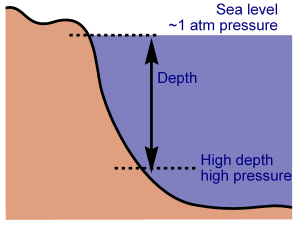
When you increase your depth under water, the water pressure on your body

a)

increases

b)

decreases

c)

stays the same

103.

How do you Calculate Pressure

a)

Force(N)/Area(m2)

b)

Force(kg)/Area(mi2)

c)

Area(m2)/Force(N)

104.
Which liquid is the least dense?
a)
oil
b)
water
c)
syrup 
d)
plastic bottle
105.
The buoyant force on an object equals 250 N. What is the weight of the displaced water?
a)
250 N
b)
250 lbs
c)
250 N/9.8 m/sec2
d)
not enough information given
106.

"The ability of a a fluid (liquid or gas) to exert an upward force on the object immersed in it" is the BEST definition for which of the following terms:

a)

Density

b)

Weight

c)

Buoyancy

d)

Pressure

107.

"The buoyant force on an object is equal to the weight of the fluid displaced by the object" is the basis for which of the following principles:

a)

Pascal's Principle

b)

Bernoulli's Principle

c)

the Quantum Entanglement Principle

d)

Archimedes' Principle

108.
What  is the formula to calculate heat energy required to raise the temperature of any substance?
a)
Q=mc∆t
b)
Q=mc
c)
Q= ½mv
d)
m=QC
109.
A pot of 2400g of water at a temperature of 25˚C is heated on a stove until the water boils (100˚C).  The specific heat of water is 4.18 J/(g˚C).
Determine the heat energy needed to heat the water in the pot to boiling.
a)
133.76J
b)
43,062.2J
c)
752,400J
d)
1,003,200J
110.
If 200 grams of water is to be heated from 24.0° C to  100.0° C to make a cup of tea, what is the mass and what is the change in temperature?
a)
m=200g
∆t= 66
b)
m=200g
∆t=124
c)
m=200
∆t=100
d)
m=200g
∆t=76
111.

In order to make a cup of milk coffee at 78°C, 200 g of coffee is mixed up with 40 g of milk. If the original temperature of the coffee is 80°C, find the original temperature of the milk. Assume that there is no heat lost to the surroundings. Given that the specific heat capacity of coffee and milk are 4000 J kg-1 °C-1 and 3900 J kg-1 °C-1 respectively.

a)

10.3°C

b)

20.7°C

c)

45.2°C

d)

67.7°C

112.

Mix 700 g of water at 100°C with 500 g of water at 30°C. Find the final temperature of the water.

【specific heat capacity of water = 4200 J/kg°C】

a)

65 °C

b)

42.5 °C

c)

70.8 °C

d)

45.8 °C

113.
A 300g piece of aluminum at 100 oC is placed in a 150g of H2O at 200 oC. The final temp. of the mix is 35 oC. What is the specific heat of the aluminum if the specific heat of the water is 4180 J/kgK?
a)
22415 J
b)
22415 g
c)
32415 J
d)
32415 g