
 Worksheets
DUAL NATURE
Total questions: 112
Worksheet time: 1hrs 14mins
Photoelectric effect phenomenon was discovered by:
Newton
Maxwell
Hertz
Huygens
Hallwachs experiment set-up is used to study:
Tyndal effect
Diffraction of light
Photo electric effect
Raman effect
Photoelectric current is ………. proportional to the number of photoelectrons emitted per second.
inversely
directly
first directly and then inversely
none of these
The stopping potential depends upon the ....……….. of the fastest electron.
velocity
charge
mass
density
For a given frequency of the incident radiation, the stopping potential …..…….... of its intensity.
is directly proportional
is inversely proportional
is independent
None of these
Photoelectric emission is a/an …………………. process.
slow
fast
instantaneous
very slow
The maximum kinetic energy of the photoelectrons is ….......... proportional to the frequency of incident radiation.
inversely
directly
first directly and then inversely
none of these
According to the quantum theory, light is emitted in the form discrete bundles of energy called ……………..
waves
corpuscles
photons
mesons
The energy spent in releasing the photoelectrons from a metal surface is called ……………
kinetic energy
potential energy
work function
excitation energy
A photon of frequency ν is incident on a metal surface of threshold frequency νο. The kinetic energy of the emitted photoelectron is:
h (𝜈– 𝜈ο )
h𝜈
h𝜈ο
h (𝜈 + 𝜈ο )
Assertion: The relative velocity of two photons travelling in opposite direction is the velocity of light.
Reason: The rest mass of a photon is zero.
both Assertion and Reason are true and the Reason is correct explanation of the Assertion.
both Assertion and Reason are true, but the Reason is not a correct explanation of the Assertion.
Assertion is true and Reason is false.
both, Assertion and Reason are false.
Assertion : Photo-emission from a photosensitive surface is possible only if the incident radiation has a frequency above threshold frequency.
Reason: Unless, the energy of incident photon is greater than the work function of photo-sensitive surface no photo-emission is possible.
both Assertion and Reason are true and the Reason is correct explanation of the Assertion.
both Assertion and Reason are true, but the Reason is not a correct explanation of the Assertion.
Assertion is true and Reason is false.
both, Assertion and Reason are false.
Assertion : An electron microscope can achieve better resolving power than an optical microscope.
Reason: The de-Broglie wavelength of the electrons
emitted from an electron gun with velocity 500 m/s is much less than 500 nm.
both Assertion and Reason are true and the Reason is correct explanation of the Assertion.
both Assertion and Reason are true, but the Reason is not a correct explanation of the Assertion.
Assertion is true and Reason is false.
both, Assertion and Reason are false.
Assertion: If we consider electrons and photons of the same wavelength, they will have the same momentum.
Reason: Electrons and photons have the same energy.
both Assertion and Reason are true and the Reason is correct explanation of the Assertion.
both Assertion and Reason are true, but the Reason is not a correct explanation of the Assertion.
Assertion is true and Reason is false.
both, Assertion and Reason are false.
Assertion : A proton is about 1840 times heavier than an electron. When it is accelerated by a potential difference of 1 kV, its kinetic energy is 1 keV.
Reason: Gain in kinetic energy = charge x potential difference.
both Assertion and Reason are true and the Reason is correct explanation of the Assertion.
both Assertion and Reason are true, but the Reason is not a correct explanation of the Assertion.
Assertion is true and Reason is false.
both, Assertion and Reason are false.
Assertion : Light of frequency 1.5 times the threshold frequency is incident on photo-sensitive material. If the frequency is halved and intensity is doubled, the photo current remains unchanged.
Reason: The photo electric current varies directly with the intensity of light and frequency of light.
both Assertion and Reason are true and the Reason is correct explanation of the Assertion.
both Assertion and Reason are true, but the Reason is not a correct explanation of the Assertion.
Assertion is true and Reason is false.
both, Assertion and Reason are false.
Assertion. Photoelectric effect demonstrates the wave nature of light.
Reason. The number of photoelectrons is proportional
to the frequency of light.
both Assertion and Reason are true and the Reason is correct explanation of the Assertion.
both Assertion and Reason are true, but the Reason is not a correct explanation of the Assertion.
Assertion is true and Reason is false.
both, Assertion and Reason are false.
Assertion. Photocell is called electric eye.
Reason. Photocell can see the things placed before it.
both Assertion and Reason are true and the Reason is correct explanation of the Assertion.
both Assertion and Reason are true, but the Reason is not a correct explanation of the Assertion.
Assertion is true and Reason is false.
both, Assertion and Reason are false.
Assertion. The de-Broglie wavelength of a neutron is X when its kinetic energy is k is . Its wavelength is 2x when its kinetic energy is 4 k.
Reason. The de-Broglie wavelength is proportional to square root of the kinetic energy.
both Assertion and Reason are true and the Reason is correct explanation of the Assertion.
both Assertion and Reason are true, but the Reason is not a correct explanation of the Assertion.
Assertion is true and Reason is false.
both, Assertion and Reason are false.
Assertion. The de-Broglie wavelength equation has significance for any microscopic or sub microscopic particles.
Reason. The de-Broglie wavelength is inversely proportional to the
mass of the object if velocity is constant
both Assertion and Reason are true and the Reason is correct explanation of the Assertion.
both Assertion and Reason are true, but the Reason is not a correct explanation of the Assertion.
Assertion is true and Reason is false.
both, Assertion and Reason are false.
Statement-1:
A laser beam of 0.2 W can drill holes through a metal sheet whereas a 1000 W light cannot.
Statement-2 :
The frequency of laser light is much higher than that of torch light.
Statement-1 is true ; Statement-2 is true ; Statement-2 is a correct explanation of Statement-1.
Statement-1 is true ; Statement-2 is true ; Statement-2 is not a correct explanation of Statement-1.
Statement-1 is true ; Statement-2 is false.
Statement-1 is false ; Statement-2 is true.
Statement-1:
The kinetic energy of photo-electrons emitted by a photo-sensitive surface depends upon the frequency of the incident radiations.
Statement-2 :
The kinetic energy of the emitted photoelectrons changes only with a change in the frequency of the incident radiations.
Statement-1 is true ; Statement-2 is true ; Statement-2 is a correct explanation of Statement-1.
Statement-1 is true ; Statement-2 is true ; Statement-2 is not a correct explanation of Statement-1.
Statement-1 is true ; Statement-2 is false.
Statement-1 is false ; Statement-2 is true.
.
Statement-1 is true ; Statement-2 is true ; Statement-2 is a correct explanation of Statement-1.
Statement-1 is true ; Statement-2 is true ; Statement-2 is not a correct explanation of Statement-1.
Statement-1 is true ; Statement-2 is false.
Statement-1 is false ; Statement-2 is true.
Statement-1 :
An electron of mass m when accelerated through a potential difference V, has de-Broglie wavelength . The de-Broglie wavelength associated with a proton of mass M accelerated through the same potential difference will be a
Statement-2 :
de-Broglie wavelength λ= 2meVh
Statement-1 is true ; Statement-2 is true ; Statement-2 is a correct explanation of Statement-1.
Statement-1 is true ; Statement-2 is true ; Statement-2 is not a correct explanation of Statement-1.
Statement-1 is true ; Statement-2 is false.
Statement-1 is false ; Statement-2 is true.
Statement-1:
Work function of a metal is 2 eV. The maximum wavelength of photons required to emit electrons from its surface is 6200 A.
Statement-2:
Work function, Wo = hc/ max.
Statement-1 is true ; Statement-2 is true ; Statement-2 is a correct explanation of Statement-1.
Statement-1 is true ; Statement-2 is true ; Statement-2 is not a correct explanation of Statement-1.
Statement-1 is true ; Statement-2 is false.
Statement-1 is false ; Statement-2 is true.
Statement-1:
Photoelectrons emitted from a metal surface have speeds varying from zero up to certain maximum value.
Statement-2 :
The work function of the metal goes on decreasing with the emission of electrons from it.
Statement-1 is true ; Statement-2 is true ; Statement-2 is a correct explanation of Statement-1.
Statement-1 is true ; Statement-2 is true ; Statement-2 is not a correct explanation of Statement-1.
Statement-1 is true ; Statement-2 is false.
Statement-1 is false ; Statement-2 is true.
Statement-1 :
The photoelectric current in a photocell increases with the increase in wavelength of the incident radiation.
Statement-2:
The energy of the incident radiation increases with the increase in frequency of incident radiation.
Statement-1 is true ; Statement-2 is true ; Statement-2 is a correct explanation of Statement-1.
Statement-1 is true ; Statement-2 is true ; Statement-2 is not a correct explanation of Statement-1.
Statement-1 is true ; Statement-2 is false.
Statement-1 is false ; Statement-2 is true.
Statement-1 :
The photoelectrons produced by a monochromatic light beam incident on a metal surface have a spread in their kinetic energies.
Statement-2:
The work function of the metal varies as a function of depth from the surface.
Statement-1 is true ; Statement-2 is true ; Statement-2 is a correct explanation of Statement-1.
Statement-1 is true ; Statement-2 is true ; Statement-2 is not a correct explanation of Statement-1.
Statement-1 is true ; Statement-2 is false.
Statement-1 is false ; Statement-2 is true.
Statement-1:
A small metal ball is suspended in a uniform electric field with an insulated thread. If high energy X-rays beam falls on the ball, the ball will be deflected in the electric field.
Statement-2:
X-rays emit photoelectrons and metal becomes negatively charged.
Statement-1 is true ; Statement-2 is true ; Statement-2 is a correct explanation of Statement-1.
Statement-1 is true ; Statement-2 is true ; Statement-2 is not a correct explanation of Statement-1.
Statement-1 is true ; Statement-2 is false.
Statement-1 is false ; Statement-2 is true.
When a surface 1 cm thick is illuminated with light of wavelength , the stopping potential is Vo. But when the same surface is illuminated by light of wavelength 3 λ , the stopping potential is Vo/6. The threshold wavelength for surface is 4 λ.
True
False
The mercury line of wavelength 2536 Å is used to eject photoelectrons from silver metal. The difference in potential required to bring all the ejected electrons to rest is 0.11 volt. The energy necessary to remove an electron from silver metal is 4.77 eV. Given hc = 12400eV Å.
True
False
. Energy from sun is received on earth at the rate of 2 calories per cm2 per minute. If average wavelength of solar light be taken at 5500 Å, then the number of photons received on the earth per cm2 per minute are 3 x 10¹⁹ [use,h = 6.6 x 10⁻³⁴ Js ; 1 calories = 4.2 J]
True
False
An X-ray tube operates at 10kV, The ratio of X-ray wavelength to that of de-Broglie wavelength is nearly 10 .
True
False
Given , Boltzman constant = 1.38 x 10⁻²³ J molecule-1 K-1 , h = 6.63 x 10⁻³⁴ Js, mass of neutron = 1.66 x 10⁻²⁷ kg. The de-Broglie wavelength of neutron at 27’ C is 2.46 Å.
True
False
Two metals X and Y have work function 2 eV and 5 eV respectively . when these metals are irradiated with light of wavelength 400nm, the emission of photoelectron will take place from metal Y only and not from metal X. [use hc = 1240 eV nm]
True
False
X-ray of wavelength λ fall on a photosensitive surface , emitting photoelectrons. Neglecting the work function of the surface , the de-Broglie wavelength of emitted photoelectron will be √hλ/mc.
True
False
100W light bulb is placed at the centre of a spherical chamber of radius 0.10 m . Assume that 75.36 % of the energy supplied to the bulb is converted into light and that the surface of chamber is perfectly absorbing . the pressure exerted by the light on the syrface of the chamber is 6.5 x 10⁻⁷ pa.
True
False
The light photons of energy 1 eV and 3 eV respectively are made incident on a metallic plate of work function 0.5 eV one after the other. The ratio of maximum kinetic energy of photoelectron emitted by them is 1 : 5.
True
False
If the wavelength of incident light changes from 4400Å to 4000Å , then change in stopping potential is -0.28 V. [ use hc = 12400 eV Å].
True
False
1 The minimum energy required by an electron to just eject from the metal surface so as to overcome the restraining forces at the surface is called ……………..
(a)
2. The phenomenon of photoelectric emission was discovered by ……..
(a)
3. The maximum kinetic energy of emitted photoelectrons depends on the ………..and nature of …………but is independent of………..
(a)
4. The ratio of number of photoelectron ejected to the number of the photons falling on a metal surface is ….. than ………..
(a)
5. Photon is not a ………but it is a ………..
(a)
6. The velocity of photon in different media is………..
(a)
7. The intensity of light depends upon the… (a) …present in light.
8. The momentum of a photon of energy E is………. and of wavelength is……
(a)
9. The de-Broglie wavelength of a photon of an electromagnetic radiation is …………
(a)
10. A photon and electron have got same de-Broglie wavelength . Total energy of an electron is…….than that of photon .
(a)
11. For a given photosensitive material, the photoelectric current is ……….on decreasing the wavelength of incident radiation , without any change in intensity of radiation .
(a)
12. The expression for de-Broglie wavelength of an electron moving under a potential difference of V volt is……………
(a)
13. de-Broglie waves are associated with a moving particle irrespective of ………on it.
(a)
14. The main aim of Davission –Germer experiment is to verify…….
(a)
15. An increase in the frequency of the incident light ……….the velocity with which photoelectron is ejected.
(a)
Two photons, each of energy 2.5 eV are simultaneously incident on sodium metal surface the work function of sodium is 2.75 eV, then from its surface __________ will be emitted.
one electron
two electrons
more than two electrons
not a single electron
1 eV is equal to _______
1.602 × 10¹⁹ J
1.602 × 10⁻¹⁹ J
1.602 × 10⁻²⁹ J
1.602 × 1029 J
When the intensity of a light source is increased
the number of photons emitted by the source in unit time increases
more energetic photons are emitted
faster photons are emitted
total energy of the photons emitted per unit time decreases
The photo current in an experiment on photoelectric effect increases if
the intensity of the source is increased
the exposure time is increased
the intensity of the source is decreased
the exposure time is decreased
As the intensity of incident light increases, the
K.E of emitted photo electrons increases
photoelectric current decreases
photoelectric current increases
K.E of emitted photo electrons decreases
The value of stopping potential when the frequency of light is equal to the threshold frequency is
maximum
zero
minimum
infinity
Light exhibits ______ duality
particle-wave
solid-liquid
liquid-gas
gas-plasma
The phenomenon by which metals emit electrons under the influence of radiation is called ____
photoelectric effect
interference
polarization
ionization
Photoelectric effect was first discovered by
Einstein
Newton
Hertz
Germer
At the stopping potential, photoelectric current is _______-
maximum
a constant
zero
infinity
If the kinetic energy of photo electron is found to be 16 J, whose mass is me , the maximum velocity of that electron will be______
4me2
4me
2me4
2me1
The saturation current is proportional to the ______ of radiation
intensity
time of travel
target material
frequency
For frequency v3 >v2 >v1 , the corresponding stopping voltages are in the order
(V0)1>(V0)2 >(V0)3
(V0)2>(V0)1 >(V0)3
(V0)3>(V0)2 >(V0)1
(V0)1>(V0)3 >(V0)2
The frequency of the incident radiation below which the photo electric emission is not possible completely is known as ______ frequency
stopping
zero-level
threshold
highest
Below the threshold frequency, if the intensity of radiation is increased, the emission of photoelectrons _____
increases
decreases
zero
constant
The light photon has ____ nature
wave
particle
matter
dual
The photon behaves as a particle in ________ phenomenon
emission
diffraction
polarization
interference
The energy spent in releasing a photoelectron is called photoelectric _____ of the metal
energy
ionization potential
work function
absorption energy
The minimum amount of energy required to liberate a photo electron from the metal surface is called as ________
cut off energy
work function
threshold frequency
potential energy
The cathode is coated with a material of low work function because
a large number of photo electron can be got
high work function should be achieved later
it is transparent
it is low in cost
The alphabet "h" represent ____ constant
Planck's constant
Boltzman
Einstein
gravitational
The value of Planck's constant is _______
6.62 × 10⁻³⁴ Js
6.62 × 1034 Js
6.62 × 10−45 Js
6.62 × 1045 Js
Mass of an electron in gram_____
9.11 × 10⁻³¹
9.11 × 10⁻²⁸
9.11 × 10⁻³³
9.11 × 10⁻³⁰
1 joule = eV
1.6× 10¹⁸
1.6× 10191
1.61019
1.610−19
Work function of a metal is the
energy required by an electron to escape from the metal surface
minimum energy required by an electron to escape from the metal surface
energy required by an electron to get absorbed in the metal surface
maximum energy required by an electron to escape from the metal surface
In Which case is electron emission form a metal not known?
heating the metal sufficiently
Applying a very strong magnetic field to metal
illuminating a metal surface with suitable light
none of these
Photoelectric effect is
emission of electrons by insulators when illuminated by light of suitable frequency
emission of electrons by metals when heated
emission of electrons by glass when illuminated by light of suitable frequency
emission of electrons by metals when illuminated by light of suitable frequency
Photoelectric effect is possible
with only ultraviolet
with only visible
with only white light
with both visible and UV depending on the metal
In photoelectric effect
electrical energy its converted into light energy
electric energy is converted into magnetic field
light energy is converted into electric energy
electric energy is converted into heat
In various experiments on photo electricity the stopping potential for a given frequency of the incident light
is inversely proportional to the radiation intensity
is independent of radiation intensity
is incident of the radiation intensity
is proportional to radiation intensity
In various experiments on photo electricity dealing with the stopping potential dependence on frequency of incident radiation the conclusion was that stopping potential
depends on the light intensity
is independent of frequency
depends on the initial current
depends on the frequency
In photo electric effect, the K.E of electrons emitted from the metal surface depends upon
intensity of light
frequency of incident light
velocity of incident light
both intensity and velocity of light
The collector plate in an experiment on photoelectric effect is kept vertically above the emitter plate, light source is put on and a saturation photoelectric current is recorded. An electric field is switched on which has a vertically downward direction
the stopping potential will decreases
the threshold frequency will increase
the photoelectric current will increases
the kinetic energy of the electron will increases
In the above experimental setup for studying photoelectric effect if keeping the frequency of the incident radiation and the accelerating potential fixed, the intensity of light is varied
photocurrent decreases linearly with intensityy
photocurrent increases linearly with intensity
photocurrent remains same with intensity
photocurrent decreases non linearly with intensity
The work function value of molybdenum is
2.14
5.65
4.17
4.28
What did Max Planck tell about light?
Light travels in the form of small packets of energy called photons.
Light travels in the form of small packets of energy called quanta.
Light travels in the form of electromagnetic radiation.
Light is made up of tiny particles called corpuscles.
Multiple answers can be correct: Energy of light is proportional to:
Directly proportional to frequency
Inversely proportional to wavelength.
Directly proportional to speed of light.
Independant of speed and wavelength
Properties of photons are:
It has perfectly elastic collision with everything that comes into its path.
It transfers all its energy to the object it collides with.
Every photon has energy proportional to its frequency.
Energy of a photon in every medium is the same.
The electrons that are emitted from a metal surface when light falls on the surface of the metal are called:
Photon
Electron
Photoelectron
Photon-electron pair
The minimum required frequency required to remove an electron from an atom is called:
Thershold frequency
Critical frequency
Infliction frequency
None of the above
To observe photoelectric current, the wavelength of photon should be:
greater than threshold wavelength
less than threshold wavelength
equal to threshold wavelength
any wavelength can create a photoelectric current
More than one answer can be correct: Intensity of light is dependant on:
Number of photon incident on unit area
Energy of each individual photon incident
Wavelength of photon
None of these
Work function is defined as:
Maximum energy that an atom can with stand.
Energy required to remove any electron from the atom.
A function of work at nuclear level
Energy required to remove the outrermost electron from the atom
Stopping potential is:
The minimum potential required to create a potential energy to stop even the most energetic photoelectron.
The potential required to stop any photoelectron.
The maximum potential required to contain a photoelectron
None of these
Who came up with the idea of matter waves?
Compton
Planck
Maxwell
De' Broglie
According to de Broglie's hypothesis, the wavelength of a moving object is
Proportional to the linear momentum of the object
Inversely proportional to the linear momentum of the object
Proportional to the angular momentum of the object
Inversely proportional to the angular momentum of the object
An electron, a proton, an alpha-particle and a hydrogen atom are moving with the same kinetic energy. The associated de Broglie wavelength will be longest for
Electron
Proton
Alpha particle
Hydrogen
The theory, on the basis of Photoelectric effect can be explained
corpuscular theory
electromagnetic theory
wave theory
quantum theory
electron volt is a unit of
potential
momentum
energy
charge
A particle of light is called a...
Photoelectron
Photon
Proton
Electron

That light has a dual nature is referring to light:
having high- or low-energy photons.
acting as waves and particles.
having energy and momentum
undergoing pair production.
· All moving particles have a "matter wave" with a wavelength associated with them" This hypothesis has a name. Which?
Davisson and Germer hypothesis
De Broglie hypothesis
Schrödinger hypothesis
Bainbridge hypothesis
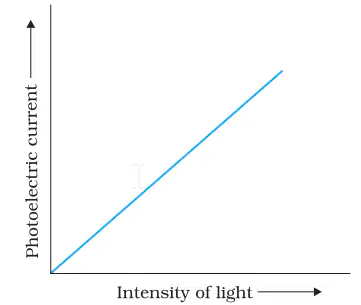
The relation between photocurrent and intensity of light is:


NONE
Photoelectric current is ………. proportional to the number of photoelectrons emitted per second.
inversely
directly
first directly and then inversely
none of these
For a given frequency of the incident radiation, the stopping potential …..…….... of its intensity.
is directly proportional
is inversely proportional
is independent
None of these
A photon of frequency ν is incident on a metal surface of threshold frequency νο. The kinetic energy of the emitted photoelectron is:
h (𝜈– 𝜈ο )
h𝜈
h𝜈ο
h (𝜈 + 𝜈ο )

