
 Worksheets
The Executive Branch
Total questions: 58
Worksheet time: 29mins
Executive Branch
Congress
President
US Supreme Court
Why did the Founding Fathers create the Electoral College system?
They wanted to encourage the creation of a two-party system.
They wanted the President and Vice President to be elected together.
They did not trust that voters were informed enough to choose the President.
They did not want certain groups of people to vote in national elections.
Enforces Laws
Legislative
Executive
Judicial
Article II
Executive Branch
Legislative Branch
Judicial Branch
Which role of the President is being described below?
"Biden Approves Plan to Redeploy Several Hundred Ground Forces Into Somalia"
Chief Legislator
Chief Executive
Commander-in-Chief
Economic Leader
In which scenario is the President acting as Chief Diplomat?
The United States creates a treaty with Canada.
The United States sends troops to the Middle East.
Why did the Founding Fathers create the Electoral College system?
They wanted to encourage the creation of a two-party system.
They wanted the President and Vice President to be elected together.
They did not want certain groups of people to vote in national elections.
They did not trust that voters were informed enough to choose the President.
How is the number of Electoral College votes determined for each state?
the size of each state in square miles
the overall population of citizens over the age of 18
the amount of representatives the state has in Congress
the total number of representatives in the state legislature
The scenario below may be addressed by local, state, or national governments.
"After careful analysis, it has been confirmed that Florida is in danger of government spending far exceeding its tax income."
Who is responsible for resolving the issue?
The Governor of Florida
The Mayor of Orlando
The President of the United States
Power of the President to head the U.S. military and send troops overseas.
Chief the the party
Commander-in-Chief
Chief Diplomat
Economic Leader

The headline demonstrates the Senate's confirmation of a Supreme Court Justice. Who appoints Supreme Court Justices?
The President
The Vice President
The Speaker of the House
The Chief Justice
12th Amendment: Electoral college elects...
Governor and Senator
President and Governor
Vice President and Senator
President and Vice President
Who is in charge of determining the budget for the government of the state of Florida?
The President
The Speaker of the House
The Mayor
The Governor
What is the main function of the Executive Branch?
Makes laws
Enforces Laws
Interprets Laws
Why did the Founding Fathers create the Electoral College system?
They wanted to encourage the creation of a two-party system.
They wanted the President and Vice President to be elected together.
They did not want certain groups of people to vote in national elections.
They did not trust that voters were informed enough to choose the President.
Directive handed down by President that has same power as a law (Congress has no say in it)
Veto
Executive Order
Pardon
Advice and Consent
The scenario below may be addressed by local, state, or national governments.
"After careful analysis, it has been confirmed that Florida is in danger of government spending far exceeding its tax income."
Who is responsible for resolving the issue?
The Governor of Florida
The Mayor of Orlando
The President of the United States
If the President wants to create a law that Congress refuses to pass, what can the President do instead?
Pass an Executive Order.
Use the military to force Congress to pass the law.
Fire members of Congress.
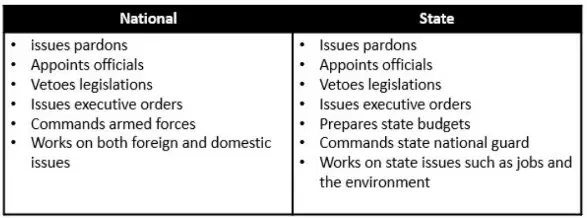
This chart shows executive authority at the national and state levels.
What conclusion can be drawn from this chart?
State executive's authority only extends to the state they were elected in.
National executives have more control over the budget than state executives.
Neither state nor national executives can prevent the passage of bills into law.
State executives have more power over foreign policy than national executives.
veto, grant pardons, chief executive, four-year term
President only
Governor only
Both President and Governor
How is executive authority at the state and national levels of the United States similar?
Each writes the laws for an entire community.
Each makes decisions about constitutional amendments.
Each oversees that policies are enforced and followed.
Each acts as commander in chief of the U.S. armed forces.
What powers do the Governor of Florida and the President of the United States have in common?
veto, grant pardons, chief executive, four-year term
six-year term, grant pardons, make treaties, commander-in-chief
grant pardons, veto, deliver State of the Union address, six-year term
deliver State of the Union address, four-year term, commander-in-chief, grant pardons
12th Amendment: Electoral college elects...
President and Vice President
President and Governor
Vice President and Senator
Governor and Senator
How are the responsibilities of the legislative and executive branches different when it comes to the
lawmaking process?
The President votes on laws, while Congress must approve and veto them.
Congress can override a veto, while the president can declare the law unconstitutional.
The President can propose ideas for laws, while Congress can declare them unconstitutional.
Congress proposes laws, while the President can only approve or veto them.
Power of the Executive to forgive someone who committed a crime - Can be released from jail early.
Veto
Pardon
Executive Order
Chief Executive of State Government
President
Governor
Mayor
Congress
How is executive authority at the state and national levels of the United States similar?
Each writes the laws for an entire community.
Each makes decisions about constitutional amendments.
Each oversees that policies are enforced and followed.
Each acts as commander in chief of the U.S. armed forces.
Below is a headline from a newspaper article.
"U.S. Senate Approves New Supreme Court Justice!"
What power outlined in Article II of the U.S. Constitution would the president have used to lead to this
event?
Veto
Negotiate Treaties
Make Appointments
Grant Pardons
Power of the Executive to forgive someone who committed a crime - Can be released from jail early.
Veto
Pardon
Executive Order
The Electoral College chooses BOTH the President AND Vice President as a result of the ___ Amendment.
1st
2nd
12th
19th
Chief Executive of State Government
President
Speaker of the House
Mayor
Governor
State executive's authority only extends to the _______________.
State they were elected in.
County they were elected in.
The entire country.
Below is an excerpt from a government document.
"Profane (inappropriate) speech is prohibited on broadcast radio and television between the hours
of 6 a.m. and 10 p.m."
Federal Communications Commission, an administrative agency
Which function of an administrative agency is being represented?
making new regulations
passing executive orders
enforcing laws
Oversees that policies are enforced and followed.
Executive at the state and national levels
Executive at the state level only
Executive at the national level only
Chief Executive of the National Government
Governor
President
Mayor
Congress
Administrative Agencies
Make and enforce regulations (rules)
Can impeach the President (remove from office)
Ratify treaties and appointments
Oversees that policies are enforced and followed.
Executive at the state level only
Executive at the state and national levels
Executive at the national level only
Part of Executive branch that makes regulations (rules).
The Cabinet
The Vice President
Administrative Agencies
If the President wants to create a law that Congress refuses to pass, what can the President do?
Fire members of Congress.
Use the military to force Congress to pass the law.
Pass an Executive Order.
What is the main function of the Executive Branch?
Writes laws
Creates Laws
Interprets Laws
Enforces Laws
How is executive authority at the state and national levels of the United States similar?
Each writes the laws for an entire community.
Each acts as commander in chief of the U.S. armed forces.
Each oversees that policies are enforced and followed.
veto, grant pardons, chief executive, four-year term
President only
Both President and Governor
Governor Only
The ______________ appoints new Supreme Court Justices but they must be approved by the _______________.
Governor; President
President; Senate
President; House of Representatives
Congress; States
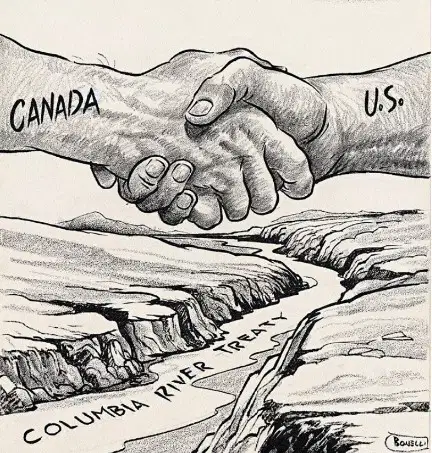
Which executive leader would be responsible for this action?
Mayor
President
Governor
Vice President
Chief Executive of the National Government
President
Governor
Mayor
Congress
Below is an excerpt from a government document.
"Profane (inappropriate) speech is prohibited on broadcast radio and television between the hours
of 6 a.m. and 10 p.m."
Federal Communications Commission, an administrative agency
Which function of an administrative agency is being represented?
making new regulations
passing executive orders
enforcing laws
Rules that are made by administrative agencies
Vetoes
Executive Orders
Regulations
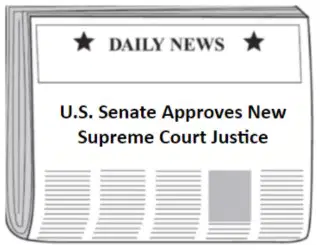
Below is a headline from a newspaper article.
What power outlined in Article II of the U.S. Constitution would the president have used to lead to this
event?
make appointsments
grant pardons
negotiate treaties
execute laws
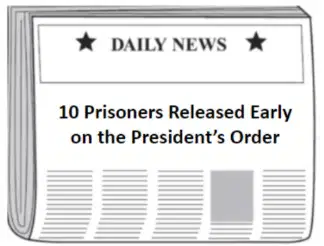
Below is a headline from a newspaper article.
Which process of the executive branch is reflected in the headline?
veto
pardon
regulation
appointment
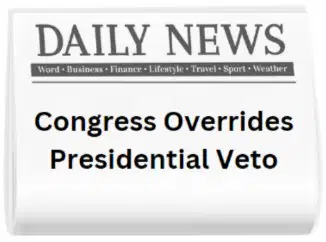
Below is a newspaper headline.
Which principle is reflected in the headline above?
checks and balances
separation of powers
consent of the governed
popular sovereignty
The quote below is from John Adams.
"Liberty cannot be preserved without general knowledge among the people..."
-John Adams
Based on the quote, what is one importance of the rule of law?
Citizens should be informed about government actions.
Citizens should have access to all laws.
The government should keep secrets from citizens.
The government should be free from distractions while making laws.
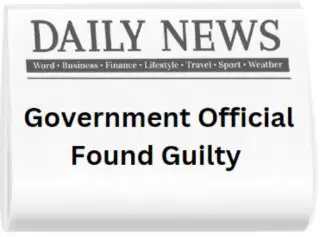
Below is a newspaper headline.
How does the headline demonstrate the impact of the rule of law on government officials?
Government officials are accountable to the law.
Government officials make decisions based on the law.
Government officials must have transparency of institutions.
Government officials may not receive due process from institutions.
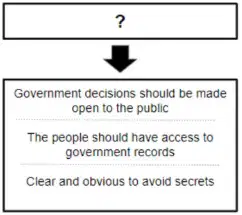
Below is a diagram of the rule of law.
Which principle of the rule of law best completes the diagram?
procedures
consistency
transparency
enforcement
Which choice reflects the executive authority that is shared by both the Governor of Florida and the
President of the United States?
chief executive, four-year term, grant pardons, and veto
commander-in-chief, grant pardons, make treaties, and six-year term
deliver State of the Union address, grant pardons, six-year term, and veto
commander-in-chief, deliver State of the Union address, four-year term, and grant pardons
Below is an excerpt from Article I of the U.S. Constitution.
" Every Bill which shall have passed the House of Representatives and the Senate, shall, before it become a Law, be presented to the President of the United States; If he approve he shall sign it, but if not he shall return it, with his Objections to that House in which it shall have originated . . ."
How are the responsibilities of the legislative and executive branches different when it comes to the
lawmaking process?
The President votes on laws, while Congress must approve and veto them.
Congress proposes laws, while the President can only approve or veto them.
Congress can override a veto, while the president can declare the law unconstitutional.
The President can propose ideas for laws, while Congress can declare them unconstitutional.
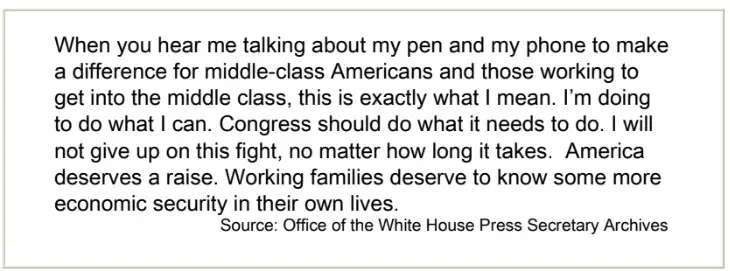
The passage below is a speech by President Barack Obama on February 2, 2014.
What executive process is being described in the passage?
veto
regulation
appointment
executive order
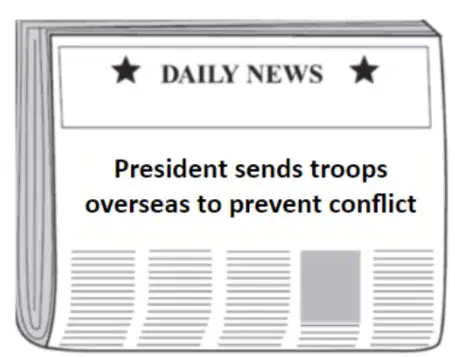
Use the headline below to answer the following question.
Which power described in Article II of the U.S. Constitution is referenced in the headline?
Execute the Laws
Granting Pardons
Commander in Chief
Appointing Ambassadors
Appointment
Power of the President to nominate candidates for government jobs.
Power of the President to reject bills passed by Congress.
Power of the President to let convicted criminals out of jail early.
Power of the President to lead the US army and navy,

