
Font size
 Worksheets
Photosynthesis Quiz
Total questions: 32
Worksheet time: 18mins
What is the main purpose of photosynthesis?
To convert chemical energy into light energy
To convert light energy into chemical energy in the form of sugars
To release carbon dioxide as a byproduct
To produce ATP directly from sunlight
What are the two crucial resources provided by glucose molecules during photosynthesis?
Oxygen and nitrogen
Energy and fixed carbon
Water and carbon dioxide
ATP and sunlight
What is the process called when carbon from carbon dioxide is incorporated into organic molecules?
Carbon reduction
Carbon fixation
Carbon oxidation
Carbon evaporation
Which of the following organisms are photosynthetic?
Plants, Algae, Some Bacteria
Animals, Fungi, Humans
Insects, Fish, Birds
Reptiles, Amphibians, Mammals
What is the role of photosynthetic organisms in the ecosystem?
They introduce chemical energy and fixed carbon.
They consume organic compounds.
They deplete oxygen levels.
They produce methane gas.
What are organisms called that cannot convert carbon dioxide to organic compounds?
Heterotrophs
Autotrophs
Phototrophs
Chemotrophs
How does photosynthesis affect Earth's atmosphere?
It generates oxygen gas as a byproduct.
It increases carbon monoxide levels.
It reduces nitrogen levels.
It produces sulfur dioxide.
What do photosynthetic organisms use carbon atoms for?
To build organic molecules
To create inorganic salts
To form metallic compounds
To produce fossil fuels
What are the most common autotrophs in terrestrial-land ecosystems?
Animals
Fungi
Plants
Bacteria
Where does the majority of photosynthesis take place in plants?
Roots
Leaves
Stems
Flowers
What is the primary site of photosynthesis in the leaf?
Epidermis
Mesophyll
Stomata
Veins
What are the pores on the surface of leaves called?
Chloroplasts
Mesophyll
Stomata
Thylakoids
What do stomata allow to enter and exit the leaf?
Water and minerals
Carbon dioxide and oxygen
Glucose and oxygen
Nitrogen and hydrogen
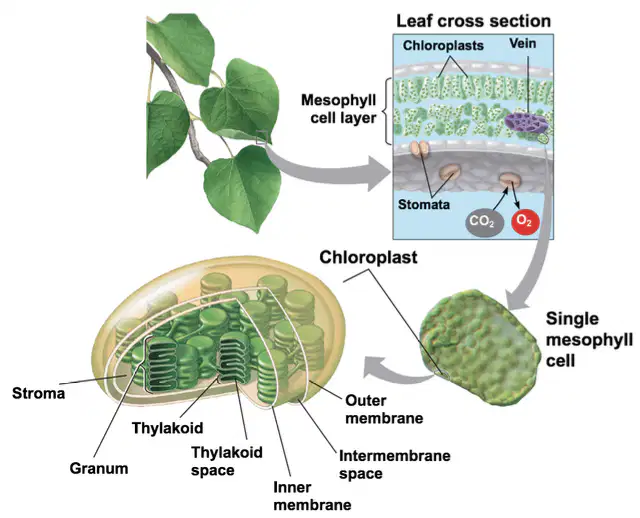
The diagram shows what structures of a leaf,
The diagram shows the structure of a leaf, including the mesophyll, stoma, chloroplast, granum, and thylakoids.
The diagram shows the structure of a leaf, including the epidermis, cuticle, xylem, phloem, and guard cells.
The diagram shows the structure of a leaf, including the petiole, blade, vein, midrib, and margin.
The diagram shows the structure of a leaf, including the root, stem, flower, fruit, and seed.
What organelles in mesophyll cells are responsible for photosynthesis?
Mitochondria
Ribosomes
Chloroplasts
Nuclei
What are thylakoids arranged in stacks called?
Stroma
Grana
Lumen
Membrane
What is the function of chlorophylls in the thylakoid membrane?
Store nutrients
Absorb light energy
Produce oxygen
Transport water
What is the fluid space inside the thylakoid discs known as?
Cytoplasm
Stroma
Thylakoid space
Intermembrane space
What is the second stage of photosynthesis called?
Krebs cycle
Calvin cycle
Electron transport chain
Glycolysis
Where does the Calvin cycle take place?
Thylakoid
Cytoplasm
Stroma
Nucleus
What is produced during the Calvin cycle?
Oxygen
Glucose
Glyceraldehyde-3-phosphate (G3P)
Pyruvate
What molecules are used from the light-dependent reactions in the Calvin cycle?
ATP and NADPH
ADP and NADP+
Glucose and Oxygen
Water and Carbon Dioxide
Which process occurs in chloroplasts and uses carbon dioxide?
Photosynthesis
Cellular Respiration
Fermentation
Glycolysis
What is the energy source for photosynthesis?
Glucose
ATP
Sun
Oxygen
Which of the following is a product of cellular respiration?
Glucose
Oxygen
Carbon Dioxide
Water
In which process is energy absorbed and stored?
Cellular Respiration
Photosynthesis
Fermentation
Glycolysis
What are the reactants in cellular respiration?
Carbon Dioxide and Water
Glucose and Oxygen
Sunlight and Water
ATP and Oxygen
Discuss the role of oceans in the carbon cycle.
Oceans release carbon dioxide into the atmosphere
Oceans store carbon in the form of dissolved carbonates
Oceans have no role in the carbon cycle
Oceans convert carbon dioxide into methane
Predict the long-term effects of increased atmospheric carbon dioxide on ecosystems.
Increased biodiversity
Decreased global temperatures
Ocean acidification and climate change
Stabilization of weather patterns

Where does the light reaction take place?
Thylakoid
Stroma
Granum
Inner membrane

"B" is step two in (a) and is called the (b)

What is the product of the Calvin Cycle? (a)

