
Font size
 Worksheets
REVISION - YEAR 7 PHYSICS
Total questions: 100
Worksheet time: 1hrs 2mins
Law of reflection state that - The angle of incidence is .................. to the angle of reflection.
(La ley de reflexión establece que - El ángulo de incidencia es .................. al ángulo de reflexión.)
equal (igual)
half (mitad)
double (doble)
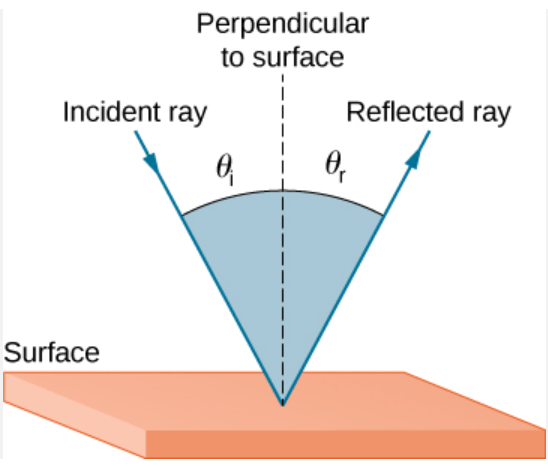
If the angle of incidence is 20 degrees, what will be the value of the angle of reflection?
(Si el ángulo de incidencia es de 20 grados, ¿cuál será el valor del ángulo de reflexión?)
0
10
20
30
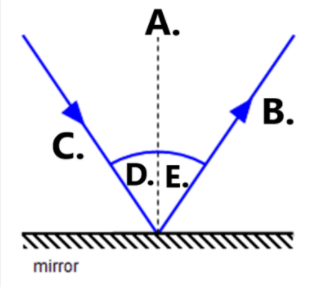
In the diagram, which letter represents the angle of incidence?
(En el diagrama, ¿qué letra representa el ángulo de incidencia?)
B
C
D
E
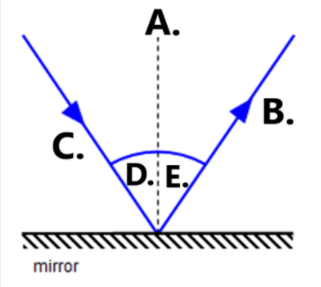
In the diagram, which letter represents the angle of reflection?
(En el diagrama, ¿qué letra representa el ángulo de reflexión?)
B
C
D
E
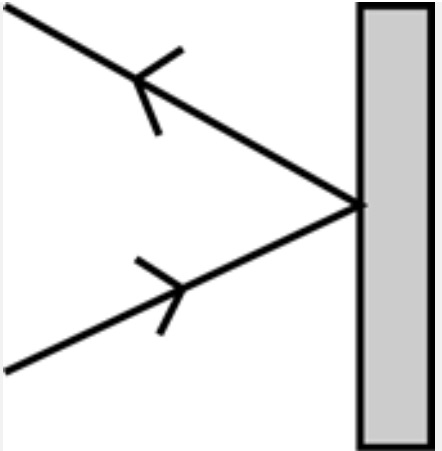
The illustration shows a light ray striking an object.
In the illustration, the light ray striking the object is-
(La ilustración muestra un rayo de luz que golpea un objeto. En la ilustración, el rayo de luz que golpea el objeto es:)
absorbed (absorbido)
stopped (detenido)
reflected (reflejado)
refracted (refractado)
The ray of light that strikes a reflecting surface is called ________.
(El rayo de luz que incide en una superficie reflectante se llama ________.)
incident ray (rayo incidente)
reflected ray (rayo reflejado)
normal line (normal line)
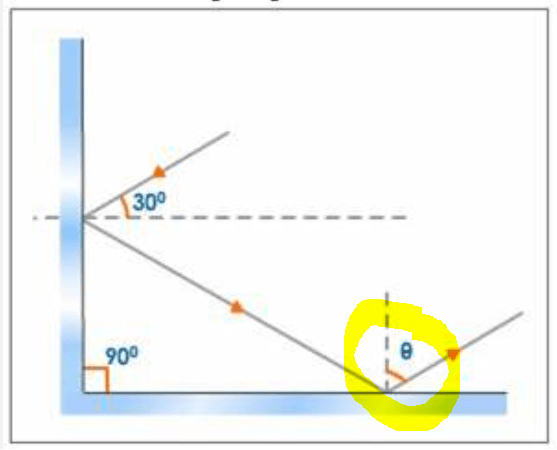
What is the value of the unknown angle (theta) in the following diagram?
(¿Cuál es el valor del ángulo desconocido (theta) en el siguiente diagrama?)
60 degrees
30 degrees
90 degrees
45 degrees


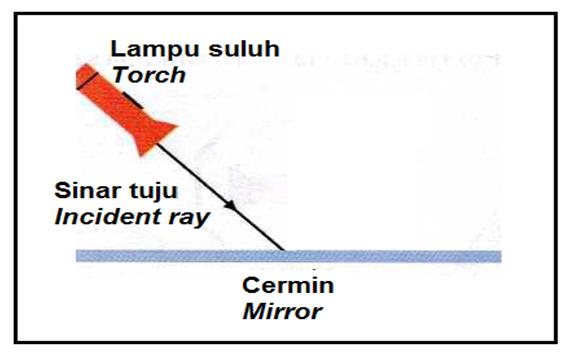
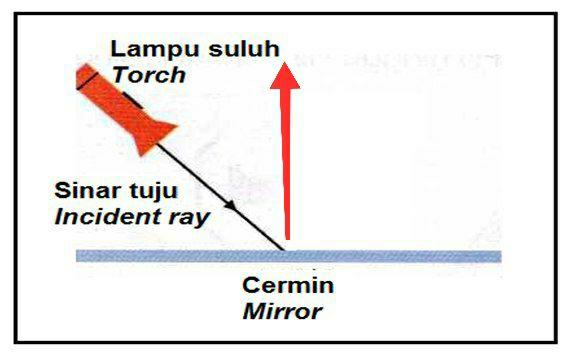
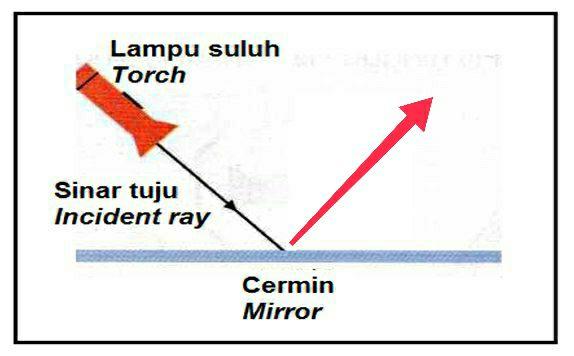
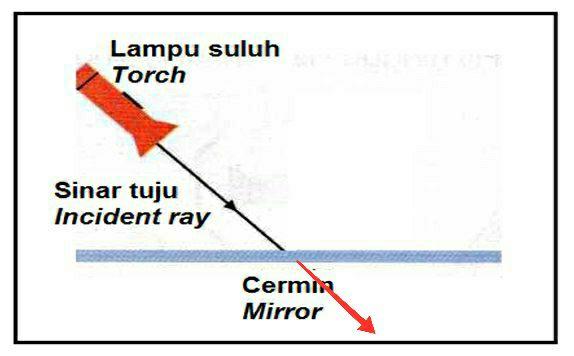
The following diagram shows the ray diagram when a torch light is torched towards a mirror. Which of the following is the correct reflected ray?
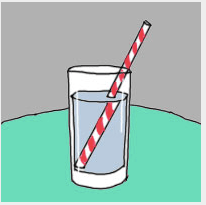
Why does the straw appear to be bent?
light is reflected
light is absorbed
light is turned
light is refracted

A
B
C
D
Which diagram correctly shows a ray of light reflected by a plane mirror?


A student placed a pencil in a cup of water. The pencil appears broken because light
always travels in a straight line.
bends when it passes through water.
makes the water in the glass evaporate.
reflects the pencil on the water's surface.


Glass has a _____________ density than air.
Smaller
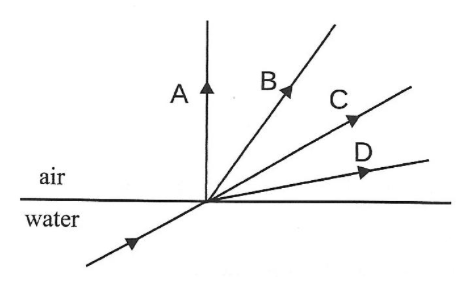
A light ray is incident from water to air. Which of the refracted rays is correct?
A
B
C
D
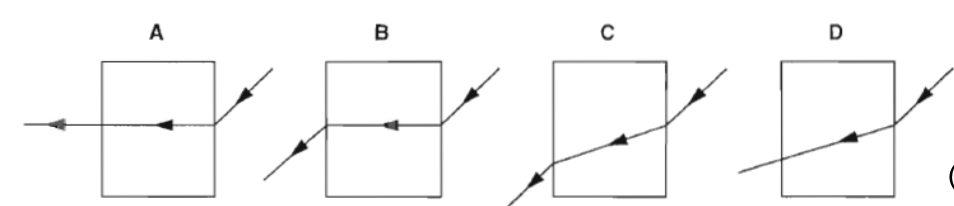
A ray of light travels from air into a glass block.
Which diagram correctly shows the path of the ray through the glass block?
A
B
C
D

The angle of reflection is
90 degrees
55 degrees
45 degrees
135 degrees

Which number represents the normal?
1
2
3
Refraction is when light...
Bounces
Transmits
Bends
Absorbs
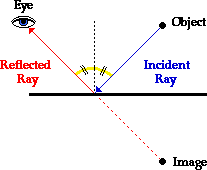
What is the angle of reflection equal to?
The angle of refraction
The angle of incidence
The angle of absorption
The angle of light

What would you call this?
Reflection
Diffraction
Refraction
Friction
When angle of incident (i) equals to critical angle (c) if light is traveled from a denser medium to a less dense medium,
total internal reflection occurs.
angle of refraction is equal to 90 degree.
light is refracted out
light travel in straight line
What is total internal reflection
Where a wave is refracted at the boundary between a dense medium and a less dense medium when the angle of incidence is greater than the critical angle.
Where a wave is refracted at the boundary between a dense medium and a less dense medium when the angle of incidence is smaller than the critical angle.
Where a wave is reflected at the boundary between a dense medium and a less dense medium when the angle of incidence is greater than the critical angle.
Where a wave is reflected at the boundary between a dense medium and a less dense medium when the angle of incidence is smaller than the critical angle.
When will total internal reflection occur?
When light travels from a less dense to a more dense medium
When the angle of incidence is smaller than the critical angle
When the angle of incidence is greater than the critical angle
When the light cannot pass through a medium
When the angle of refraction is 90 ° the angle of incidence is called the...
Angle of incidence
Critical angle
Angle of total internal reflection
Angle of refraction

see image
A
B
C
D


see image
A
B
C
D
What happens in the retina?
What part of the eye works alongside the lens to focus light?
The cornea
The iris
The pupil
The optic nerve
The image on the retina is (a) which means upside down
What part of the eye detects light?
The retina
The CCD
The photographic film
The lens
What does the iris do?
transmits light rays to retina
helps the eye focus
sends messages to the brain
regulates how much light enters the eye through the pupil
solar
renewable
non-renewable
oil
renewable
non-renewable
water
renewable
non-renewable
sheep
renewable
non-renewable
steam
renewable
non-renewable
wind
renewable
non-renewable
coal
renewable
non-renewable
natural gas
renewable
non-renewable
renewable resource
can be replaced
limited amounts
is being used up too quickly

Resources that are not able to be reproduced as quickly as they are used are called _____.
renewable resources
replaceable resources
non renewable resources
non replaceable resources
Geothermal energy uses heat from ____ to produce electricity.
the earth
coal
oil
natural gas
Coal is burned to heat water so that the _______ can turn turbines.
fire
steam
water
heat
Renewable resources ...
are not replaceable
are used more frequently than non renewables
are never going to run out
going to run out
Which of these is non renewable
natural gas
water in a dam
solar power
wind energy
Which of the following is a renewable resource?
Oil
Solar
Coal
Natural Gas
Hyrdo Power is a __________ energy resource.
Renewable
Non-renewable
Which of the following is a non-renewable resource?
Water
Wood
Oil

Geothermal energy uses heat from hot rocks deep in the Earth's crust.
True
False
Natural resources can be both renewable and non-renewable.
True
False
Nuclear energy produces dangerous waste that remains radioactive for thousands of years. Is this an advantage or disadvantage?
Advantage
Disadvantage
What type of energy is produced from flowing or moving water, usually from a dam?
Geothermal
Biomass
Hydropower
Solar
Natural resources that cannot be remade or regrown close to the rate at which they are being used.
Non-renewable energy
Renewable energy
Check all of the boxes that are FOSSIL FUELS.
Oil
Natural gas
Coal
Uranium
What kind of energy comes from burning plant and animal waste?
Geothermal
Solar
Wind
Biomass
Which of these are renewable resources?
coal
wind
geothermal
water in a dam
biomass
Solar Power is a __________ energy resource.
Renewable
Non-renewable

_________resources are all that exists without the actions of humankind.
Natural Resources.
Human Resources.
Advantage of Energy resources.
These resources are nearly infinite.
A very large amount of energy could be generates in this way.
Maintenance requirements are lower and save money
Al of these.

One advantage of solar and wind power over fossil fuels is that
wind and solar are presently much less expensive than fossil fuels.
wind and solar come from natural processes and fossil fuels do not.
wind and solar are nonrenewable resources and fossil fuel are renewable.
wind and solar are continuously renewable and fossil fuels take millions of years to be formed.

Gold is a renewable resource.
True
False

The sun is a renewable resource.
True
False


I am a very small rock entering a planet's atmosphere.
meteor
meteorite
asteroid
comet


When a meteoroid STRIKES the surface of the earth scientists refer to them as:
Asteroids
Comets
Meteors
Meteorites

Where are asteroids found?
Between Earth and Venus
Between Jupiter and Saturn
Between Saturn and Uranus
Between Mars and Jupiter

Which of the following celestial bodies has a long and lighted tail?
Comet
Asteroid
Meteorite
Mercury

A meteor when it burns in the atmosphere is also known as a ____.
rock
shooting star
ball of ice
Where are most of the asteroids in the solar system located?
Asteroid Belt
Orion's Belt
Gemini Area
A meteoroid is found
in Space
entering earths atmosphere
impacting earths surface

A meteor that does not burn up in Earth's atmosphere and reaches Earth's surface
Meteorite
Meteoroid
Meteor
What's the difference between comets and asteroids?
Asteroids are made of metal and rock, while Comets are ice and rock
Asteroids are made of ice and rock, while Comets are made of metals and rock
There is no difference
Asteroids are made of stardust, while Comets are made up of water

