wayground logo

Free Printable Worksheets

Font size

S
M
L
XL
Worksheets

YEAR 8 REVISION -PHYSICS

Total questions: 116

Worksheet time: 3hrs 44mins

Name
Class
Date
1.

If Harry drives 4 miles in 2 minutes, what was his speed?

a)

0.5 m/min

b)

2 m/min

c)

2 min/m

d)

0.5 min/m

2.

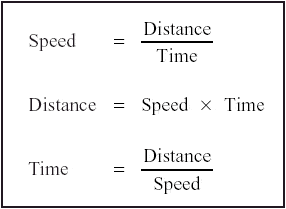
What is missing in the triangle of knowledge?

a)

speed

b)

distance

c)

time

d)

minutes

3.

If Sally is speeding through the parking lot at 18m/hr, and she travels 9 m, how long did it take her?

a)

2 m/hr

b)

0.5 hr

c)

2 m

d)

0.5 m

4.
Reese can run 10 meters in 5 seconds. What is her speed?
a)
5 meters/sec
b)
2 meters/sec
c)
5 miles/hour
d)
2 miles/hour
5.
Calculate these 3 car's speeds, then rank them in order of fastest to slowest, with 3 being the fastest car and 1 the slowest car.
Car A- distance: 4 meters, time: 2 sec
Car B- distance: 2 meters, time: 2 sec
Car C- distance: 8 meters, time: 2 sec
a)
Car A= 1
Car B= 2
Car C = 3
b)
Car A = 2
Car B= 1
Car C= 3
c)
Car A= 3
Car B= 1
Car C = 2
d)
Car A = 3
Car B= 2
Car C= 1
6.
Boedy swims 100 meters in 5 minutes. What is his speed?
a)
15 meters/minute
b)
20 meters/minute
c)
25 meters/minute
d)
30 meters/minute
7.
A different runner trains for a marathon for 6 months by eating nothing but bags of french fries from McDonalds. They run a 10 meter dash in 100 seconds. What is their speed?
a)
0.01 m/s
b)
0.1 m/s
c)
1 m/s
d)
10 m/s
8.

The formula for Speed is...

a)

Speed = distance/ time

b)

Speed = time/ distance

9.

If Emma is running for 8 minutes at 2 miles/min, how far did she run?

a)

4 miles

b)

16 min

c)

16 miles

d)

0.5 min

10.

In order to find the Time, you must

a)

divide the distance by the speed (distance/speed)

b)

multiply the distance by the speed (distance/speed)

c)

Neither of the Above

11.

What two measurements are needed to calculate average speed?

a)

Distance and Time

b)

Volume and Mass

c)

Mass and Time

d)

Speed and Distance

12.

What is the formula for average speed?

a)

Average Speed = Total Time undefined Total Distance

b)

Average Speed = Total Time + Total Distance

c)

Average Speed = Total Distance ÷\div Total Time

d)

Average Speed = Total Distance ×\times Total Time

13.

A car travelled for 5 hours at a speed of 30 km/h. Calculate the distance travelled by the car.

a)

35 km

b)

150 km

c)

6 km

d)

55 km

14.

A cheetah ran at a speed of 20 m/s. What was the time taken for the cheetah to cover a distance of 180m?

a)

200 s

b)

160 s

c)

9 s

d)

360 s

15.

A rabbit hops 45 cm in 5 minutes. What is its speed.

a)

50 cm/min

b)

9 cm/min

c)

225 cm/min

d)

65 cm/min

16.
Kelsey ran 130 m in 15 seconds, then she ran 310 m in 25 seconds. What was Kelsey's average speed in m/s?
a)
12.4 m/s
b)
8.67 m/s
c)
11 m/s
d)
10 m/s
17.
Bill jogs 400 meters to Andy's house, turns around, and runs 400 meters back home.  He does so in 267 seconds.  What is Bill's average speed?
a)
about 3 m/s
b)
about 1.5 m/s
c)
0
d)
about 4 m/s
18.
Which of the following is a unit of speed ?
a)
sec
b)
mi
c)
m/s
d)
min
19.

The distance from Pasir Mas to Kuala Terengganu is 272 km. A bus departs from Pasir Mas at

0830. The average speed of the bus is 80 km/h. At what time will the bus arrive in Kuala Terengganu? State

your answer in the 24-hour system.

a)

0910

b)

1010

c)

1154

d)

1210

20.

Gary took 3 hours 7 minutes to drive from Kuala Lumpur to Skudai at an average speed of 103 km/h. However he took 3/4 of an hour longer on his return trip from Skudai to Kuala Lumpur. Calculate the average speed of Gary's return journey in km/h.

a)

83.04 km/h

b)

84.04 km/h

c)

85.04 km/h

d)

86.04 km/h

21.
If the average speed of a car is 110 km/h, how long will it take the car to travel 715 km?
a)
6 h
b)
6.5 km/h
c)
6.5 h
22.
What is the speed of an object that travels 60 meters in 4 seconds?
a)
240 m/s
b)
15 m/s
c)
0.067 m/s
d)
15 mph
23.

Jane jogs 18 km in 2 hours. Then she walks for 6 km in 2 hours. Find her average speed.

a)

9

b)

3

c)

12

d)

6

24.
What does this graph represent?
a)
Constant Speed
b)
Acceleration
c)
Not moving
25.
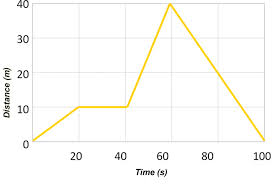
How long did it take this object to travel back to its reference/starting point?
a)
20 s
b)
30 s
c)
60 s
d)
100 s
26.
At 60 seconds, how far had this object traveled? 
a)
0 m
b)
10 m
c)
20 m
d)
40 m
27.
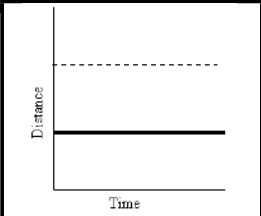
What does this graph represent?
a)
Constant speed
b)
Acceleration
c)
Not moving
28.
What is happening at D?
a)
Stationary
b)
Accelerating
c)
Fast steady speed; moving away from the starting position
d)
Slower steady speed; moving away from the starting position
29.
What is happening at C?
a)
Stationary
b)
Accelerating
c)
Fast steady speed; moving away from the starting position
d)
Slower steady speed; moving away from the starting position
30.
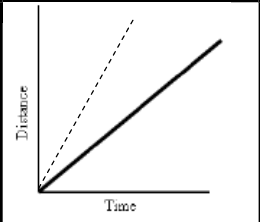
What does this graph represent?
a)
Constant speed
b)
Acceleration
c)
Not moving
31.
How long did it take this object to travel 10 m?
a)
0 s
b)
10 s
c)
15 s
d)
20 s
32.
Which runner had a head start?
a)
A
b)
B
c)
C
33.
What two measurements are necessary for calculating speed?
a)
Mass and time
b)
Temperature and mass
c)
Mass and distance
d)
Distance and time
34.
A measurement of how fast an object is moving
a)
Velocity
b)
Speed
c)
Vector
d)
Acceleration
35.
Can be measured in meters (m)
a)
Distance
b)
Time
c)
Speed
d)
Acceleration
36.
What does this graph represent?
a)
Constant speed
b)
Acceleration
c)
Not moving
37.

Match the description to the graph:

"The car is coming back."

a)
b)
c)
d)
38.

Match the description to the graph:

"The car is traveling at a constant speed."

a)
b)
c)
d)
39.
What does this graph represent?
a)
Constant speed
b)
Acceleration
c)
Not moving
40.

Segment B-C The bus is _________________.

a)

at rest

b)

returning (to original position)

c)

moving forward

41.

A man left home at 12 noon to go for a cycle ride.

The travel graph represents part of the man’s journey.


What is his distance from home at 1.30pm.

a)

12 km

b)

13 km

c)

14 km

d)

15 km

42.
According to the graph how far does the person travel in the first 5 seconds?
a)
2 m
b)
10 m
c)
0 m
d)
5 m
43.

Segment O-A The bus is _________________.

a)

at rest

b)

returning (to original position)

c)

moving forward

44.

Segment A-B The bus is _________________.

a)

at rest

b)

returning (to original position)

c)

moving forward

45.

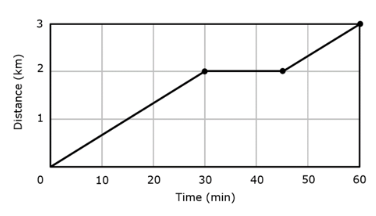
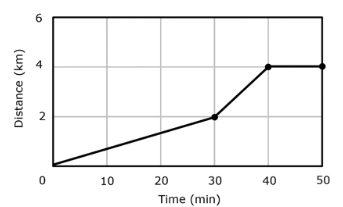
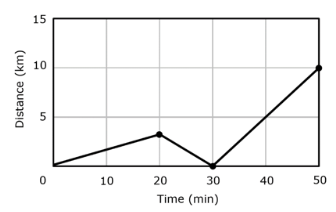
A student walks 2.0 km in a time of 30 minutes. The student then stop for 15 minutes to eat a snack then travels 1.0 km in 15 minutes.

Which graph shows the journey described?
a)
b)
c)
d)
46.

Edward drove 80 miles from his home to London.

He stopped and visited his friend Nicola on the way. Here is the distance-time graph for the journey.


How far was Edward from home when he visited Nicola?

a)

30 miles

b)

40 miles

c)

10 miles

d)

45 miles

47.

Edward drove 80 miles from his home to London.

He stopped and visited his friend Nicola on the way.

Here is the distance-time graph for the journey.


How long did Edward stop for?

a)

2 hours

b)

1 hour

c)

1.2 hours

d)

1.5 hours

48.

Ellie cycled from her home to her friendʼs house.

She stayed at her friendʼs house and then traveled home.


At what time did Ellie leave home?

a)

9:05

b)

9:02

c)

9:00

d)

9:10

49.

Ellie cycled from her home to her friendʼs house.

She stayed at her friendʼs house and then traveled home.


How long did Ellie stay at her friend's house?

a)

10 mins

b)

20 mins

c)

1 hour

d)

15 mins

50.

Anne cycles from Bristol to Salisbury.

The diagram shows the distance-time graph of her journey.


How far from Bristol is Anne at 8:00?

a)

15 miles

b)

20 miles

c)

10 miles

d)

40 miles

51.

Anne cycles from Bristol to Salisbury.

The diagram shows the distance-time graph of her journey.


What is Anne's speed for the first two hours of her journey?

a)

40 mph

b)

30 mph

c)

20 mph

d)

10 mph

52.

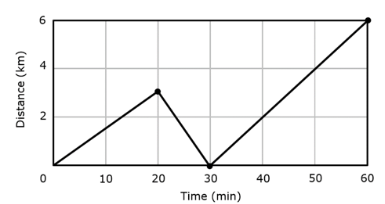
Which part of this graph shows the journey home?

a)

A

b)

B

c)

C

53.

The simple equation for average speed is:


total distance travelled/total time taken total time taken/total distance travelled total distance travelled + total time taken total distance travelled × total time taken

a)

total distance travelled/total time taken

b)

total time taken/total distance travelled

c)

total distance travelled + total time taken

d)

total distance travelled × total time taken

54.
Which runner won the race?
a)
A
b)
B
c)
C
55.

Which is faster?

a)

walking

b)

skating

c)

biking

56.

the rate at which speed or velocity changes

a)

acceleration

b)

average speed

c)

motion

d)

reference point

57.

Is this a speed or acceleration graph?

a)

speed

b)

acceleration

58.

What is happening at segment E?

a)

acceleration

b)

deceleration

c)

constant speed

d)

no motion/object at rest

59.

A helicopter flies west 200 miles in 2 hours. What is its velocity?

a)

99 mph

b)

100 mph south

c)

400 mph south

d)

297 mph south

60.
The metric unit for acceleration is ______.
a)
m
b)
m/s
c)
m/s2
d)
s
61.
Which graph shows the object standing still?
a)
A
b)
B
c)
C
d)
D
62.
A box sliding down an inclined plane attains a velocity of 27 m/s in 3 seconds from rest.  Find the acceleration.
a)
30 m/s
b)
24 m/s2
c)
9 m/s2
d)
81 km/hr
63.
Which graph represents zero acceleration (constant velocity)?
a)
A
b)
B
c)
C
d)
D
64.
A roller coasters accelerates from an initial velocity of of 6.0 m/s to a final velocity of 70 m/s over 4 seconds.  What's the acceleration?
a)
24 m/s2
b)
18 m/s2
c)
16 m/s2
d)
16 m/s
65.
Which of the following is a unit for acceleration?
a)
km/s
b)
m/s2
c)
mi/hr
d)
ft
66.
Calculate the average speed (in meter/sec) if a cheetah runs 180 meters in 10 seconds.
a)
198 m/sec
b)
170 m/sec
c)
12 m/sec
d)
18 m/sec
67.
Acceleration is defined as the CHANGE in 
a)
time it takes for one place to move to another place. 
b)
velocity of an object.
c)
distance divided by the time interval 
d)
velocity divided by the time interval 
68.
John Cena’s speed increases from 15 m/s to 25 m/s as he runs downhill over a 5 second period.
a)
2 m/s²
b)
10 m/s²
c)
8 m/s²
d)
2 m/s
69.

What type of acceleration is shown in the graph?

a)

positive

b)

negative

c)

centripetal

d)

Zero

70.

Suppose your bike accelerates from 2 m/s to 11 m/s in 3 seconds. What is your average acceleration?

a)

3 m/s

b)

-3 m/s/s

c)

3 mph

d)

3 m/s/s

e)

4.5 m/s/s

71.

Forces that are exerted on an object which are equal in size but opposite in direction

a)

Unbalanced force

b)

Balanced force

72.

Applied forces on an object are unequal in size but are the same or opposite in direction

a)

Unbalanced force

b)

Balanced force

73.

An airplane taking off

a)

Unbalanced force

b)

Balanced force

74.
What is the net force?
a)
40 N left
b)
0 N Balalnced
c)
400 N right
d)
40 N right
75.
What is the net force?
a)
400 N Up
b)
400 N Down
c)
- 400 N Down
d)
800 N Down
76.

Which of the following is an example of an unbalanced force?

a)
b)
c)
d)
77.

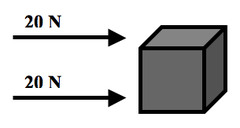
Calculate the resultant force.

a)

40N, Left

b)

40N, Right

c)

0N, Balanced

d)

75N, Right

78.
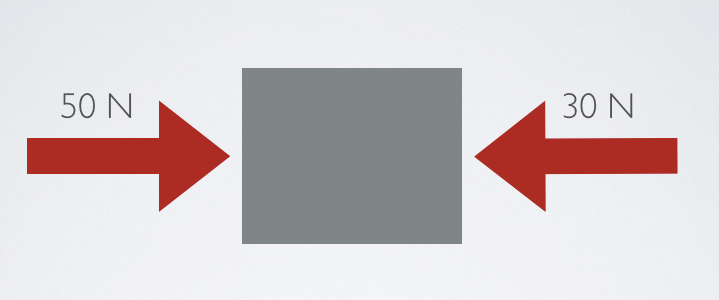
What is the net force?
a)
17 N Right
b)
3 N Right
c)
3 N Left
d)
17 N Left
79.
How will this object move? 
a)
It won't move. 
b)
It will move to the right. 
c)
It will move to the left. 
d)
It will move up. 
80.
How will this object move? 
a)
It won't move. 
b)
It will move to the right. 
c)
It will move to the left. 
d)
It will move in both directions. 
81.
What is the net force?
a)
30 N left
b)
25 N right
c)
5 N left
d)
55 N right
82.
You and your dad are moving the couch from one side to another. Your dad pushes with a force of 35 N to the right and you push with a force of 25 N right. What is the net force on the couch?
a)
60 N right
b)
10 N left
c)
60 n right
d)
50 N left
83.
What is the net force?
a)
10 N
b)
0 N
c)
25 N
d)
1 N
84.

These forces are...

a)

Balanced

b)

Unbalanced

85.
Balanced or unbalanced?
a)
balanced
b)
unbalanced
86.

What is the formula for calculating moments?

a)

mass multiplied by acceleration

b)

force multiplied by distance

c)

velocity multiplied by time

d)

pressure multiplied by area

87.

A beam is supported by two pillars. If the beam is 6 meters long and the distance from one pillar to the other is 4 meters, what is the force exerted on each pillar if the beam carries a weight of 200 N at its center?

a)

250 N

b)

150 N

c)

50 N

d)

100 N

88.

A lever is used to lift a heavy object. If the effort force applied to the lever is 50 N and the distance from the fulcrum to the effort force is 2 meters, what is the weight of the object being lifted if the distance from the fulcrum to the weight is 4 meters?

a)

50 N

b)

100 N

c)

200 N

d)

25 N

89.

The units for moments are...

a)

Newtons (N)

b)

Metres (m)

c)

Newton Metres (Nm)

d)

Newtons per Metre (N/m)

90.

The weight of the barrel is (a)   N

91.
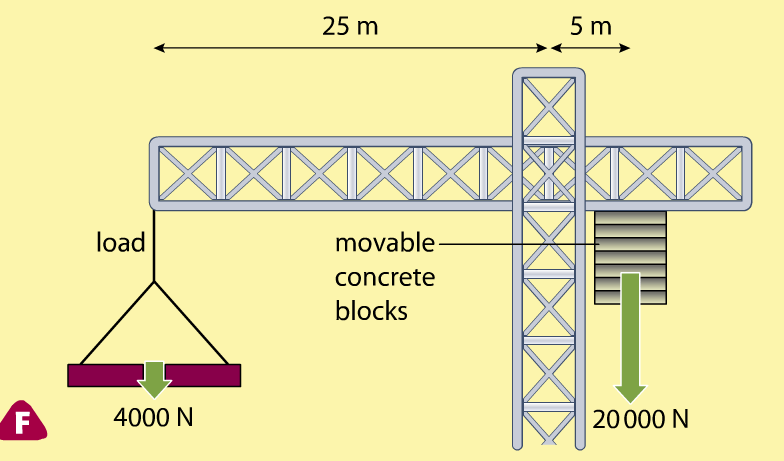
What is the anticlockwise moment acting on this crane?
a)
80,000Nm
b)
100,000Nm
c)
120,000Nm
d)
140,000Nm
92.
What is the moment acting on the seesaw?
a)
1.6Nm
b)
15Nm
c)
16N
d)
4Nm
93.

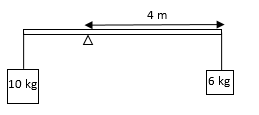
Two masses of mass 10.0 and 6.0 kg are hung from massless strings at the end of a light rod. The rod is virtually weightless. A pivot (fulcrum) is placed off center and the system is free to rotate. If the 6.0 kg mass is 4.0 m away from the pivot, how far away is the 10.0 kg mass if the system is not rotating?

a)

0.42 m

b)

2.4 m

c)

4.8 m

d)

4.2 m

94.
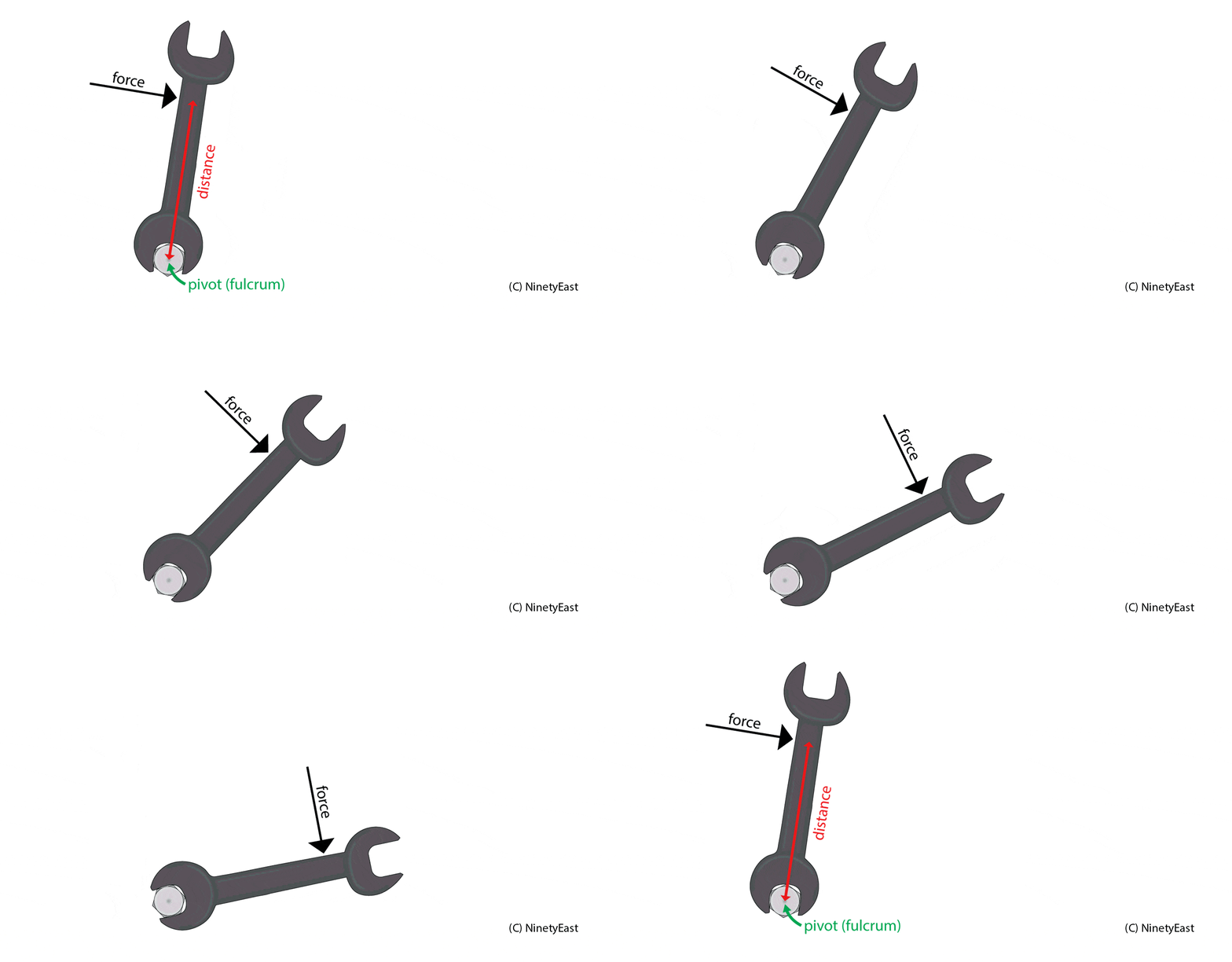
A wrench is used to tighten a nut. A 15N perpendicular force is applied 50cm away from the axis of rotation, and moves a distance of 10 cm as it turns. What is the torque applied to the wrench?
a)
7.5 Nm
b)
1.5 Nm
c)
750 Nm
d)
150 Nm
95.

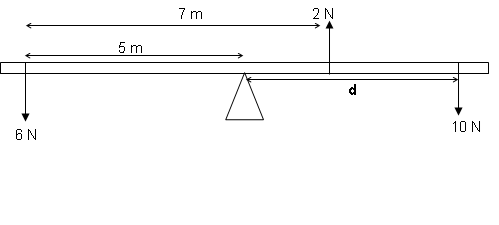
Assuming the system is in equilibrium, calculate the missing distance d

a)

3.4 m

b)

2.8 m

c)

4.4 m

d)

1.6 m

96.

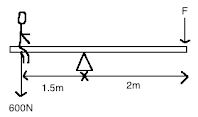
A boy of weight 600N sits on the see-saw as shown at a distance of 1.5m from the pivot. What is the force F required at the other end to balance the see-saw?

a)

450 N

b)

350 N

c)

4.5 N

d)

200 N

97.

What to we call forces applied to anything that turns?

a)

Minute

b)

Moment

c)

Minimum

d)

Monument

98.

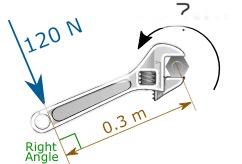
What is the size of the moment shown by the black arrow?

a)

30 Nm

b)

36 Nm

c)

40 Nm

d)

60 Nm

99.
If density of air is high, pressure is:
a)
high
b)
low
100.
More molecules close together, means density is:
a)
high
b)
low
101.
What is the equation used to calculate pressure?
a)
pressure= force/mass
b)
pressure =mass/volume
c)
pressure=area/force
d)
pressure=force/area
102.
What is the unit of measurement for pressure?
a)
pascal
b)
grams
c)
milliters
d)
meters
103.
Look at the pressure triangle. How do we calculate the area?
a)
f ÷ a
b)
f x p
c)
p x f
d)
f ÷ p
104.
What pressure does a 4000N horse exert on the ground if each foot is 10cm2?
a)
40 N/cm2
b)
100 N/cm2
c)
400 N/cm2
d)
10 N/cm2
105.
A person wearing steel toe capped boots and a person wearing stilleto heels stand on a wooden floor. They both have the same weight. Which person exerts a greater pressure on the floor?
a)
The person wearing the boots because the boots have a larger surface area in contact with the floor
b)
The person with the stiletto heels because they have a larger surface area in contact with the floor
c)
The person wearing the boots because the boots have a smaller surface area in contact with the floor 
d)
The person with the stiletto heels because they have a smaller surface area in contact with the floor
106.
Which of the statements is true?
a)
The bottom of the boot exerts more pressure than the shoe as a result of an increase in surface area.
b)
The bottom of the shoe exerts more pressure than the boot as a result of an decrease in surface area.
c)
The bottom of the shoe exerts the same pressure as the bottom of the boot.
107.
Army tank tracks are useful for travelling through the mud because..
a)
they decrease the force the vehicle exerts on the ground
b)
they increase the force the vehicle exerts on the ground
c)
they decrease the pressure the vehicle exerts on the ground
d)
they increase the pressure the vehicle exerts on the ground
108.
Which of these animals would probably cause the greatest pressure on the ground?
a)
A fat cow with big feet
b)
A fat cow with small feet
c)
 A calf with big feet
d)
A calf with small feet
109.
Convert 10 kg to Newtons
a)
0.098 N
b)
4.5 N
c)
100 N
d)
98 N
110.
Pressure can be measured in Pascales (Pa) or Newtons per square metre.
1 Pa = 1N/m2
a)
True
b)
False
111.
The pressure resulting from a force of 50 N exerted over an area of 5 m2 is
a)
10 N
b)
0.1 N
c)
10 N/m2
d)
0.1 Pa
112.

Pressure in gases is a measure of:

a)

the number of collisions per second of the particles with the side of the container.

b)

the force of the collisions of the particles with the side of the container.

c)

the amount of space taken up by the particles in the container.

d)

None of the above

113.

Pressure can be exerted by solids, liquids and gases.

a)

TRUE

b)

FALSE

114.

The pressure inside the balloon will:

a)

Decrease

b)

Increase

c)

Remain the same

d)

Not enough information to formulate an answer

115.

This is an example of the everyday application of pressure in:

a)

Solids

b)

Liquids

c)

Gases

d)

Plasma

116.

We can increase the pressure of a gas by:

a)

Adding more gas.

b)

Reduce the volume of the container.

c)

Increase the temperature of the gas.

d)

None of the above answers.