wayground logo

Free Printable Worksheets

Font size

S
M
L
XL
Worksheets

PS2.3-PS2.5: Describing Motion & Newton's Laws

Total questions: 111

Worksheet time: 2hrs 6mins

Name
Class
Date
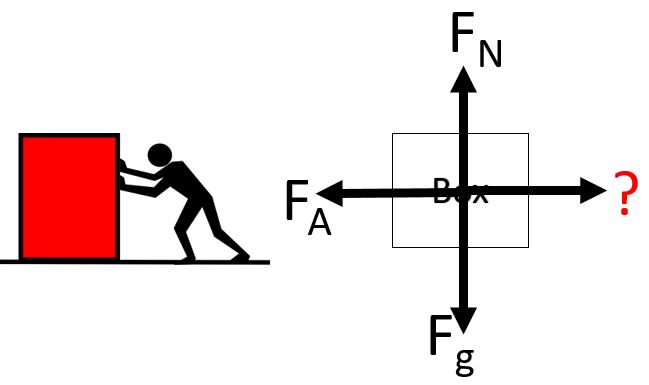
1.
Name the missing force....
a)
weight force
b)
normal force
c)
frictional force
d)
tension force
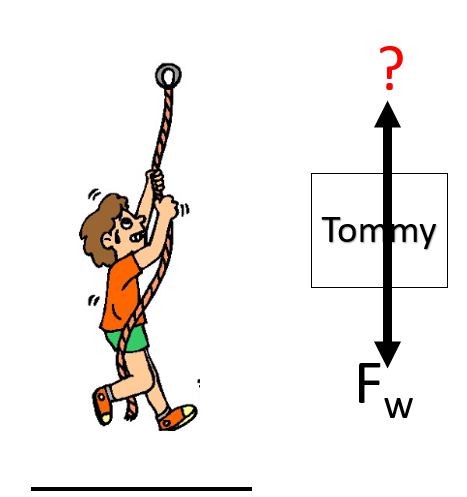
2.
Name the missing force...
a)
frictional force
b)
weight force
c)
thrust
d)
buoyant force
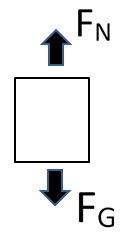
3.
Name the missing force...
a)
tension force
b)
gravitational force
c)
normal force
d)
applied force
4.
What is the net force?
a)
5000 N right
b)
4000 N right
c)
40 N left
d)
4000 N left
5.
What is the net force in this diagram?
a)
8N right
b)
2 N right
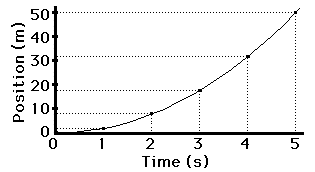
c)
8N left
d)
2N left
6.
What is the net force of an object that is not moving?
a)
0N
b)
100N
c)
Upward force
7.
What is the net force in this picture?
a)
50 Newtons to the right
b)
950 Newtons to the right
c)
950 Newtons to the left
d)
50 Newtons to the left
8.
What makes a rolling ball stop moving?
a)
gravity
b)
friction
c)
a balanced force
9.
Forces that have a net force of zero ( the object is still).
a)
Balanced force
b)
Unbalanced force
10.
8 N to the left , and 4 N to the right. Find the net force. Is this balanced 
a)
12 N Right  No
b)
4 N Left  No
c)
12 N Right  Yes
d)
4 N Left  Yes
11.
If these boys are pulling with the same amount of force.  What will happen?
a)
The boy in blue will win.
b)
They will not move at all.
c)
The boy in red will win.
d)
Both will fall down.
12.
Match description with free-body diagram.
a)
A book is at rest on a tabletop.
b)
A gymnast holding onto a bar, is suspended motionless in mid-air. The bar is supported by two ropes that attach to the ceiling. Diagram the forces acting on the combination of gymnast and bar.
c)
An egg is free-falling from a nest in a tree. Neglect air resistance.
d)
A flying squirrel is gliding (no wing flaps) from a tree to the ground at constant velocity. Consider air resistance.
13.
Match description with free-body diagram.
a)
A rightward force is applied to a book in order to move it across a desk with a rightward acceleration. Consider frictional forces. Neglect air resistance. 
b)
A rightward force is applied to a book in order to move it across a desk at constant velocity. Consider frictional forces. Neglect air resistance. 
c)
A college student rests a backpack upon his shoulder. The pack is suspended motionless by one strap from one shoulder. 
d)
A skydiver is descending with a constant velocity. Consider air resistance.
14.
Match description with free-body diagram.
a)
A rightward force is applied to a book in order to move it across a desk with a rightward acceleration. Consider frictional forces. Neglect air resistance. 
b)
A rightward force is applied to a book in order to move it across a desk at constant velocity. Consider frictional forces. Neglect air resistance. 
c)
A college student rests a backpack upon his shoulder. The pack is suspended motionless by one strap from one shoulder. 
d)
A skydiver is descending with a constant velocity. Consider air resistance.
15.
What is the magnitude (size) and direction of the net force?
a)
10 N to the Right
b)
10 N to the Left
c)
0 N
d)
8 N to the Left
16.

The best way to label a push or a pull on a diagram is to use

a)
b)
c)
d)
17.

What is the appropriate way to indicate Gravity in a diagram?

a)
b)
c)
d)
18.

Which of the following is true about this free-body diagram?

a)

the forces are are balanced

b)

the object is free-falling

c)

the object is moving upward

d)

the forces are unbalanced

19.

What is the net force on the block?

a)

balanced, the net force is 0

b)

unbalanced, the net force is 5 N up

c)

unbalanced, the net force is 5 N down

d)

Unbalanced, the net force is 5 N sideways

20.

What is the net force on the cart?

a)

balanced, the net force is 0

b)

unbalanced, the net force is 50 N up

c)

unbalanced, the net force is 50 N left

d)

Unbalanced, the net force is 50 N right

21.

You push backwards on the Earth. What is the reaction?

a)

The Earth pushes forward on you

b)

You move

c)

The Earth pushes up on you

d)

Gravity pulls you down

22.
You push on a tree with 20 N of force. If the tree doesn't move, the tree is pushing back on you with _____of force.
a)
20N 
b)
40N 
c)
10N 
d)
70N
23.
Calculate the net force acting upon the object.
a)
10 N north
b)
20 N south
c)
10 N south
d)
22.4 N north
24.

What do two EQUAL forces on OPPOSITE sides of a free body diagram do when you are calculating net force?

a)

Cancel each other out

b)

Double the net force

c)

Cut the net force in half

d)

They do not affect the net force.

25.
Calculate the net force acting upon the object.
a)
10 N east
b)
0 N
c)
14.1 N east
d)
20 N north
26.
Why is force a vector quantity?
a)
Because it has magnitude
b)
Because it is a vector
c)
Because it has direction
d)
Because it has magnitude and direction
27.

When an unbalanced force acts on an object, the force ______________________.

a)

changes the motion of the object

b)

is cancelled by another force

c)

does not change the motion of an object

d)

is equal to the weight of the object
28.
Ms. Schmidt comes in the morning and moves a box of textbooks to the right with 50 N of force. Mr. Jensen comes in the afternoon and moves the same box of textbooks to the left with 150 N of force. What is the net (resultant) force?
a)
200 N
b)
100 N left
c)
100 N right
d)
0 N
29.
When forces are balanced an object can be stationary or 
a)
slowing down
b)
speeding up
c)
moving at a constant speed
d)
accelerating
30.
Which causes accelerations?
a)
Balanced forces
b)
Unbalanced forces
c)
Changes in velocity
d)
Equilibrium
31.
The acceleration of an object is directly proportional to the _______ the object.
a)
mass of
b)
momentum of
c)
net force on
d)
magnitude of
32.
Jenny applies a 60 N force to a 20 Kg cart, what is the acceleration of the cart if friction can be neglected?
a)
1200 m/s/s
b)
0.33 m/s/s
c)
20 m/s/s
d)
3 m/s/s
33.
A cannonball with a mass of 0.5 kg is flying at an acceleration of 10 m/sec/sec. What is it's force?
a)
50 Newtons
b)
5 Newtons
c)
20 Newtons
d)
9.5 Newtons
34.
Calculate the Acceleration.
a)
20
b)
5
c)
.2
d)
80
35.
Calculate the Acceleration.
a)
8
b)
1
c)
.125
d)
5
36.
Calculate the net force.
a)
16 N
b)
4 N
c)
.25 N
37.
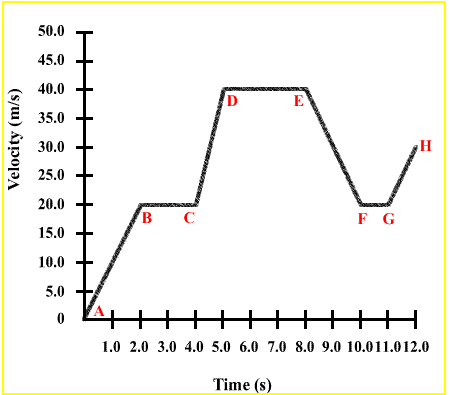
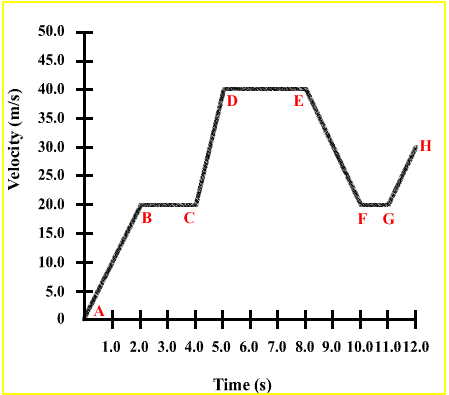
Which section of the graph shows constant velocity?
a)
AB
b)
BC
c)
EF
d)
GH
38.
Which section of the graph shows acceleration?
a)
AB
b)
BC
c)
EF
d)
FG
39.
Which section of the graph shows deceleration?
a)
AB
b)
BC
c)
EF
d)
GH
40.
Which section of the graph shows increasing velocity?
a)
AB
b)
BC
c)
DE
d)
EF
41.
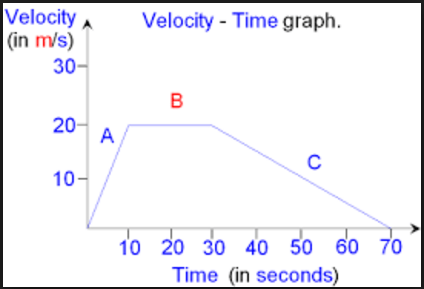
This is a velocity-time graph.  What is the object doing in segment A?
a)
Positive acceleration
b)
Negative acceleration
c)
Constant Velocity
d)
Not moving
42.
This is a velocity-time graph.  What is the object doing in segment B?
a)
Positive acceleration
b)
Negative acceleration
c)
Constant Velocity
d)
Not moving
43.
What kind of acceleration is shown here?
a)
positive
b)
negative
c)
none
d)
varies
44.
What is the velocity?
a)
positive
b)
negative
c)
decreasing
d)
increasing
45.
Is the speed constant or non-constant?
a)
constant
b)
non-constant
46.
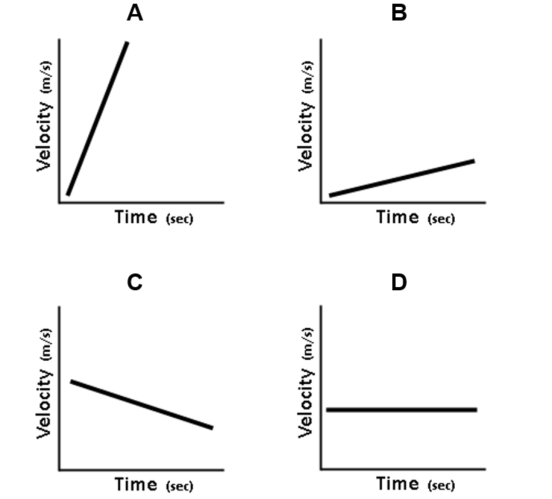
Which graph represents the greatest acceleration?
a)
A
b)
B
c)
C
d)
D
47.
Acceleration is defined as the CHANGE in 
a)
time it takes for one place to move to another place. 
b)
distance of an object.
c)
distance divided by the time interval 
d)
velocity over a time period 
48.
Which best describes the speed for the object?
a)
constant speed
b)
not moving
c)
speed increasing
d)
speed increasing at a constant rate
49.
What happened during C to D point?
a)
not moving
b)
increasing speed at a constant rate
c)
moving at a constant speed
d)
moving at 5 m/sacceleration
50.
In reference to speed, describe speed during A to B?
a)
not moving
b)
increasing speed at a constant rate
c)
moving at a constant speed
d)
moving at 10 m/sacceleration
51.

The velocity-time table represents the motion of a motorcycle as it moves from left to right.

Is the motorcycle accelerating?

a)

yes

b)

no

52.
a)
b)
c)
d)
53.
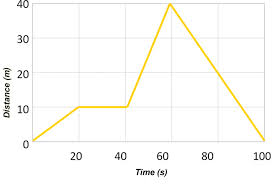
How long did it take this object to travel 10 m?
a)
0 s
b)
10 s
c)
15 s
d)
20 s
54.
What is happening in this graph from point B to C?
a)
The object is going down a hill.
b)
The object is returning to its starting location.
c)
The object is slowing down.
d)
The object is staying still.
55.
What is this graph showing?
a)
Constant Speed
b)
Acceleration (speeding up)
c)
Deceleration (slowing down)
d)
No motion
56.
What is the motion of the object?
a)
+ constant velocity to the right (no acceleration)
b)
- constant velocity to the right (no acceleration)
c)
+ constant velocity to the left (no acceleration)
d)
- constant velocity to the left (no acceleration)
57.
What is the motion of the object?
a)
+ velocity to the right (no acceleration)
b)
- velocity to the left (no acceleration)
c)
 + velocity to the right, speeding up
d)
+ velocity to the right, slowing down
58.
What is the motion of the object?
a)
+ constant velocity to the right (no acceleration)
b)
- constant velocity to the right (no acceleration)
c)
+ constant velocity to the left (no acceleration)
d)
- constant velocity to the left (no acceleration)
59.
What is the motion of the object?
a)
+ velocity to the right, slowing down
b)
- velocity to the left, slowing down
c)
- velocity to the left, speeding up
d)
+ velocity to the right, speeding up
60.
The picture of the position vs. time graph shows an object that is...
a)
accelerating/speeding up
b)
moving at a constant speed 
c)
not moving 
d)
accelerating/slowing down. 
61.
What is the velocity?
a)
0 m/s
b)
positive m/s
c)
negative m/s
d)
decreasing
62.
LT4: The graph shows Ashley riding her bike to Maria's house. 
What was occurring from point B to point C?
a)
She was increasing her speed.
b)
She stopped for 4 minutes
c)
She was decreasing in speed
63.
LT4: The graph shows Ashley riding her bike to Maria's house. 
What is occurring from point A to point B?
a)
they are traveling at a constant speed
b)
they are decreasing in speed
c)
they stopped to take a break
64.
This graph shows
a)
An object stopped
b)
An object slowing down
c)
An object speeding up
d)
An object moving at constant speed
65.
This graph shows
a)
An object stopped
b)
An object speeding up
c)
An object slowing down
d)
An object moving at constant speed
66.
This graph shows
a)
An object stopped
b)
An object moving at constant speed
c)
An object slowing down
d)
An object speeding up
67.
This graph shows
a)
An object speeding up
b)
An object slowing down
c)
An object stopped
d)
An object moving at constant velocity
68.
This graph shows
a)
An object stopped
b)
An object slowing down
c)
An object speeding up
d)
An object moving at constant speed
69.
This graph shows
a)
An object speeding up
b)
An object slowing down
c)
An object stopped
d)
An object moving at constant speed
70.
If gravity between the Sun and Earth suddenly vanished, Earth would continue moving in 
a)
a curved path.
b)
an outward spiral path. 
c)
an inward spiral path. 
d)
a straight line. 
71.
What is the acceleration of an object in free fall at Earth's surface? 
a)
10 m/s2, or more precisely, 9.8 m/s2
b)
100,000 m/s2
c)
v = d/t
d)
-100 N
72.

Which one of the graphs represents a car whose speed is increasing?

a)

A

b)

B

c)

A and B

d)

C

e)

D

73.

Which graph shows a car standing still?

a)

A

b)

B

c)

C

d)

D

74.

Which graph represents a car whose speed is decreasing?

a)

A

b)

B

c)

C

d)

D

75.
Which of the following is speeding up?
a)
1
b)
2
c)
3
d)
4
76.
Which of the following has the fastest constant speed?
a)
1
b)
2
c)
3
d)
4
77.
Which of the following examples shows the car coming to a stop then speeding up slowly?
a)
B
b)
C
c)
D
d)
E
78.
What is the best way to describe what is happening number 1?
a)
The car is slowing down
b)
The car is traveling at the same speed. 
c)
The car is speeding up
d)
The car is changing direction
79.
What is the best description for car A in the following diagram?
a)
The car is speeding up at a constant acceleration
b)
The car is moving at a constant velocity.
c)
The car is slowing down
d)
The car is not driving
80.

These graphs both represent:

a)

decreasing speed

b)

constant speed

c)

acceleration

d)

object at rest

81.

which of the following graphs best illustrates someone travelling at a constant speed?

a)
b)
c)
d)
82.
What is the net force?
100 N        230 N
<------        --------->
a)
30 N to the right
b)
230 N to the right
c)
130 N to the right
d)
This is a balanced force
83.
What is the Net Force?
a)
5 N to the right
b)
10 N to the right
c)
15 N to the right
d)
0 N
84.
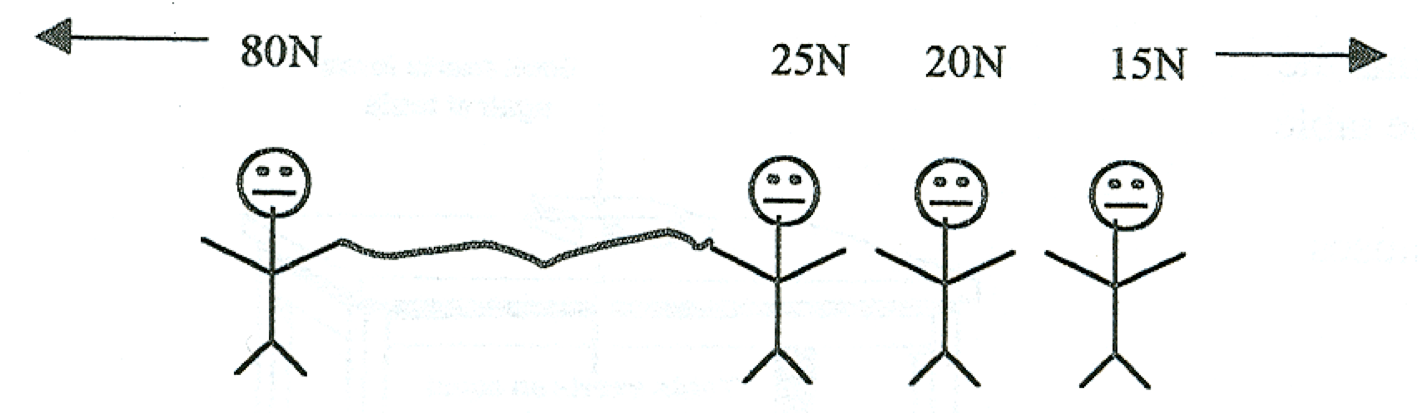
Who wins the tug of war with what net force?
a)
The person on the left with 20 N
b)
The person on the left with 80 N
c)
The people on the right with 20 N
d)
The people on the right with 100 N
85.
When velocity is represented as a vector _____. 
a)
the length of the arrow represents the speed
b)
the length of the arrow is drawn to a suitable scale
c)
the direction of the arrow shows the direction of motion
d)
all of these answers
86.

When an object is in equilibrium which of the following is true

a)

a) the object's acceleration is greater than zero.

b)

b) the net force is zero

c)

c) the object is accelerating

d)

a & b

e)

a & c

87.
Two objects - one with mass m and the other with mass 2m - are released from rest at the same height. Which object hits the ground first?
a)
mass m
b)
mass 2m
c)
both objects hit the ground at the same time
d)
unable to determine with information given
88.

The graph above represents the motion of a car. Based on the graph, the car is most

likely—

a)

driving up a steep hill

b)

speeding up

c)

driving at constant speed

d)

decelerating

89.

Which pair of graphs represents the same motion of an object?

a)
b)
c)
d)
90.

Which One of Newton's Laws does this apply to?


The need for a head rest in a car.

a)

Newton's 1st law

b)

Newton's 2nd law

c)

Newton's 3rd law

91.

Which One of Newton's Laws does this apply to?


It takes more force to move a loaded wagon than it does to move an empty wagon.

a)

Newton's 1st law

b)

Newton's 2nd law

c)

Newton's 3rd law

92.

Which One of Newton's Laws does this apply to?


A rocket ship being launched.

a)

Newton's 1st law

b)

Newton's 2nd law

c)

Newton's 3rd law

93.
  1. Which One of Newton's Laws does this apply to?


Seat belts are needed in a car.

a)

Newton's 1st law

b)

Newton's 2nd law

c)

Newton's 3rd law

94.
A magician pulls a table cloth from under a table of dishes.
a)
Newton's
1st
Law of Motion
b)
Newton's
2nd
Law of Motion
c)
Newton's
3rd
Law of Motion
95.
The harder you hit a baseball, the faster it accelerates.
a)
Newton's
1st
Law of Motion
b)
Newton's
2nd
Law of Motion
c)
Newton's
3rd
Law of Motion
96.
You push against a wall and the wall is pushing back on you.
a)
Newton's
1st
Law of Motion
b)
Newton's
2nd
Law of Motion
c)
Newton's
3rd
Law of Motion
97.
The acceleration of a 4 kg bowling ball will be greater than the acceleration of a 6 kg bowling ball if the same force is applied to both.
a)
Newton's
1st
Law of Motion
b)
Newton's
2nd
Law of Motion
c)
Newton's
3rd
Law of Motion
98.
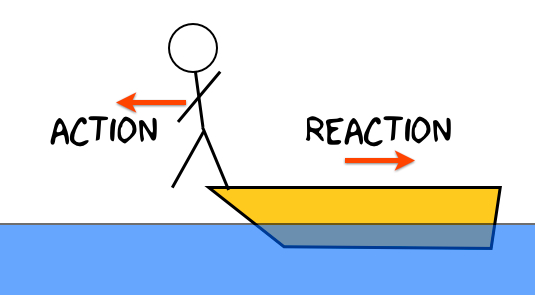
What law of motion does this picture represent?
a)
Newtons 1st law
b)
Newtons 4th law 
c)
Newtons 3rd law 
d)
Newtons 2nd law
99.
Mr. Gammon and Batman have a tug-of-war competition. Mr. Gammon pulls on the rope with a force of 30 Newtons to the left. Batman pulls on the rope with a force of 25 Newtons to the right. What is the net force on the rope?
a)
5 Newtons to the left
b)
5 Newtons
c)
55 Newtons
d)
55 Newtons to the left
100.

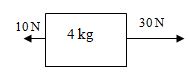
If the box shown has a mass of 3 kg, its acceleration will be

a)

1 m/s2 to the left

b)

1 m/s2 to the right

c)

6.3 m/s2 to the right

d)

9 m/s2 to the right

101.
The moon and other satellites rotate around the earth. Identify the force that keeps these satellites in orbit.
a)
centripetal force due to gravity
b)
friction in space
c)
a strong force
d)
electromagnetic force
102.
What is the net force?
a)
17 N Right
b)
3 N Right
c)
3 N Left
d)
17 N Left
103.
When an unbalanced force acts on an object, the force...
a)
Changes the motion of the object
b)
Is canceled by another force 
c)
Does not change the motion of the object 
d)
Is equal to the weight of the object 
104.
What is the net force?
a)
400 N Up
b)
400 N Down
c)
- 400 N Down
d)
800 N Down
105.
Balanced or Unbalanced?
a)
Balanced 
b)
Unbalanced
106.
What is the net force?
a)
10 N
b)
0 N
c)
25 N
d)
1 N
107.
How will this object move? 
a)
It won't move. 
b)
It will move to the right. 
c)
It will move to the left. 
d)
It will move in both directions. 
108.
Which of the following objects has the least acceleration?
a)
a. an empty shopping cart pushed with a hard force
b)
b. a full shopping cart pushed with a hard force
c)
c. an empty shopping cart pushed with a light force
d)
d. a full shopping cart pushed with a light force
109.
Forces that combine produce a net force of zero are _____.
a)
static friction
b)
unbalanced forces
c)
inertia
d)
balanced forces
110.
Forces that combine produce a net force different from zero are _____.
a)
unbalanced forces
b)
sliding friction
c)
balanced forces
d)
fluid friction
111.
_____ can cause an object to change its speed and/or direction.
a)
inertia
b)
balanced forces
c)
momentum
d)
unbalanced forces