
 Worksheets
Chapter 6 Review GAME
Total questions: 55
Worksheet time: 40mins
Myofibrils are composed of _______________ and _____________________ filaments.
sarcolemma, sarcoplasm
Actin, Myosin
ADP, ATP
Collagen, Elastin
What is muscle tone (see page 195)?
The ability of a muscle to maintain a continuous and passive partial contraction.
The maximum force a muscle can exert in a single effort.
The speed at which a muscle can contract.
The endurance level of a muscle during prolonged activity.
A muscle cramp is due to lack of _____ needed to return calcium to the ___________________________.
ATP, sarcoplasmic reticulum
ADP, T-Tubules
oxygen, sarcolemma
potassium, neuron
A partial but sustained contraction is known as muscle ____________.
tone
tetanus
twitch
recruitment
Neurotransmitters are stored in vesicles in the ___________________________.
motor neuron axon terminal
myofibrils
sarcolemma
motor end plate
The amount of oxygen needed to convert lactic acid to glucose is called _____________________.
oxygen debt (defecit)
oxygen surplus
oxygen reserve
oxygen balance
How does smooth muscle contract differently compared to skeletal muscle?
Smooth muscle contracts involuntarily and slowly, while skeletal muscle contracts voluntarily and rapidly.
Smooth muscle contracts voluntarily and rapidly, while skeletal muscle contracts involuntarily and slowly.
Both smooth and skeletal muscles contract involuntarily and rapidly.
Both smooth and skeletal muscles contract voluntarily and slowly.
Actin has binding sites for _____________.
Actin has binding sites for various proteins, including myosin, tropomyosin, and others.
Actin has binding sites for carbohydrates, lipids, and nucleic acids.
Actin has binding sites for vitamins, minerals, and water.
Actin has binding sites for hormones, enzymes, and antibodies.
All-or-none response means: when a fiber _______________, it does so to its _____________ extent.
fires; maximum
fires; minimum
contracts; partial
relaxes; full
A motor unit includes: _______________ and _____________________.
A motor unit includes a motor neuron and the muscle fibers it innervates.
A motor unit includes a sensory neuron and the muscle fibers it innervates.
A motor unit includes a motor neuron and the tendons it connects to.
A motor unit includes a sensory neuron and the tendons it connects to.
The enzyme acetylcholinesterase causes acetylcholine to ___________________.
be broken down.
be synthesized.
be stored in vesicles.
be converted to dopamine.
Muscle fatigue is due to a build-up of ___________________, _________ imbalance, and a lack of ______.
lactic acid, electrolyte, energy
carbon dioxide, protein, oxygen
glucose, mineral, water
ammonia, vitamin, glucose
A muscle that assists a prime mover is a(n) ________________ - example = ____________________
synergist
antagonist
fixator
agonist
A muscle that opposes a prime mover is a(n) ____________________
antagonist
synergist
agonist
fixator
The minimal stimulus needed to elicit a contraction is called _________________________.
minimal stimulus
threshold stimulus
submaximal stimulus
maximal stimulus
The organs of the muscular system are the _____________________.
muscles
bones
nerves
ligaments
How do muscles help maintain body temperature?
They generate heat.
They absorb cold.
They store energy.
They release moisture.
How is cardiac muscle different than smooth muscle?
Cardiac muscle is voluntary, while smooth muscle is involuntary.
Cardiac muscle is striated, while smooth muscle is non-striated.
Cardiac muscle is found in the digestive system, while smooth muscle is found in the heart.
Cardiac muscle has a single nucleus, while smooth muscle has multiple nuclei.
How is cardiac muscle different than skeletal muscle?
Cardiac muscle is voluntary, while skeletal muscle is involuntary.
Cardiac muscle has intercalated discs, while skeletal muscle does not.
Cardiac muscle is multinucleated, while skeletal muscle is not.
Cardiac muscle is attached to bones, while skeletal muscle is not.
Label the Muscle
Perimysium
Epimysium
Endomysium
Myofibril
Myofilament

Skeletal muscle fibers are made up of tiny rods, as pictured in 5, called:
myofibrils
endomysium
muscle fibers
fascicles
Which of the following numbers indicates the location of a muscle fascicle?
1
2
3
4
Which layer of tissue is represented by #1
myofibrils
endomysium
epimysium
fascicles
Which of the following indicates the location of the perimysium?
1
2
3
4


Which label is the muscle fiber?
A
B
C
D

What is another name #1?
Skeletal muscle
Cardiac muscle
Smooth muscle
Myofiber
What is another name #2? (Hint: It is a muscle layer)
Skeletal muscle
Epimysium
Perimysium
Endomysium
What number covers a fascicle?
#6
#5l
#4
#10
Reorder the following from LARGEST structure down to smallest structure
muscle
fascicle
muscle fiber
myofibril
sarcomere
Reorder the following from LARGEST structure down to smallest structure
epimysium
perimysium
endomysium

What structure does letter A represent?
Z disc
I band
A band
Sarcomere
What structure does letter B represent?
Z disc
I band
A band
Sarcomere
What structure does letter C represent?
Z disc
I band
A band
Sarcomere
What structure does letter D represent?
Z disc
I band
A band
Sarcomere

Identify the sarcomere in the diagram above.
A
B
F
G
H

Identify the I band in the diagram above.
A
D
F
G
H

Identify the zone of overlap in the diagram above.
A
D
F
G
H

Identify the structure that the thin filaments are anchored to in the diagram above.
A
B
C
D
E

Identify the structure that the thick filaments are anchored to in the diagram above.
A
B
C
D
E
Which protein(s) is/are found in the thin myofilament? Select all that apply.
actin
myosin
troponin
tropomyosin
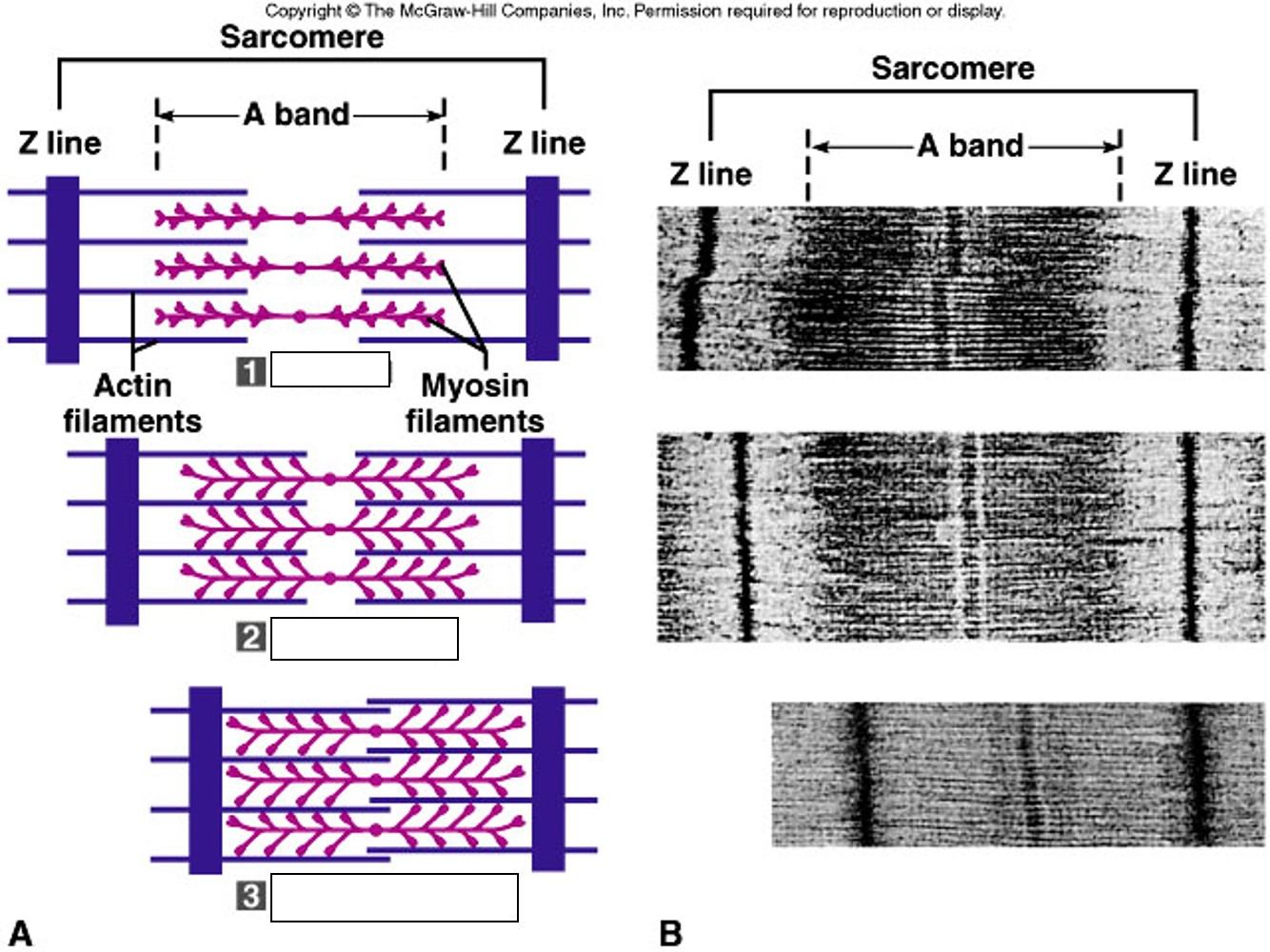
Which of the following does not occur during sarcomere shortening?
I band narrows
A band narrows
H zone narrows
zone of overlap increases

cardiac muscle

smooth muscle

skeletal muscle


