
 Worksheets
Quarter 1 PSSA Review
Total questions: 17
Worksheet time: 9mins



Which statement best explains the importance of fossils to scientists?
Fossils show that animals lived in the same location today as they once did, so scientists know more about today's environment.
Fossils show how animals viewed their surroundings, so scientists know more about past animals.
Fossils show where animals once lived, so scientists know more about the environment and how it has changed.
Fossils show what color animals once were, so scientists know more about what they ate.
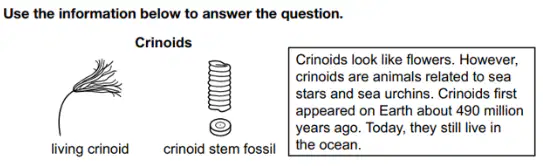
A fossil collector found crinoid fossils. The collector did some research and read the information shown. What can the collector best infer about the area where the fossil was found?
The rocks in the area most likely formed in the last 1,000 years.
The area was most likely also a habitat for sea stars and sea urchins.
The area may once have been the site of an ocean.
The rocks in the area may have been moved from a different location.
Fossils of extinct corals are commonly found in Pennsylvania. Scientists who study these coral fossils indicate that they are similar to living corals. Which statement best explains why these fossils provide valuable information about prehistoric Pennsylvania?
They may provide evidence that Pennsylvania was once covered by warm ocean waters since most corals are presently found in these environments.
They may indicate that the earliest settlers moved inland from the coasts and brought coral-based fertilizer for their crops.
They may provide evidence for evolution by comparing adaptations for living on land with aquatic adaptations in the same species.
They may indicate that corals may have lived on land at some point in history because corals presently live in aquatic environments.
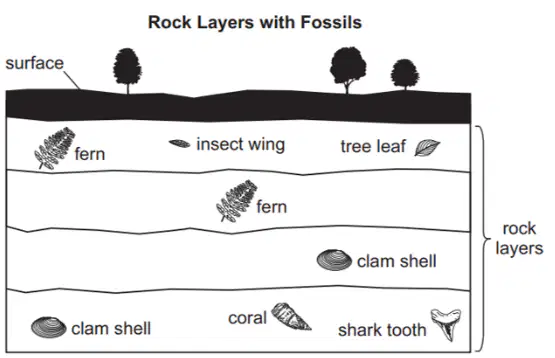
The diagram shows an area where fossils were discovered in different rock layers. Which sequence best represents how the environment in this area changed over time?
dry land → ocean
ocean → dry land → ocean
dry land → ocean → dry land
ocean → dry land

