
 Worksheets
Periodic Trends
Total questions: 40
Worksheet time: 40mins
Of the halogens, which has the smallest radius?
F
Br
He
At
Which of the following will have a higher electronegativity than arsenic (As)?
Carbon (C)
Neon (Ne)
Antimony (Sb)
Germanium (Ge)

What is one-half the distance between the nuclei of identical atoms that are bonded together?
atomic radius
atomic diameter
atomic width
atomic length

What is the amount of energy required to remove an electron from an atom?
atomic energy
ionization energy
ionic energy
electron energy

What is a positively-charged ion which forms when an atom loses electrons?
atom
ion
cation
anion

What is a measure of the tendency of an atom to attract a bonding pair of electrons when the atom is in a compound?
ionization energy
electropositivity
electronegativity
electron energy

What is a negatively-charged ion which forms when an atom gains electrons?
cation
anion
electron
ion

What is a vertical (up and down) column in the periodic table?
group or family
period
periodic law
octet rule
Vertical columns of elements (families) on the periodic table with similar properties
period
row
groups
quadrants
If a potassium atom lost one electron, it becomes an ion. What would be the symbol for that ion?


Select all the nonmetals (choose all that apply)
H
P
In
Na
Which is true regarding the element in period 2, group 8?
small atomic radius, low electronegativity, low ionization energy
small atomic radius, no electronegativity, high ionization energy
small atomic radius, high electronegativity, high ionization energy
large atomic radius, low electronegativity, high ionization energy
Which atom is larger?
Fe+2
Fe+3
Fe
Which atom is larger?
N-3
N
N-2
Which atom is larger?
Ca+2
Ca
Ca+1
Which atom is larger?
P-2
P-1
P
Which list of elements from group 2 on the periodic table is arranged in order of increasing atomic radius?
Be, Mg, Ca
Ca, Mg, Be
Ba, Ra, Sr
Sr, Ra, Ba
The common charge on an atom in group 17 would be....
+1
+7
-7
-1
17
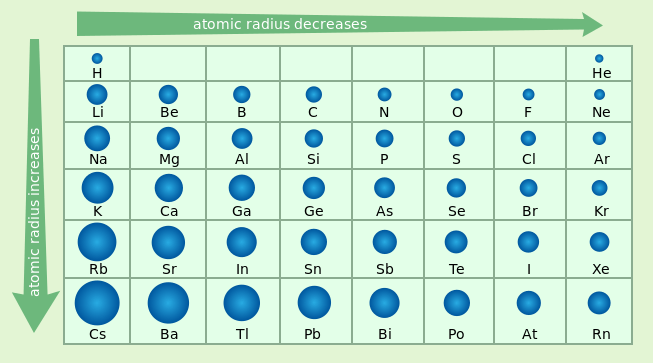


When atom loses an electron, the size will
be greater
increase
have no change
be smaller
When atom gains an electron, the size will
increase
decrease
have no change
smaller
The ability to attract an electron in a chemical bond
electronegativity
electron affinity
metallic character
ionization energy
Which atom has the smallest metallic character?
O
Ba
Co
K
Fluorine has a smaller atomic radius than B because...
F has more valence e- than B
F has more shielding than B
F has a larger atomic number than B
F has a greater effective nuclear charge than B
Cl or Ar

How many electrons can be held in the 2nd energy level (shell)?
2
6
8
18

