
 Worksheets
Lopez Unit 2B Review
Total questions: 69
Worksheet time: 4hrs 11mins

What is the name for this quadratic function?
basic function
parent function
sister function
Coach Lopez's function
What is the equation for this quadratic function?
y=(x+2)2
y=2x
y=x2
y+2=x
What is the vertex of the parent function?
y = x2
(10, 10)
0
(0, 0)

How has the new function (in red) transformed from the parent function?
stretched by 3
shifted down by 3
reflected
shifted right by 3
What is the equation of the transformed function (in red)?
y = (x−3)2
y = (x+3)2
y = 3x
y = x2 + 3
What is the vertex of the transformed function (in red)?
(0, 0)
(3, 0)
(0, 3)
(3, 3)

How has the new function (in red) transformed from the parent function?
stretched by 4
shifted down by 4
reflected
shifted right by 4

What is the equation of the transformed function (in red)?
y = (x−4)2
y = (x+4)2
y = −4x2
y = x2 − 4

What is the vertex of the transformed function (in red)?
(0, 0)
(4, 0)
(0, -4)
(-4, 0)

How has the new function (in red) transformed from the parent function?
compressed and reflected
reflected and shifted down
stretched and shifted down
stretched and reflected
What is a possible equation for the transformed function (in red)?
y = −x2 − 5
y = −5x2
y = −(5−x)2
y = −51x2
What is the vertex of the transformed function (in red)?
(0, -5)
(-5, 0)
(0, 0)
(5, -5)
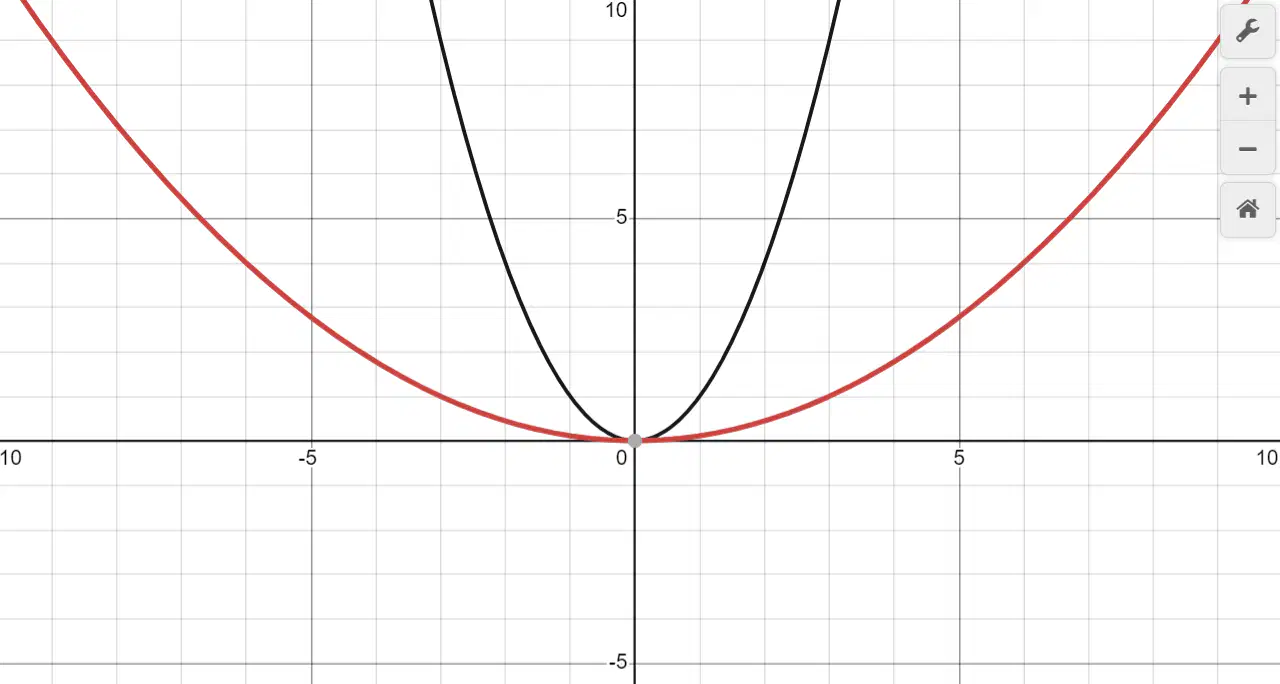
How has the new function (in red) transformed from the parent function?
compressed
reflected
stretched
shifted down

What is a possible equation for the transformed function (in red)?
y = x2 − 9
y = −9x2
y = −91x2
y = 91x2
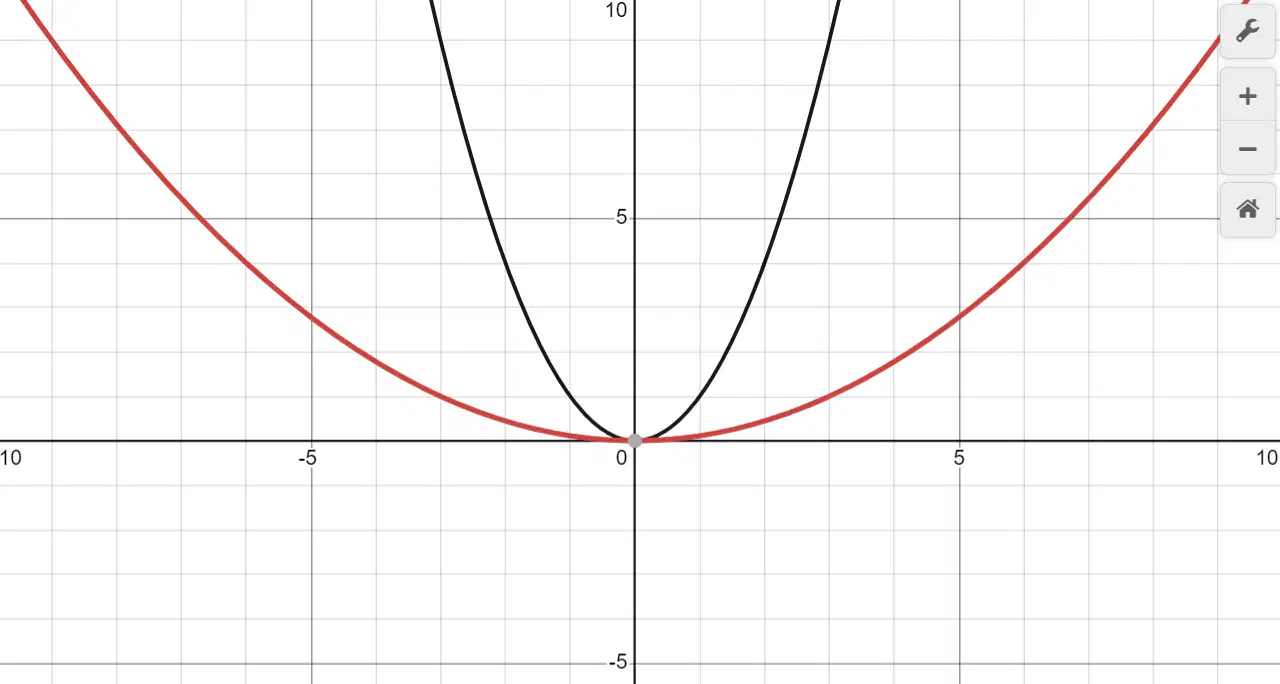
What is the vertex of the transformed function (in red)?
(0, -9)
(-9, 0)
(0, 0)
(9, -9)

How has the new function (in red) transformed from the parent function?
(select all that apply)
reflected
stretched/compressed
shifted left/right
shifted up/down

What is the equation of the transformed function (in red)?
y = x2 + 2
y = (x−1)2 + 2
y = (x+1)2 + 2
y = (x+2)2 + 1
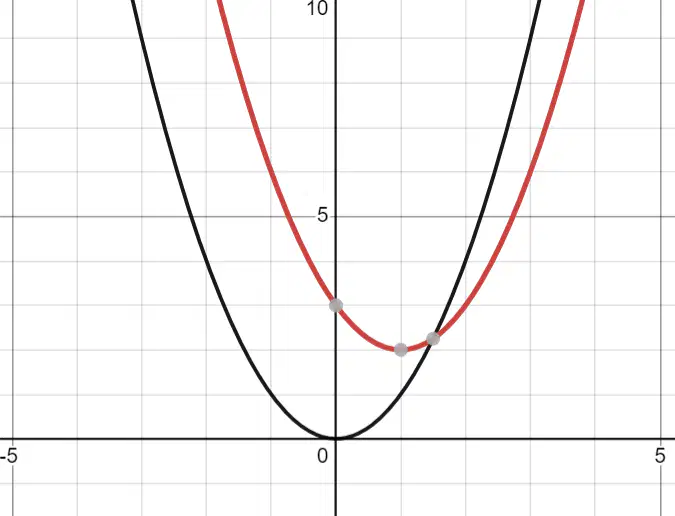
What is the vertex of the transformed function (in red)?
(2, 1)
(1, 2)
(1, 1)
(-1, 2)
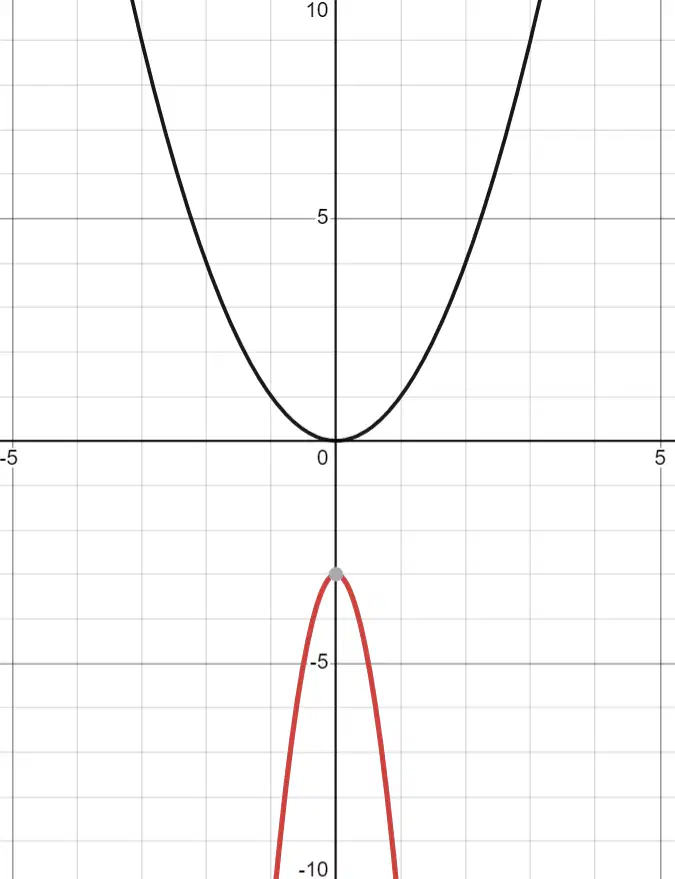
How has the new function (in red) transformed from the parent function?
(select all that apply)
reflected
stretched/compressed
shifted left/right
shifted up/down
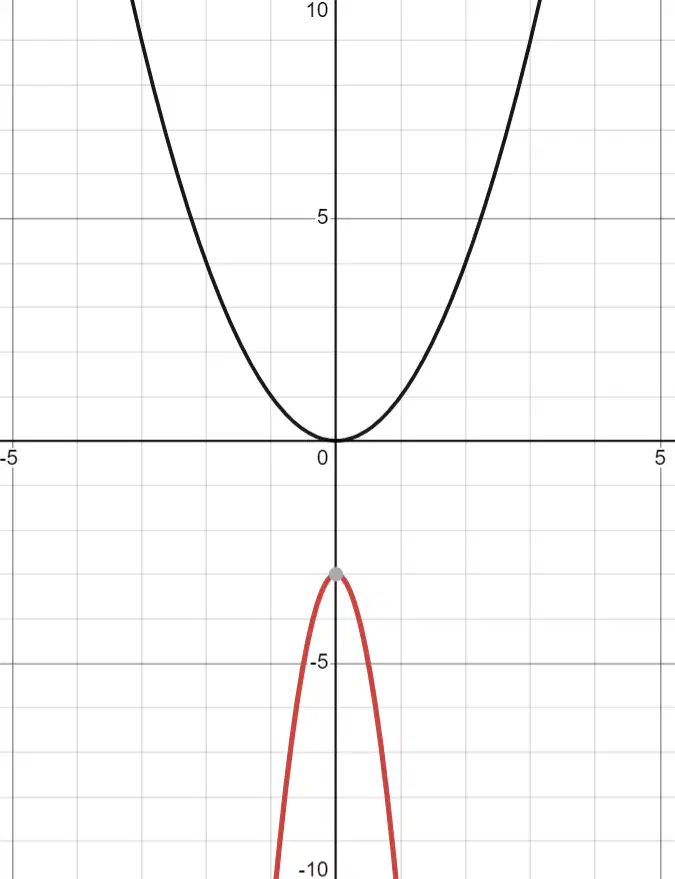
What is the equation of the transformed function (in red)?
(it was stretched by a factor of 8)
y = −8x2 − 3
y = (x−8)2 + 3
y = −(x+8)2 + 3
y = −(x+3)2 −8
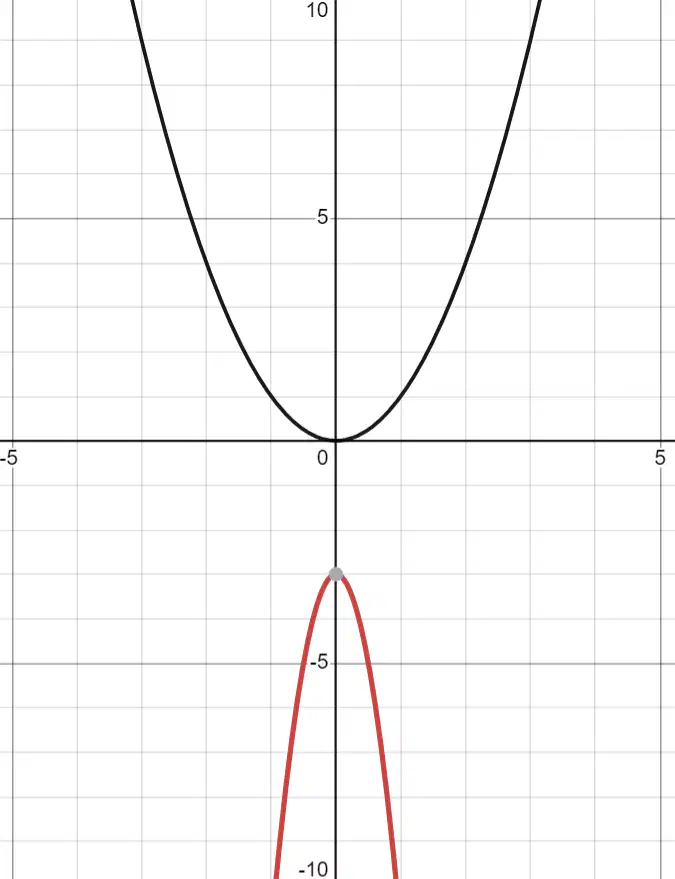
What is the vertex of the transformed function (in red)?
(8, 3)
(0, 8)
(-3, 0)
(0, -3)
Choose the graph of the following equation:
y = 101(x−4)2 − 3
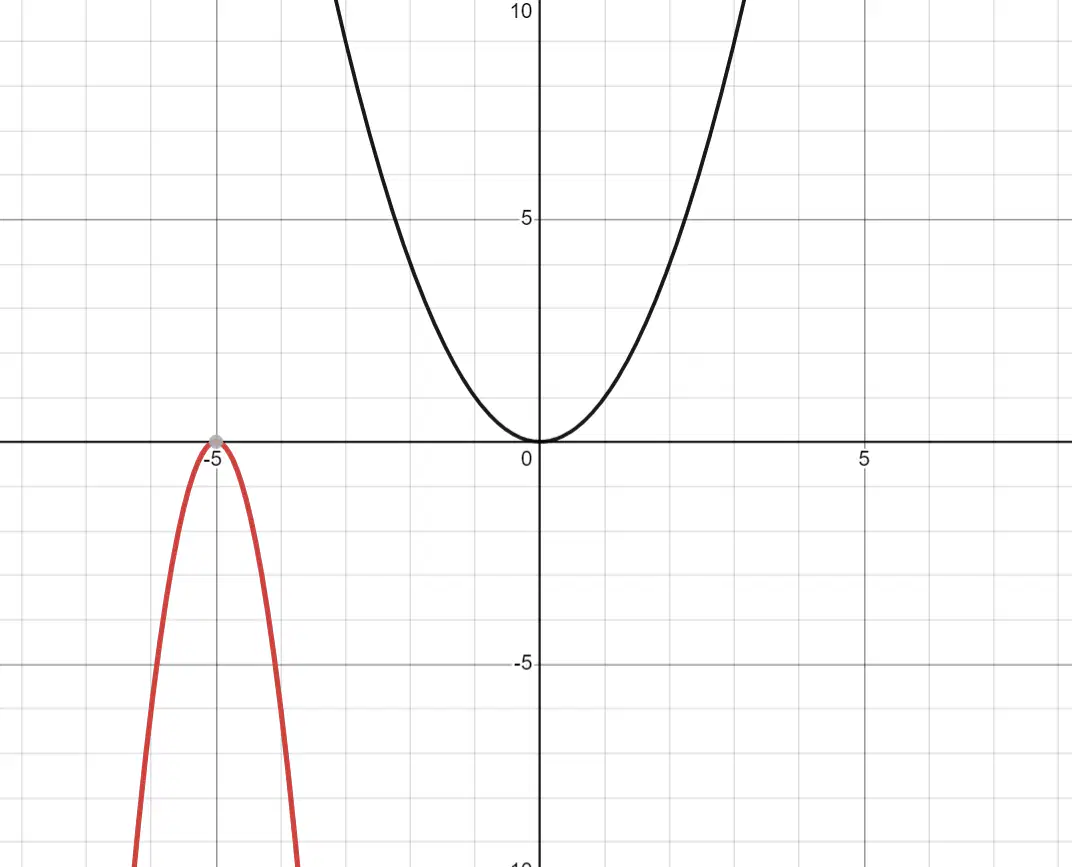
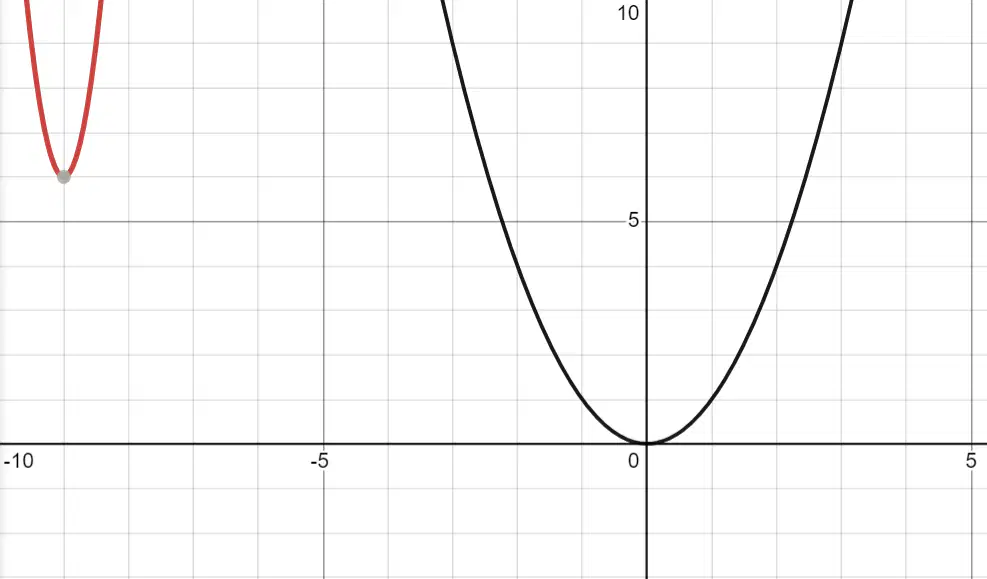
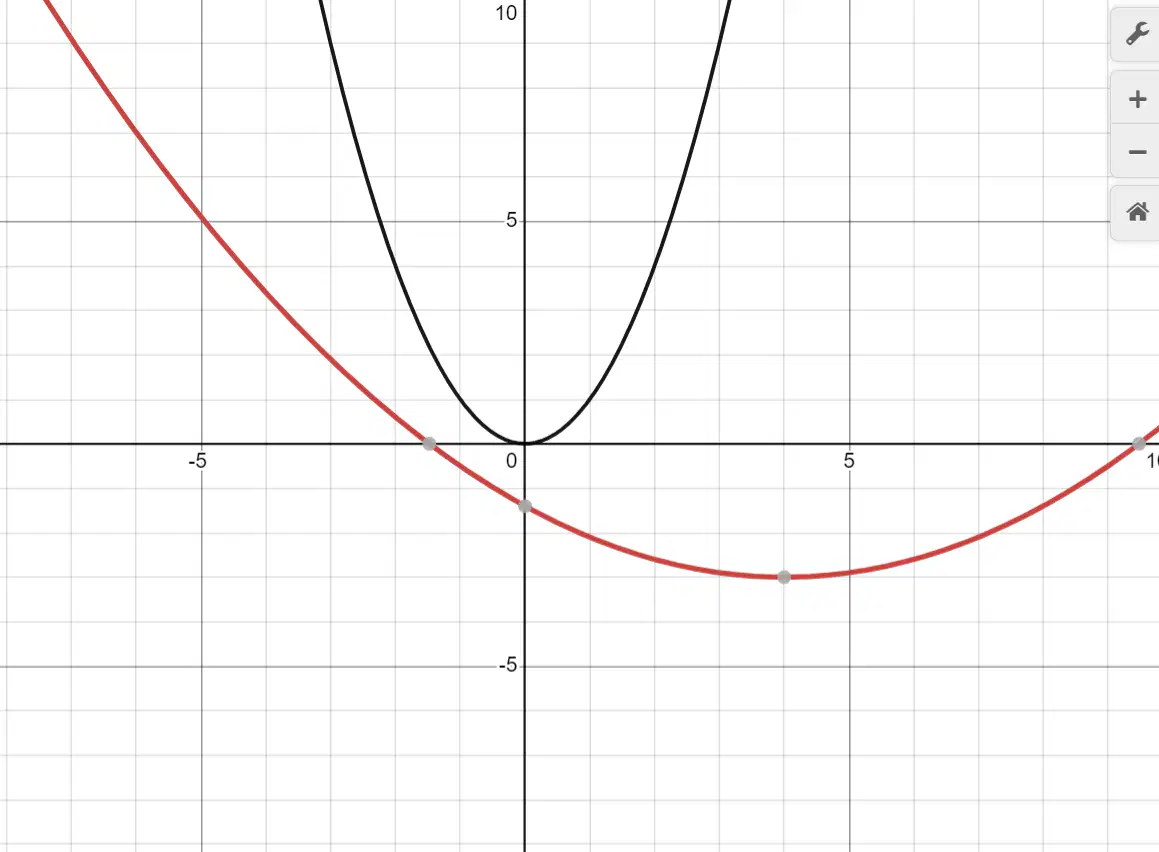
Choose the graph of the following equation:
y = −6(x+5)2
Choose the graph of the following equation:
y = 12(x+9)2 + 6
Choose the graph with the vertex:
(4, -3)
Choose the graph with the vertex:
(-9, 6)
Choose the graph with the vertex:
(-5, 0)
Which transformation maps the graph of
f(x) = x2 to the graph of g(x) = (x + 4)2?
a reflection across the x-axis
4 units up
4 units to the left
4 units to the right

How did we transform from the parent function?
y = x2 + 2
horizontal shift up 2
vertical shift up 2
horizontal shift down 2
vertical shift down 2
How did we transform from y=x2?
y = -3x2
reflection over x-axis and vertical shift down 3
reflection over x-axis and vertical stretch by 3
vertical stretch by -3
reflection over x-axis and vertical shrink by -3

f(x) = x2
then the red must be...

Compare the function y = 0.3x2 to the parent function y = x2
Vertical Compression by 0.3
Vertical Stretch by 0.3
Given f(x) = ax² , if 0 < a < 1 , the graph will transform by
becoming wider or vertically compressed
becoming narrower or vertically stretched
Given f(x) = -x² , how did we transform from the parent function?
Horizontal shift left
Reflection over the x-axis
Vertical shift down
Vertical compression

Reflected over the x-axis
Stretched by a factor of 2
y = 1/3x2?
y = 1/3x2 is shifted up.
y = 1/3x2 is shifted down.
y = 1/3x2 is wider.
y = 1/3x2 is narrower.
Given f(x) = ax² , if a > 1 , the graph will transform by
becoming wider or vertically compressed
becoming narrower or vertically stretched
Given f(x) = -x² , what transformation does the negative make?
Horizontal shift left
Reflection over the x-axis
Vertical shift down
Vertical compression
Find the equation of the parabola that has...
stretched by factor of 3
y=31x2
y=(x+3)2
y=x2+3
Find the equation of the parabola that has been...
reflected
y=(x−1)2
−y=x2
y=x2−1
Find the equation of the parabola that has...
been reflected
stretched by 5
y=−5x2
y=−51x2
−y=5x2
−y=51x2
Which equation will cause the graph to become wider?
y=81x2
y=3x2
y=x2−7
y=(x−9)2
Which equation will cause the parabola to become narrower?
y=2x2
y=21x2
y=x2+10
y=(x−6)
Which equation will cause the parabola to reflect and become wider?
y=−54x2
y=32x2
y=−8x2
y=3x2
Convert y=3x2−36x to Vertex Form
y=3(x+6)2−108
y=(x+3)2−36
y=3(x−6)2−108
y=(x−3)2+36
Which function is equivalent to y=x2−6x+10 ?
y=(x+3)2−1
y=(x−3)2+1
y=(x+6)2−10
y=(x−6)2+10
Which function is equivalent to h(t)=−16t2+32t+4 ?
h(t)=−16(t−1)2+3
h(t)=−16(t−1)2−3
h(t)=−16(t−1)2+20
h(t)=−16(t−1)2−20
The equation 2x2−5x=−12 is rewritten in the form 2(x−p)2+q=0 . What is the value of q?
16167
871
825
1625
Which equation is equivalent to x2−10x=28 ?
(x+10)2=53
(x−10)2=53
(x+5)2=53
(x−5)2=53
Which choice gives a different form of g(x)=x2+6x+10 and also the axis of symmetry?
g′(x)=(x−3)2=1; x=−3
g′(x)=(x+3)2=1; x=3
g′(x)=(x−3)2=−1; x=3
g′(x)=(x+3)2=−1; x=−3
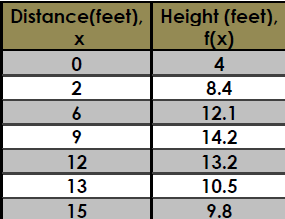
Find the quadratic regression equation for the relationship of the horizontal distance and the height of the ball in the provided table.
−18x2+2.11x+4.21
−0.06x2+1.06x+7.9
−6x2+1.06x+79
−0.12x2+2.11x+4.22
Find the height of the ball when it traveled a distance of 10 feet.
12.8 ft
13.5 ft
11.1 ft
17 ft
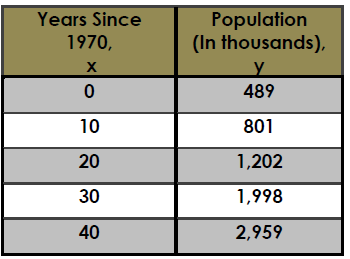
Find the best fitting quadratic model for the data given.
1.2x2+13x+504.3
12x2+13x+504.3
0.12x2+1.3x+504.3
Find the population for 1975.
HINT: Read the headers on the table!
623 thousand people
650 thousand people
599 thousand people
513 thousand people

Use the given points to find the equation of the line of best fit (regression equation).
Enter your answer as y=ax^2+bx+c
(a)

The table shows the population of a town from 1996 to 2004. Assume that t is the number of years since 1996 and P is measured in thousands of people.
Which of the following is the model that best fits the data rounded to the nearest tenth?
P(t)=−0.21x2+2.08x+22.96
P(t)=−.2x2+2x+22.9
P(t)=−.2x2+2.1x+23.0
P(t)=−.2x2+2.1x+22.9

"Use the results of the regression shown to predict the population in 2007. "
What value of x will you be plugging into your equation??
(a)

Using the regression equation rounded to TWO decimal places, what would be the estimated population for the year 2007?
*Your answer should be a whole number in the thousands!
(a)


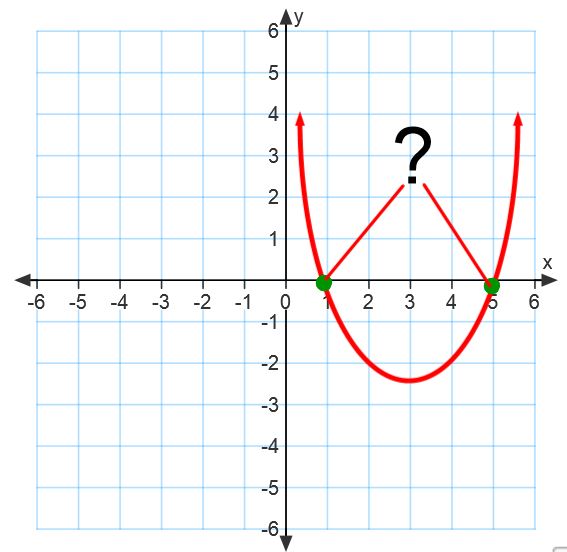
Determine key features from the give function.
Positive function with a minimum
Negative function with a maximum
Vertex located at (3, -16), and an axis of symmetry at x = 3
Vertex located at (3, -16) and an axis of symmetry at y = -16
Reflects over the x-axis
Determine the x-intercepts of the given function by solving for x.
x-intercepts are located at (7, 0) and (-1, 0)
x-intercepts are located at (19, 0) and (13, 0)
x-intercepts are located at (11, 0) and (-5, 0)
x-intercepts are located at (1, 0) and (-7, 0)
Convert the given function to standard form and locate the y-intercept.
h(x)=−4x2−16x+116
The y-intercept is (0, 116)
g(x)=−4x2−16x−104
The y-intercept is (0, -104)
g(x)=−4x2+4x+104
The y-intercept is (0, 104)
g(x)=−4x2−16x+84
The y-intercept is (0, 84)

