
 Worksheets
Ap art history
Total questions: 89
Worksheet time: 45mins
Which of the following is an example of an illuminated manuscript from Early Byzantine Europe?
Catacomb of Priscilla
Rebecca and Eliezer at the Well
Great Mosque, Córdoba
Bayeux Tapestry
What material is used in the construction of the Church of Sainte-Foy in Conques, France?
Brick and stone
Stone and paint
Limestone and stained glass
Painted wood
Which structure is known for its use of brick, marble, and stone veneer mosaic?
Santa Sabina
San Vitale
Hagia Sophia
Pyxis of al-Mughira
The Bayeux Tapestry is an example of which type of art?
Fresco
Embroidery on linen
Stone masonry
Encaustic on wood
Which of the following is a Gothic structure with original construction in the 12th century?
Chartres Cathedral
Santa Sabina
Great Mosque, Córdoba
Lindisfarne Gospels
Who was the artist for the Arena (Scrovegni) Chapel in Padua, Italy?
Giotto di Bondone
Leonardo da Vinci
Michelangelo
Raphael
What type of material was used for the Alhambra in Granada, Spain?
Whitewashed adobe stucco
Marble
Granite
Limestone
Which artwork is an illuminated manuscript from the late medieval period?
Golden Haggadah
The Arnolfini Portrait
Adam and Eve
Hunters in the Snow
What is the medium used for the Annunciation Triptych by Robert Campin?
Oil on wood
Fresco
Engraving
Tempera
Which artist created the Isenheim Altarpiece?
Matthias Grünewald
Albrecht Dürer
Pieter Bruegel the Elder
Jan van Eyck
What is the medium used in the Catacomb of Priscilla?
Marble and granite
Excavated tufa and fresco
Limestone and clay
Sandstone and plaster
Where is the Catacomb of Priscilla located?
Athens
Paris
Rome
Cairo
What cultural influences are seen in the Catacomb of Priscilla?
Greek and Byzantine
Etruscan and Pompeii painting style
Egyptian and Persian
Gothic and Renaissance
What is the approximate date range for the creation of the Catacomb of Priscilla?
100-200 C.E.
200-400 C.E.
400-600 C.E.
600-800 C.E.
What is the purpose of the loculi in the Catacomb of Priscilla?
Storage for treasures
Burial for poorer families
Meeting rooms for worship
Art galleries
What was the primary function of the Catacomb of Priscilla?
A place for public gatherings
An underground burial site for Jews and Christians
A marketplace for ancient Rome
A Roman military base
Approximately how many tombs are held within the Catacomb of Priscilla?
10,000
20,000
40,000
50,000
Which religious paintings can be found in the Catacomb of Priscilla?
The Birth of Venus
The Last Supper, Jonah and the Whale, the Annunciation
The School of Athens
The Creation of Adam
Where is the Catacomb of Priscilla located?
Beneath the city of Athens
Beneath the city of Rome
Beneath the city of Jerusalem
Beneath the city of Alexandria
What materials were used in the creation of the Catacomb of Priscilla?
Marble and granite
Excavated tufa and fresco
Limestone and sandstone
Brick and mortar
What painting technique is used in the depiction of the woman with the veil?
Oil painting
Fresco
Watercolor
Acrylic
What is the woman with the veil doing in the middle depiction?
Dancing
Praying
Singing
Reading
Where is the Catacomb of Priscilla located?
Paris, France
Athens, Greece
Rome, Italy
Cairo, Egypt
What cultural factors influenced the frescoes in the Catacomb of Priscilla?
Economic and political
Religious and social
Technological and scientific
Environmental and geographical
What medium was used in the artwork from Via Salaria?
Oil on canvas
Excavated tufa and fresco
Marble sculpture
Tempera on wood
What cultural influence is evident in the artwork from Via Salaria?
Greek culture
Egyptian culture
Roman culture
Byzantine culture
What is the primary function of the artwork from Via Salaria?
To depict a historical battle
To showcase the new religion, Christianity
To illustrate a mythological story
To portray a royal family
In the painting from Via Salaria, how is Christ depicted?
As a king with a crown
As a shepherd with a goat/sheep on his back
As a warrior with a sword
As a teacher with a book
Where is the Catacomb of Priscilla located?
Paris, France
Rome, Italy
Athens, Greece
Madrid, Spain
What materials were used in the construction of Santa Sabina?
Marble and glass
Brick and stone
Steel and concrete
Clay and straw
What is the architectural style of Santa Sabina?
Gothic
Baroque
Late Antique Europe
Renaissance
What is the roof of Santa Sabina made of?
Concrete
Glass
Wooden truss
Metal
What is the date range for the construction of Santa Sabina?
500-600 C.E.
300-400 C.E.
422-432 C.E.
200-300 C.E.
What was the original purpose of Santa Sabina before it became a church?
A marketplace
A residential building
An administrative building
A library
What significant change in religious practice does Santa Sabina reflect?
The rise of Protestantism
The legalization of Christianity
The spread of Buddhism
The decline of paganism
What visual element is used in Santa Sabina to lead the eyes to the altar?
Stained glass windows
Enormous arches
Colorful mosaics
Intricate tapestries
What is depicted on the carved wooden door of Santa Sabina?
Scenes from Greek mythology
The life of Saint Peter
Old and New Testament scenes
The history of Rome
Where is Santa Sabina located?
On the Palatine Hill
On the Aventine Hill
Near the Colosseum
In Vatican City
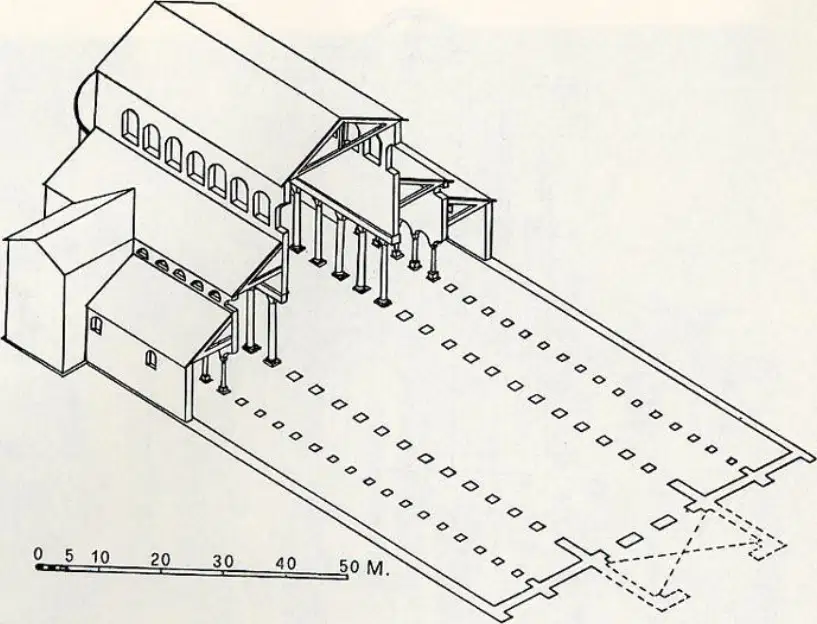
What is the name of the structure shown in the isometric reconstruction?
S. Giovanni in Laterano
Colosseum
Pantheon
St. Peter's Basilica
What materials were used in the construction of Santa Sabina?
Brick, stone, crystalline gypsum, and wood
Marble, granite, and limestone
Concrete and steel
Glass and iron
What is the primary function of Santa Sabina?
A marketplace
A place of Christian worship
A government building
A library
What architectural feature is used to create a visual rhythm in Santa Sabina?
Stained glass windows
Enormous arches
Spiral staircases
Domed ceilings
What type of plan does the church's ground structure follow?
Circular plan
Longitudinal axis plan
Square plan
Triangular plan
What visual elements are depicted in the spandrels above the arches in Santa Sabina?
Scenes of nature
Images of the Eucharist
Historical battles
Mythological creatures
Where is Santa Sabina situated and what factors influenced its creation?
On the Aventine Hill in Rome; influenced by religious, social, and political factors
In Athens, Greece; influenced by economic and cultural factors
In Paris, France; influenced by artistic and philosophical factors
In Cairo, Egypt; influenced by historical and geographical factors
What is the medium used in the Vienna Genesis?
Oil on canvas
Tempera, gold, and silver on purple vellum
Watercolor on paper
Charcoal on parchment
What cultural influences are noted in the Vienna Genesis?
Greek and Egyptian culture
Medieval and Roman culture
Renaissance and Baroque culture
Modern and Contemporary culture
What is the format of the Vienna Genesis?
Scroll
Codex
Tablet
Digital
What is the Vienna Genesis primarily used for?
Scientific research
Religious purposes
Political propaganda
Educational textbooks
Where was the Vienna Genesis likely created?
Rome
Constantinople or a Syrian workshop
Alexandria
Athens
What story is depicted in the illustration "Rebecca Visiting the Well" from the Vienna Genesis?
The birth of Jesus
The Exodus from Egypt
Rebecca arriving at the well to help Eliezer
The creation of the world
What medium is used in the Vienna Genesis?
Oil on canvas
Watercolor on paper
Illuminated manuscript (tempera, gold, and silver on purple vellum)
Charcoal on parchment
What is the title of the illustration from the Vienna Genesis that depicts the biblical story of Jacob?
Jacob Wrestling the Angel
David and Goliath
Moses and the Burning Bush
Solomon's Wisdom
Where was the Vienna Genesis likely created?
Constantinople or a Syrian workshop
Rome or Athens
Cairo or Alexandria
Jerusalem or Bethlehem
What type of materials suggest that the Vienna Genesis was made for a wealthy or royal patron?
Luxurious materials
Simple materials
Recycled materials
Natural materials
Which cultures influenced the Vienna Genesis?
Sumerian and Roman
Greek and Egyptian
Persian and Indian
Chinese and Japanese
What is the medium used for the artwork titled "San Vitale"?
Brick, marble, and stone veneer; mosaic
Wood and clay; sculpture
Canvas and oil paint; painting
Glass and metal; stained glass
Where is the location of the artwork titled "San Vitale"?
Ravenna, Italy
Florence, Italy
Venice, Italy
Rome, Italy
What is the primary material used in the construction of the building described?
Wood
Bricks
Glass
Steel
What is the shape of the central plan of the building?
Circular
Square
Octagonal
Triangular
Why was the church in Ravenna built?
To serve as a royal palace
To act as a military fortress
For the teachings of the Christian faith
As a marketplace
Where is San Vitale located?
Rome, Italy
Venice, Italy
Ravenna, Italy
Florence, Italy
What materials were used in the construction of San Vitale?
Wood and clay
Brick, marble, and stone veneer
Steel and glass
Concrete and iron
What is the primary function of San Vitale?
A royal palace
A military fortress
A place for Christian teachings
A marketplace
What shape is emphasized in the interior design of San Vitale?
Circular
Rectangular
Octagonal
Triangular
Where is San Vitale situated and why?
Rome, because it was the capital of the Roman Empire.
Ravenna, because it was the new capital of Western Rome.
Venice, because it was a major trade center.
Florence, because it was a cultural hub.
What religious factor influenced the construction of San Vitale?
Buddhism
Islam
Christianity
Hinduism
What materials were used in the construction of San Vitale?
Wood and clay
Brick, marble, and stone veneer; mosaic
Steel and glass
Concrete and iron
What is the artistic style of San Vitale?
Gothic
Renaissance
Early Byzantine
Baroque
What was the primary purpose of the Theodora Panel mosaic?
To depict a historical battle
To honor Empress Theodora
To illustrate a mythological story
To show a landscape scene
What is Empress Theodora holding in the Theodora Panel mosaic?
A sword
A book
A chalice
A scroll
Where is the Theodora Panel located?
On the north wall of the nave
On the south wall of the apse
In the center of the dome
On the west wall of the transept
What medium was used to create the Theodora Panel?
Oil paint
Watercolor
Mosaic
Fresco
What cultural influence is suggested by the depiction of the three Magi in Empress Theodora's robe?
Roman
Egyptian
Greek
Persian
What material is the mosaic made of?
Marble
Glass tesserae
Wood
Metal
What is the central figure in the mosaic depicted with?
A crown
A sword
A halo
A shield
What was the primary function of the mosaic?
To decorate the palace
To exert control and favor within the city
To commemorate a battle
To illustrate a myth
Where is the mosaic situated?
On the west side of the apse wall
On the north side of the apse wall
On the east side of the apse wall
On the south side of the apse wall
What cultural factors influenced the mosaic?
Economic factors
Political factors
Religious factors
Social factors
What is the medium used in the construction of Hagia Sophia?
Wood and plaster
Brick and ceramic elements, with stone and mosaic veneer
Steel and glass
Marble and limestone
During which years was Hagia Sophia constructed?
500-505 CE
600-605 CE
532-537 CE
700-705 CE
What architectural style influenced Hagia Sophia?
Roman
Gothic
Greek
Renaissance
For what purpose was Hagia Sophia originally built?
A royal palace
A marketplace
A Christian church
A library
Who was the ruler during the construction of Hagia Sophia?
Julius Caesar
Justinian I
Alexander the Great
Charlemagne
Where is the Hagia Sophia located?
Rome, Italy
Athens, Greece
Constantinople (Istanbul), Turkey
Cairo, Egypt
What was the primary function of the Hagia Sophia when it was built?
A royal palace
A marketplace
A Christian church
A military fortress
Under whose rule was the Hagia Sophia constructed?
Julius Caesar
Justinian I
Alexander the Great
Charlemagne
What architectural feature supports the dome of the Hagia Sophia?
Flying buttresses
Pendentives
Corinthian columns
Barrel vaults
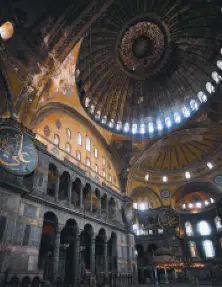
Image of the interior of Hagia Sophia showing the dome and arches.
Image of the interior of Hagia Sophia showing the dome and arches.
Image of the interior of the Colosseum showing the arena and seating.
Image of the interior of the Eiffel Tower showing the iron lattice structure.
Image of the interior of the Parthenon showing the columns and pediment.

