

wayground logo

Free Printable Worksheets

Font size

S
M
L
XL
Worksheets

FM015 PART C SET 1

Total questions: 14

Worksheet time: 7mins
Name
Class
Date
1.
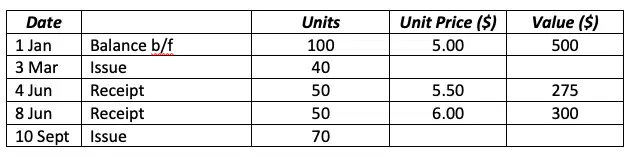
2. If the FIFO method of pricing is used, what is the value of the issue on 10 September?
a)
$410
b)
$355
c)
$395
d)
$520
2.
3. The material stores control account for 4U2 Ltd for April was provided as below:
a)
1 and 4 only
b)
2 and 4 only
c)
2, 3 and 4 only
d)
All of the above
3.

4. A manufacturing company uses 28,000 components at an even rate during the year. Each order placed with the supplier of the components is for 1,500 components, which is the economic order quantity. The company holds a buffer inventory of 700 components. The annual cost of holding one component in inventory is $3.What is the total annual cost of holding inventory of the components?

(a)  

4.
5. What is the correct description of perpetual inventory?
a)
The counting and valuing of selected items on a rotating basis
b)
The recording, as they occur, of receipts, issues and the resulting balances of individual items of inventory
c)
The recording of inventory that is constantly changing
d)
The counting and valuing inventory on a regular (e.g. weekly) basis
5.
6. Ordering lead times and weekly usage of raw material are:
a)
675 kgs
b)
700 kgs
c)
375 kgs
d)
300 kgs
6.
7. A company has established a marginal costing profit of $72,300. Opening inventory was 300 units and closing inventory is 750 units. The fixed production overhead absorption rate has been calculated as $5/unit.What was the profit under absorption costing?
a)
$67,050
b)
$70,050
c)
$74,550
d)
$77,550
7.
9. Which TWO of the following functions are fulfilled by goods received note (GRN)?
a)
Provides info to update the inventory records on receipt of goods
b)
Provide info to check the quantity on the suppliers’ invoices
c)
Provide info to check the price on the suppliers’ invoices
8.
10. Which of the following is not a cost of labour turnover?
a)
Cost of recruiting new employees to replace those leaving
b)
Cost of increased wastage due to lack of expertise among new staff
c)
Contribution forgone on the output lost due to slower working
d)
Salary paid to the personnel manager
9.

11. A company makes a product for which standard labour time in 2 hours per unit. Budgeted prod hours for a given week are 820 hours. During the week the prod staffs were able to produce 380 units of product. Staffs worked and were paid for 800 hours in which during the period 20 production hours were lost due to shortage of material. What was the efficiency ratio (to two decimal places)?

(a)  

10.
12. Which of the following labour records may be used to allocate costs to the various cost units in a factory?
a)
3 and 4 only
b)
1 and 3 only
c)
2 and 4 only
d)
1 and 2 only
11.

13. A company operates a piecework payment scheme. The staff received $0.60 for each unit produced. However, the company guarantees that every member of staff will receive at least $45 per day. Show below is the number of units produced by worker A during a recent week:

(a)  

12.
14. Which TWO of the following should be classified as indirect labour?
a)
Assembly workers on a car production line
b)
Forklift truck drivers in the stores of engineering company
c)
Floor cleaners in a factory producing clothes
d)
Bricklayers in a house building company
13.

15. An organisation operates a piecework system of remuneration, but also guarantees its employees 80% of a time-based rate of pay which is based on $20 per hour for an eight-hour working day. Three minutes is the standard time allowed per unit of output. Piecework is paid at the rate of $18 per standard hour.If an employee produces 200 units in eight hours on a particular day, what is the employee’s gross pay for that day?

(a)  

14.
16. A company had 31 direct production employees at the beginning of last year and 25 direct production employees at the end of the year. During the year, a total of 15 direct production employees had left the company to work for a local competitor.The labour turnover rate for last year was:
a)
17.9%
b)
20.0%
c)
25.0%
d)
32.14%