
NEW
Font size
 Worksheets
Understanding Static Electricity
Total questions: 17
Worksheet time: 9mins
An electric field is created by particles that
are moving.
have a charge.
are radioactive.
are electrically neutral.
Which is an example of gaining a static charge by conduction?
Rubbing a balloon against your hair.
Shuffling your shoes across a carpet.
Bringing a charged rod near an electroscope.
Touching your car on a cold day and getting a shock.
Jermaine and Lashonda each rub their dry hair with inflated balloons. What causes the balloons to push each other away?
There must be a vent in the classroom blowing the two balloons apart.
They have each gained negative charge from the hair rubbing, and like charges repel each other.
They have each gained negative charge from the hair rubbing, and like charges attract each other.
The rubber balloons are simply bouncing off each other the way a rubber ball bounces off the floor.
What type of energy occurs when a sock is stuck to a blanket when it is taken out of the dryer?
current electricity
static electricity
heat energy
high voltage electricity

One type of static electricity is the lightning in a thunder and lightning storm. Clouds become negatively charged as ice crystals inside the clouds rub up against each other. Meanwhile, on the ground, the positive charge increases. The clouds get so highly charged that the electrons jump from the ground to the cloud, or from one cloud to another cloud. This causes a huge spark of static electricity in the sky that we call lightning.
Rub a balloon so it picks up extra electrons from the sweater or your hair and becomes slightly negatively charged.
Rub a balloon filled with air on a wool sweater or on your hair. Then, hold it up to a wall.
Connect the positive pole of an electrical source to the negative pole so you create a circuit.
Walk across a carpet, shuffling your feet and touching something made of metal.

Electricity can occur naturally, or it can be harnessed by humans. Which statement best describes how static electricity occurs?
Wind can be collected by large wind turbines that mechanically power generators for electric power. This type of power is called static electricity.
Static electricity occurs when opposite poles of two magnets are placed near each other. The attraction between the poles is called static electricity.
Solar power can be collected by large solar panels on roofs and on land, which is turned into electricity. This collected energy is called static electricity.
Electrons transfer when materials come in contact, leaving one object with an excess of electrons. The build-up of excess charge is called static electricity.
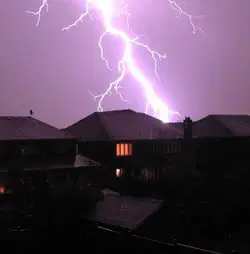
When objects come in contact with one another, they transfer electrons. Which statement best explains the role of electrons in creating static electricity?
Electrons move back and forth between magnetic objects, causing static electricity.
Electrons are small currents that move along wires and deliver electricity to homes.
Static electricity is the buildup of excess charge caused by the gain or loss of electrons.
Static electricity is caused by friction between two objects and is felt in the form of heat.
A child touched a doorknob and experienced a strong shock. What explains in terms of electricity why this child received a noticeable shock?
She was wearing leather gloves.
She was wearing clothing made of wool.
She shuffled her feet across the carpet.
She walked from the rug to the tile floor.
A positively charged ball is placed an equal distance between two charged objects, Object 1 and Object 2. In which case will the positively charged ball move toward Object 2?

If Object 2 is negatively charged and Object 1 is positively charged.

If Object 2 is positively charged and Object 1 is negatively charged.

If both Object 1 and Object 2 are positively charged.

If both Object 1 and Object 2 are negatively charged.
You have a positively charged glass rod and a negatively charged plastic straw. What will happen if you bring them close to each other?
They will repel each other.
They will attract each other.
Nothing will happen.
They will both become neutral.
What happens to electrons when you walk across a carpet and touch a metal doorknob?
Electrons move from the carpet to your body.
Electrons move from your body to the doorknob.
Electrons move from the doorknob to your body.
Electrons do not move at all.
Why do clothes sometimes stick together when they come out of the dryer?
They are wet.
They have gained static electricity.
They are made of the same material.
They are too hot.
What is the main reason a balloon sticks to a wall after being rubbed on hair?
The balloon is wet.
The balloon has gained static electricity.
The wall is magnetic.
The wall is wet.
Which of the following best describes the process of charging by friction?
Electrons are transferred from one object to another by direct contact.
Electrons are transferred from one object to another by rubbing.
Electrons are transferred from one object to another by induction.
Electrons are transferred from one object to another by conduction.
Two objects that have the same charges will...
attract
repel
not move
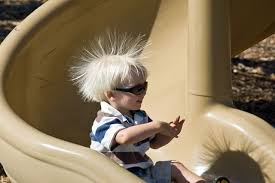
What method of static charging is shown in this picture
Polarization
Friction
Induction
Conduction
Which of the following is an example of a conductor?



