
 Worksheets
FExamQuiz
Total questions: 200
Worksheet time: 3hrs 20mins
Which fundamental quantity is measured in amperes?
electric current
amount of substance
temperature
intensity of light
The standard unit of length is
meter
second
kilogram
newton
Which one of the following is the derived unit?
speed
length
mass
luminous intensity
How many fundamental quantities are there?
10
5
7
8
Force is a
fundamental quantity
derived quantity
m
mL

The capacity of a glass of orange juice would be measured in...
litres (L)
cubic metres (m3)
millilitres (mL)
Which one of these options is NOT a derived quantity?
Area
Volume
Density
Current
452.159 meters.
Round to the nearest thousandth.
763.1247 milligrams.
25.12 meters.


How much smaller is a picoliter from a kiloliter?
1015 smaller
1010 smaller
1011 smaller
1016 smaller

Convert 4,477 micrometer to decimeters.
4.477 dm
4.477 x 10⁻² dm
4.477 x 10⁻¹ dm
4,477,000,000 dm
The metric system is based on the power of (a) .
Convert 4,477 micrometer to decimeters.
4.477 dm
4.477 x 10⁻² dm
4.477 x 10⁻¹ dm
4,477,000,000 dm
How much smaller is a picoliter from a kiloliter?
1015 smaller
1010 smaller
1011 smaller
1016 smaller
What information tells you that the measurement 2,63 x 10¹² liters is a large number?

What is the name of the part labelled B in the diagram?
Slider
Internal jaws
Outside jaws
Depth bar
Main scale

State the name of the parts labelled A in the diagram?
Main scale
Depth bar
External jaws
Internal jaws
Sliding jaw

What is the zero error on the Vernier calipers?
0.04 cm
0.06 cm
-0.04 cm
-0.06 cm

What is the reading on the vernier calipers?
1.05 cm
1.06 cm
1.16 cm
1.66 cm

How many in millimeters (mm) does the vernier caliper indicates?
31.35 mm
32.35 mm
32.30 mm
31.30 mm

How many in milimeters (mm) does the vernier caliper indicates?
39.15 mm
39.25 mm
39.10 mm
40.15 mm

How many milimeters (mm) does the vernier caliper indicates?
12.30 mm
11.15 mm
11.25 mm
12.25 mm

How many in centimeters (cm) does the vernier caliper indicates?
44.5 cm
4.46 cm
4.45 cm
4.56 cm

What are the readings of the vernier caliper in millimeters (mm)
23.75 mm
23.70 mm
23.80 mm
24.75 mm

What is the reading of vernier callipers?
0.24 cm
0.14 cm
0.04 cm
2.04 cm

what is the reading of vernier caliper?
1.65 cm
1.065 cm
1.055 cm
1.165 cm

what is the reading of micrometer?
7.24 mm
7.74 mm
5.24 mm
0.74 mm

What is the reading of micrometer?
7.38 mm
5.38 mm
7.42 mm
7.88 mm

what is the reading of micrometer?
2.88 mm
2.38 mm
0.38 mm
0.88 mm

what is the reading of micrometer screw?
12.90 mm
10.90 mm
12.40 mm
10.40 mm

diagram (a) shows the zero error in vernier calliper. diagram (b) shows the measurement of an object. What is the actual reading of vernier calliper?
6.03 cm
5.97 cm
5.99 cm
6.09 cm

the following picture shows the measurement of micrometer with and without an object. What is the actual reading of the micrometer?
2.90 mm
2.86 mm
2.40 mm
2.36 mm
As a pendulum gets longer, what happens to the period?
doesn't change
decreases
increases
What is the name of the mass on a pendulum?
ion
graviton
oscillating mass
bob
Which of these does not affect the period of a pendulum?
length
gravity
mass
What is the unit for the period of a pendulum?
second
meter
m/s/s
Newton
Which would have the longest period?
Pendulum A: A 200-g mass attached to a 1.0-m length string
Pendulum B: A 400-g mass attached to a 0.5-m length string
A
B
Same
When the length of a simple pendulum is decreased by 600 mm, the period of oscillation is halved. What was the original length of the pendulum?
800 mm
1000 mm
1200 mm
1400 mm

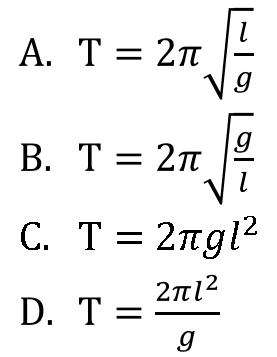
Based on your findings, which equation could best describe the pendulum’s period?
A
B
C
D
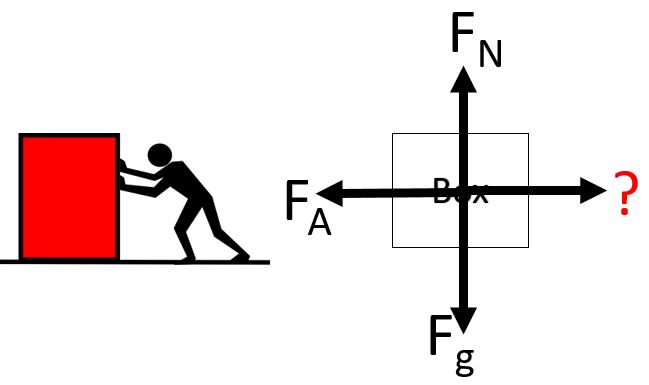


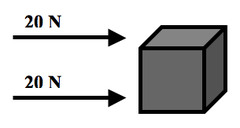
What is the resultant force?
40 N, Left
0 N, Balanced
400 N, Right
40 N, Right

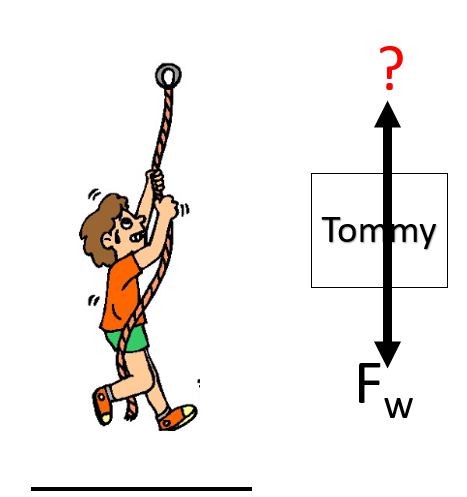
What is the resultant force?
400 N, Up
400 N, Down
800 N, Up
800 N, Down

What is the resultant force?
17 N, Left
6N, Right
11N , Left
12N, Left

What is the resultant force?
40N, Left
40N, Right
0N, Balanced
75N, Right

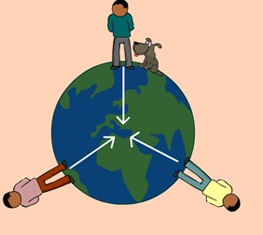
What force holds the planets in motion around the sun?
Magnetic
Electrical
Gravitational
Air Resistance

What unit of measurement is used for mass in physics?
Liter
Kilograms
Meters
Newtons
What statement is true?
Mass never changes. Weight does.
Weight never changes. Mass does.
Both mass and weight change because they are affected by gravity.
Neither mass nor weight change. They are always the same.
What do you use to measure the mass of an object?


What is the name of this tool?
spring balance
Balance scale
measuring cylinder
thermometer
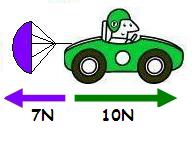
What is the net force?
3 N
3 N, right
17 N, right
3 N, left
What is the mass of an object that experiences a gravitational force of 980N near Earth's surface where g = 9.80 m/s2?
If your mass on the earth is 100 kg, then the mass on the moon (g=1.67 m/s2) would be
100 kg
16.7 kg
A student measures the mass of an 8.0 cm3 block of brown sugar to be 12.9 g. What is the density of the brown sugar?
1.6 g/cm3
0.62 g/cm3
103.2 g/cm3
0.54 g/cm3
A chef fills a 50.0 mL container with 43.5 g of cooking oil. What is the density of the oil?
1.15 g/mL
0.87 g/mL
2,175 g/mL
6.5 g/mL
A graduated cylinder is filled with water to a level of 40.0 mL. When a piece of copper is lowered into the cylinder, the water level rises to 63.4 mL. Find the volume of the copper sample.
If the density of the copper is 8.9 g/cm3 , what is its mass?
23.4 g
0.380 g
208 g
2.63 g
The density of water is 1.00 g/cm3. What mass of water in grams will fill a tank 100 cm long, 50 cm wide, and 30 cm high?
6.7 x 10⁻⁶ g
3,000 g
5,000 g
150,000 g
Pure gold has a density of 19.32 g/cm3. How large would a piece of gold be if it had a mass of 318.97 g?
6,163 cm3
16.51 cm3
0.6057 cm3
299.7 cm3
A plastic ball with a volume of 19.7 cm3 has a mass of 15.8 g. Calculate the density of the plastic ball.
Would this ball sink or float in a container of gasoline? Gasoline's density is 0.66-0.69 g/cm3.
0.802 g/cm3, Float
0.802 g/cm3, Sink
1.25 g/cm3, Float
1.25 g/cm3, Sink
A plastic ball with a volume of 19.7 cm3 has a mass of 15.8 g. Calculate the density of the plastic ball.
Would this ball sink or float in a container of gasoline? Gasoline's density is 0.66-0.69 g/cm3.
0.802 g/cm3, Float
0.802 g/cm3, Sink
1.25 g/cm3, Float
1.25 g/cm3, Sink
A solid magnesium flare has a mass of 1300 g and a volume of 743 cm3. What is the density of the magnesium?
1.75 g/cm3
0.571 g/cm3
9.65 g/cm3
10 g/cm3


If a rectangular prism's volume is 420cm3. The prism has a length of 12cm, and width of 7cm, what is height of the rectangular prism?
12cm
5cm
4cm
84cm
Which of the following scenarios is an example of Newton's First Law in action?
A car coming to a stop at a red light.
A ball rolling uphill and eventually stopping.
A book remaining at rest on a table.
A rocket launching into space.
If you double the mass of an object while applying the same force, what happens to the acceleration?
It doubles.
It remains the same.
It is halved.
It quadruples.
When a hammer strikes a nail and drives it into a piece of wood, which of Newton's laws best describes the interaction between the hammer and the nail?
Newton's First Law
Newton's Second Law
Newton's Third Law
None of the above
What does Newton's First Law, also known as the law of inertia, state about an object at rest or in uniform motion?
The object will change its motion randomly.
The object will remain at rest or in uniform motion unless acted upon by an unbalanced force.
The object will eventually stop due to natural forces.
The object will accelerate without any force.


When you push or pull something, you are creating ________.
weight
speed
force
surface
If an object is in motion it will remain ______, unless an external force act on it.
in motion
at rest
gravity
weightless
Newton's third law states for every action, there is an _____________ reaction.
opposite and equal
opposite and unequal
unbalanced
severe
Newton's second law of motion can be represented by which of the following formula
a+b =C
F = m x a
S = d/t
Y = mx+b

A person not paying attention while skateboarding hits a rock. The skateboard stops...they don't.
Newton's 1st Law
Newton's 2nd Law
The Law of Conservation of Momentum
Newton's 3rd Law
Which is an example Newton's 2nd Law?
A rocket taking off from Earth
A crash test dummy flies through the windshield in a collision
A small rock skips a pond faster than a large rock
A person leans on a wall and the wall pushes back. This is an example of --
Newton's 1st Law
Newton's 2nd Law
Newton's 3rd Law

When you are riding in a car and the car suddenly stops, your body continues to go forward.
Newton's 1st Law
Newton's 2nd Law
Newton's 3rd Law

A swimmer pushes water back with her arms, but her body moves forward.
Newton's 1st Law
Newton's 2nd Law
Newton's 3rd Law


Ice cracks if the pressure on it is more than 3000 N/m². A man of weight 900 N wants to safely walk over the ice. What should be the area of each of his snowboots?
0.15 m2
0.30 m2
1.67 m2
3.33 m2

Sam of weight 450 N sits on a chair with 4 legs. Each leg has a contact area of 3 cm by 6 cm with the ground. What is the pressure exerted on the ground?
6.25 Pa
25 Pa
6.25 N/cm2
25 N/cm2
Which would be the least likely to sink into soft ground?
A loaded lorry with 4 wheels.
An empty lorry with 4 wheels.
A loaded lorry with 6 wheels.
An empty lorry with 6 wheels.

A brick of weight 80 N rests on the ground. What is the maximum pressure it can exert on the ground?
0.08 N/cm2
0.8 N/cm2
0.4 N/cm2
1.6 N/cm2
A person weighs 700N and their feet have a surface area of 0.1m2. How much pressure is exerted?
7000N/m2
70N/cm2
100N/m2
The earth is surrounded by the ......... up to a height of many miles
water
soil
air
atmosphere
A force of 100 N is exerted upon an enclosed liquid that is kept in a container whose cross sectional area is 100 cm2. By what amount does the pressure on the liquid increase?
F1F2 = A1A2
F2A2 = F1A1
F2/A2 = F1/A1
F1A1 = F2A2
A force of 200 N is exerted upon the smaller piston of a hydraulic machine whose cross sectional area is 0.01 m2. What weight will the hydraulic machine be able to lift if the larger piston has a cross sectional area of 2 m2?
4000 N
670 mm of Hg
1 atmosphere of pressure is equal to
76 m of Hg
760 torr
76 torr
7.6 mm of Hg

What will happen to the height (h) of the mercury column in the manometer shown below if the stopcock is opened, given that the atmospheric pressure is 755 mmHg?
h will decrease
h will not change
h will increase
not enough information given to answer the question

The air pushes equally on both sides so, gauge pressure is zero
True
False

Which gas has a greater pressure?
air
methane, CH4
The gas pressures are equal
In which of the following manometers is the gas pressure equal to the atmospheric pressure?


In which of the following manometers is the gas pressure greater than the atmospheric pressure?
In which of the following manometers is the gas pressure less than the atmospheric pressure?


The pressure in the oil (S = 0.86) pipe is 12 kPa. The pressure in the water pipe is nearest:
−34.8 kPa
−28.8 kPa
−18.8 kPa
−13.1 kPa

Estimate the pressure in the water pipe shown. The manometer is open to the atmosphere.
10 kPa
8 kPa
9 kPa
7 kPa

Total Distance an object travels divided by the total time traveled.
Motion
Constant Speed
Acceleration
Average Speed

Speed that remains the same or does not change
Distance
Constant Speed
Mass
Acceleration

If a puppy runs for 50 meters in 10 seconds , what was the puppies speed in meters per second (m/s)
60 m
5 m/s
5 ft/s
5 m
What is speed?
how far you go
how much distance is covered over a period of time
how fast you accelerate
the change in the location of a object
A car accelerates as it rounds a corner, even if it is going at a constant speed. Why is that?
Its direction changes
It doesn't
It slows down
Its speeds up

What is this?
"This airplane is traveling at 500 mph, West"
Speed
Velocity
Acceleration

A train begins a journey from a station and travels 60 km in a time of 20 minutes.
What is the average speed of the train?
3.0 m / s
5.0 m / s
50 m / s
60 m / s

A car travels along the route PQRST in 30 minutes.
What is the average speed of the car?
10 km / hour
20 km / hour
30 km / hour
60 km / hour
If an airplane travels 500km in 5 hours, what was its speed?
100 km/hr
2,500 km/hr
0.01 km/hr
495 hm/hr
A boat travels 90km in 10 seconds. What was its speed?
9 km/hr
90 km/hr
1.11 km/hr
80 km/hr
What was the bicyclist's speed if they biked 60 miles in 5 hours?
12 miles/hour
300 miles/hour
55 miles/hour
0.083 miles/hour
The difference between speed and velocity is...
Speed has direction.
Velocity has direction.
They are the same thing.
This occurs when an object speeds up, slows down, or changes direction.
Speed
Velocity
Acceleration
Andrea is walking at 3 m/s. She sees the ice cream truck and starts running towards it. In 5 seconds, she speeds up to 7 m/s. What is her acceleration?
0.8 m/s^2
0.667 m/s^2
0.295 m/s^2
0.295 m/s

The diagram shows a cross-section of a pool. The density of water in the pool is 1000 kg m-3.
What is the pressure exerted by the water at X?
2.5 x 10² Pa
2.5 x 10⁻³ Pa
4.0 x 10³ Pa
4.0 x 10⁴ Pa

Diagram 6 shows a container filled with water.
Which is the correct comparison of the pressure at P and Q?
Pressure at P > pressure at Q
Pressure at P = pressure at Q
Pressure at P < pressure at Q

Diagram 8 shows two divers in a lake and a diver in a sea. The pressure of water at T, S and U is PT, PS and PU respectively.
PU > PT > PS
PU < PT < PS
PU = PT > PS
PU = PT < PS

Diagram 7 shows two identical containers containing liquid P and Q.
When the height of liquid P is 15 cm and the height of liquid Q is 20 cm, water spurts is the same.
The density of liquid P is 2.0 g cm-3.
What is the density of liquid Q?
0.67 g cm-3
1.30 g cm-3
1.50 g cm-3
2.70 g cm-3

Diagram 11 shows the process of supplying water from a water tank on a hill to a water tank X on a tall building.
Calculate the pressure of the water at X?
[Density of water: 1000 kg m-3]
1.0 x 10⁵ Nm‑2
1.4 x 10⁵ Nm‑2
1.6 x 10⁵ Nm‑2
2.6 x 10⁵ Nm‑2

Diagram 9 shows water spurting out from a container at different depths. Which graph shows the correct relationship between the pressure exerted by the water, p and the depth of the water, h?


Kumar and Abu are fishing in a lake. The bait used sinks 7.0 m into the lake. What is the water pressure exerted on the bait?
[Density of water = 1000 kgm-3]
7.0 x 10⁴ Pa
7.0 x 10³ Pa
1.4 x 10³ Pa
1.4 x 101 Pa

Diagram 11 shows a submarine in a sea.
What is the depth, h, of the submarine when the total pressure is 2.06 x 10⁷ Pa?
[Density of water = 1.03 x 10³ kgm-3]
2.00 x 10³ m
2.00 x 10⁴ m
2.12 x 10⁹ m
2.12 x 10¹¹ m

Diagram 10 shows a water container being tilted to increase the outflow of the speed of water.
Which factor increases the speed of water?
Gravity
Depth of water
Volume of water
Density of water

Diagram 11.1 shows a tank placed on a hill. The reading of a pressure meter at X is 5.0 x 10⁵ Pa and the density of water is 1000 kgm-3.
5.0 x 101 m
5.0 x 10² m
5.0 x 10³ m
5.0 x 10⁴ m

