Wayground logo

Free Printable Worksheets

Font size

S
M
L
XL
Worksheets

Weather Systems

Total questions: 45

Worksheet time: 4hrs 29mins

Name
Class
Date
1.

What is a front?

a)

when four air masses meet

b)

when three air masses meet

c)

when two air masses meet

2.
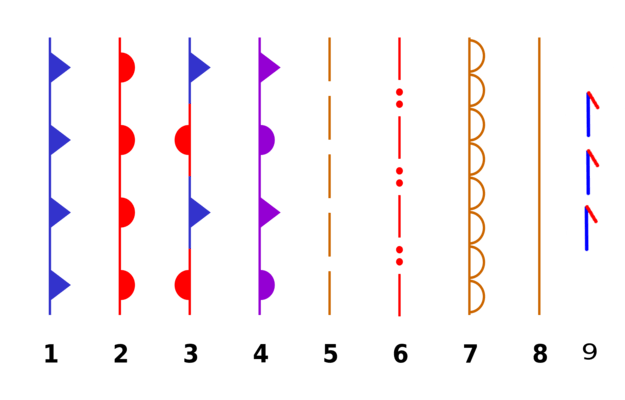
What symbol is this?
a)
warm front
b)
cold front
c)
stationary front
d)
occluded front
3.

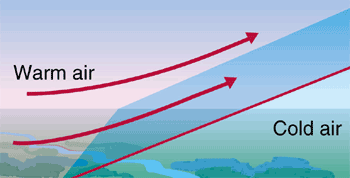
What type of front is shown?

a)

Warm Front

b)

Cold Front

c)

Occluded Front

d)

Stationary Front

4.
This is the symbol for which type of front?
a)
cold front
b)
warm front
c)
stationary front
d)
occluded front
5.

This is the symbol for a _____________ weather front.

a)

Cold

b)

Warm

c)

Stationary

d)

Occluded

6.

A _____________ weather front occurs when a cold air mass moves forward, pushing the warm air mass up.

a)

Cold

b)

Warm

c)

Stationary

d)

Occluded

7.

A _____________ weather front occurs two cold air masses meet and push/force the warm air in the middle upwards.

a)

Cold

b)

Warm

c)

Stationary

d)

Occluded

8.

Why does warm air rise above cold air?

a)

Warm air is less dense

b)

Warm air is more dense

c)

Cold air is stronger than warm air

9.
What does symbol # 3 mean?
a)
stationary front
b)
occluded front
c)
warm front
d)
cold front
10.
_____________ air is more dense and tends to sink
a)
cold
b)
warm
c)
moist
d)
dry
11.

What type of front produces gentle rain showers for longer periods of time?

a)

Cold Front

b)

Warm Front

c)

Occluded Front

d)

Stationary Front

12.

What type of front may have clear skies?

a)

Cold Front

b)

Warm Front

c)

Occluded Front

d)

Stationary Front

13.

What type of front creates violent thunderstorms?

a)

Cold Front

b)

Warm Front

c)

Occluded Front

d)

Stationary Front

14.

What type of front is stalled or still?

a)

Cold Front

b)

Warm Front

c)

Occluded Front

d)

Stationary Front

15.

Cold fronts occur when a __________ air mass overtakes a warmer air mass.

a)

cold

b)

warm

c)

cloudy

d)

thunderstorms

16.

Warm fronts move __________ than cold air masses.

a)

slower

b)

faster

c)

in the same speed as

d)

in a random pattern

17.

A Stationary Front is the boundary between __________ air masses that are not moving.

a)

two

b)

warm

c)

cold

d)

thunderstorm

18.

What type of weather might occur with a Stationary Front?

a)

Clear skies or partly cloudy skies

b)

Only heavy rain

c)

Constant thunderstorms

d)

Unchanging temperature

19.
Which type of front is near Seattle?
a)
cold front
b)
warm front
c)
occluded front
d)
stationary front
20.
Choose the best forecast for Los Angeles on Saturday.
a)
cooler temperatures
b)
warmer temperatures 
c)
low pressure
d)
snow
21.
Choose the best forecast for Dallas on Saturday.
a)
thunderstorms
b)
snow
c)
warmer temperatures
d)
clear skies
22.
Choose the best forecast for Minneapolis on Saturday.
a)
snow
b)
cloudy skies
c)
hail
d)
sunny skies
23.

A front usually marks a change in weather

a)

True

b)

False

24.

What does a "H" indicate on a weather map?

a)

a high pressure system

b)

an area with extremely high temperatures

c)

an area in which a hurricane may likely develop

d)

an area under a heat advisory

25.

What kind of weather does a High Pressure System bring?

a)

stormy weather

b)

nice weather

26.

A/an _____________________ is a large body of air that has the same temperature and humidity throughout.

a)

Front

b)

Air mass

c)

Cloud

d)

Tornado

27.

What type of air mass will cause a Cold Front?

a)

Maritime

b)

Continental

c)

Tropical

d)

Polar

28.

An air mass that formed over the ocean near the equator would probably be

a)

Maritime polar

b)

Maritime tropical

c)

Continental polar

d)

Continental tropical

29.
How do we name air masses?
a)
Water and temperature
b)
Air pressure
c)
Humidity and temperature
d)
Cold and warm
30.
How do we characterize an air mass that forms over the ocean?
a)
Dry
b)
Wet
c)
Cold
d)
Warm
31.
How do we characterize an air mass that forms over land?
a)
Dry
b)
Wet
c)
Cold
d)
Warm
32.
How do we characterize an air mass that forms near the poles?
a)
Dry
b)
Wet
c)
Warm
d)
Cold
33.
How do we characterize an air mass that forms over near the equator?
a)
Dry
b)
Wet
c)
Cold
d)
Warm
34.
What types of air masses form over oceans?
a)
Maritime
b)
Continental
c)
Polar
d)
Tropical
35.
What's the humidity and temperature of a continental tropical air mass?
a)
Wet and cold
b)
Dry and warm
c)
Wet and warm
d)
Dry and cold
36.
What's the humidity and temperature of a maritime tropical air mass?
a)
Wet and cold
b)
Dry and warm
c)
Wet and warm
d)
Dry and cold
37.
A wet and cold air mass would be a...
a)
Maritime polar
b)
Continental polar
c)
Maritime tropical
d)
Continental tropical
38.
A dry and cold air mass would be...
a)
Maritime polar
b)
Continental polar
c)
Maritime tropical
d)
Continental tropical
39.
A dry and hot air mass would be...
a)
Maritime arctic
b)
Maritime tropical
c)
Continental tropical
d)
Continental polar
40.

Which diagram (A or B) shows a HIGH pressure system?

a)

A

b)

B

41.

What type of weather would you expect in high pressure?

a)

sunny clear skies, calm winds, cool, dry air

b)

foggy skies, light rain, moist, cold air

c)

sunny skies, humid air, calm winds

d)

cloudy skies, strong winds, wet air

42.

Which diagram illustrates a LOW pressure system?

a)

A

b)

B

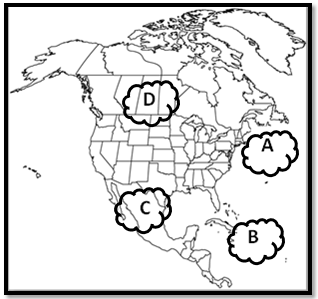
43.
Which type of air would you find at air mass B?
a)
cold, dry
b)
warm, humid
c)
warm, dry
d)
cold, humid
44.
Which type of air would you find at air mass A?
a)
cold, dry
b)
warm, humid
c)
warm, dry
d)
cold, humid
45.

The following picture shows a weather map of Virginia. What type of weather is Virginia having in this map?

a)

cloudy, rainy weather

b)

sunny, dry, fair weather