wayground logo

Free Printable Worksheets

Font size

S
M
L
XL
Worksheets

9.3 Review

Total questions: 20

Worksheet time: 6mins

Name
Class
Date
1.

Why were the Kalinga Wars seen as a turning point for Ashoka?

a)
The Kalinga Wars prompted Ashoka to adopt Buddhism and a policy of non-violence.
b)
The Kalinga Wars strengthened Ashoka's military power.
c)
Ashoka became a tyrant after the Kalinga Wars.
d)
The Kalinga Wars had no impact on Ashoka's reign.
2.

What is Legalism?

a)

Legalism is primarily concerned with moral teachings and personal ethics.

b)

Legalism is a political philosophy that advocates for strict laws and centralized authority to maintain order.

c)
Legalism is a philosophy that encourages democratic governance and public participation.
d)
Legalism promotes individual freedom and minimal government intervention.
3.

What direction is the Gobi Desert in relation to China?

a)
South
b)
East
c)
West
d)
North
4.

Who was Chandragupta II

a)
A famous philosopher in ancient Greece.
b)
A military general in the Roman Empire.
c)
A legendary figure in Chinese mythology.
d)
Chandragupta II was a ruler of the Gupta Empire in ancient India.
5.

What is Daoism?

a)
Daoism is a Western philosophy focused on individualism.
b)

Daoism is a Chinese philosophical and religious tradition that emphasizes living in harmony with nature

c)
Daoism is a form of modern art.
d)
Daoism is a type of martial arts.
6.

Who was the creator of daoism?

a)
Zhuangzi
b)

Lao tzu

c)
Sun Tzu
d)
Confucius
7.

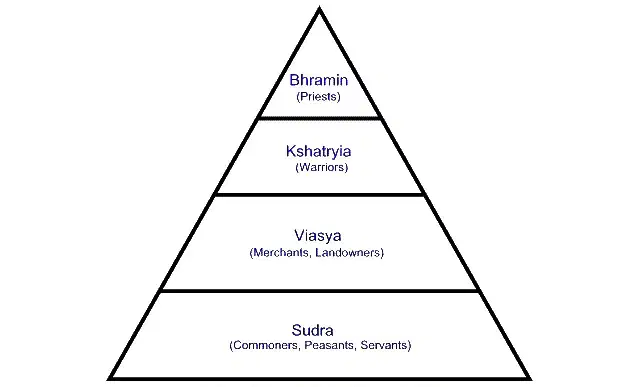
What social hierarchy pyramid is this?

a)
Varna system
b)
Class hierarchy
c)
Feudal system
d)
Caste system
8.

Which came first, Buddhism or Hindusim?

a)
Hinduism
b)

Buddhism

9.

What was the Gupta Golden Age known for?

a)
Decline in trade and commerce.
b)
Focus on military conquests.
c)
Advancements in art, science, mathematics, and literature.
d)
Emphasis on agricultural practices.
10.

What period led to rise of Shi Huangdi and the unification of China?

a)
Tang Dynasty
b)
Han Dynasty
c)
Warring States period
d)
Three Kingdoms period
11.

The name of the set of laws created and written on pillars by Ashoka

a)

Edicts

b)
Code of Hammurabi
c)
Pillars of Justice
d)
Laws of Manu
12.

What belief system does the idea of Filial Piety belong to?

a)
Hinduism
b)
Taoism
c)
Confucianism
d)
Buddhism
13.

An example of Shi Huangdi and the successful unification of China would be...

a)

Standardized currency and language

b)
The construction of the Great Wall in 300 BC.
c)
The establishment of the Han Dynasty in 206 BC.
d)
The division of China into warring states in 500 BC.
14.

The Gupta Golden Age was known for its advances in

a)
agriculture, textiles, pottery
b)
architecture, sculpture, philosophy
c)
politics, warfare, trade
d)
mathematics, astronomy, medicine, and literature
15.

Which of these is NOT a trade route used during the periods we have covered

a)

Silk Roads

b)

Indian Ocean Complex

c)

Trans-Saharan Trade Routes

d)

Mediterranean Ocean Complex

16.

What was the name of the main character in The White Tiger

a)

Haram

b)

Balram

c)

Pinky Madam

d)

The Stork

17.

What year was the Terracotta Army found?

a)

1984

b)

1974

c)

1994

d)

1964

18.

Which of these is not a major geographical feature of China

a)

Taklamakan Desert

b)

Gobi Desert

c)

Bhutan Plateau

d)

Himalayas

19.

What is an example of an Enduring Issue?

a)
Inequality
b)
Stability
c)
Freedom
d)
Opportunity
20.

The Buddha's name was??

(a)