
Font size
 Worksheets
Microscope, EDP, and variables review
Total questions: 44
Worksheet time: 43mins
What is the definition of an independent variable?
A variable that is measured or observed in an experiment.
A variable that is not relevant to the experiment.
A variable that is determined by chance in an experiment.
A variable that is manipulated or controlled by the researcher in an experiment.
What is the definition of a dependent variable?
A dependent variable is the variable that is manipulated in an experiment or study.
A dependent variable is the variable that remains constant in an experiment or study.
A dependent variable is the variable being measured or observed in an experiment or study.
A dependent variable is the variable that is controlled by the researcher in an experiment or study.
In an experiment to test the effect of sunlight on plant growth, what is the independent variable?
Sunlight
Soil
Temperature
Water
Which variable is plotted on the x-axis of a graph?
dependent variable
y-axis variable
control variable
independent variable
Which variable is plotted on the y-axis of a graph?
dependent variable
x-axis variable
control variable
independent variable
Observations made during an experiment are called:
data
problems
conclusions
questions

The graph below shows atmospheric carbon dioxide levels since the year 1880.Which of the following conclusions can be drawn from this graph
Atmospheric carbon dioxide levels are responsible for global temperature change.
Atmospheric carbon dioxide levels have been rising at about the same rate for the past century.
Atmospheric carbon dioxide levels have remained the same over the past century.
Atmospheric carbon dioxide levels have been rising at an increasingly higher rate as the past century has progressed.

At what temperature did bread mold the slowest?
20
40
60
80
Thomas tests different types of liquids to see which will grow his plants the most. He has water, soda, milk, and no liquid at all. What is the control group?
the one with water
the one with soda
the one with milk
the one with no liquid
A scientist hypothesizes that the temperature at which an alligator's egg is incubated will determine whether the alligator will be male or female. The independent variable is

In this experiment the independent variable would be:
The egg.
The volume of water.
The amount of salt.
The float level.

In this experiment the independent variable would be:
The distance travelled by the model planes.
The force each was thrown with.
The materials each was made with.
The type of model.

Why would it be a safety concern if a student eats or drinks during a lab investigation?
Because the food might not have the correct taste or smell in a lab environment
Because you may have to go out and get more food, and you will not have time
Because chemicals could splash onto the food accidentally
Because you may have to use the hot pads or protective gloves if the food is heated or you will get burned

Which instructions do students need to follow when it comes to lab safety in the science classroom?
Only the written safety notes on the lab worksheet
Safety guidelines that describe Chemical Safety only
Safety guidelines that describe Fire Safety only
Any safety guidelines that could be involved with the method and materials of the experiment.

Let's say you are trying to determine how to make a thicker liquid that will help reduce the friction or rubbing of the gears in a machine. This is the goal or main point of the lab investigation. Which step of the Engineering Design Plan is this?
ASK
IMAGINE
PLAN
CREATE
IMPROVE

Why is it important to make IMPROVEments to your Engineering Design Plan?
because you must have perfect results
because the more you write, the better your experiment will be
because often during an experiment, you and your partner come up with an extra procedural step that improves the accuracy of the experiment
because your lab results need to be better than the other teams' results

What are some ways that would be helpful to show your data and results?
Graphs, Tables, Charts
Paragraphs and sentences
By writing YES or NO in a T-Chart
as a list of materials

What does it mean if you are directed to "waft" a chemical at your table?
To waft means to drink a chemical slowly
This means to bring air across the top of the beaker with the chemical, so you do not smell it directly
Wafting a chemical means to stir it up with an unknown chemical quickly
To waft means to smell the chemical directly, take a deep breath and smell the chemical with your nose right above the beaker

What are the written lists or drawings that should be completed in the PLAN section of the Engineering Design Plan?
State the Question and Conclusion
Brainstorms (3)
Materials, Method & Diagram
Improvements
Why is it so important to COMMUNICATE AND SHARE in the Engineering Design Process? (What do you really need to talk about anyhow?)
Your team should come up with a reasoning statement, based on your data and the ideas of those in the groups.
Your team should do a lot of talking during an experiment, because it makes it more nteresting.
Your team needs to talk about finishing up the last step of the lab!
Your group will not WIN the EDP if you do not talk a lot about the investigation!

Look at the diagram of the STEM Engineering Design Plan. Which step is missing?
(a)
A series of steps that engineers can follow to solve a problem
engineering design process
engineering solutions
collaboration
matrix
If your initial design doesn't fully solve the problem or meet the criteria, you must go back and revise your plan. This is part of which step in the Design Process?
Create/build
The process by which group members freely suggest any creative solutions to a problem is called...
brainstorming
troubleshooting
patent
constraints
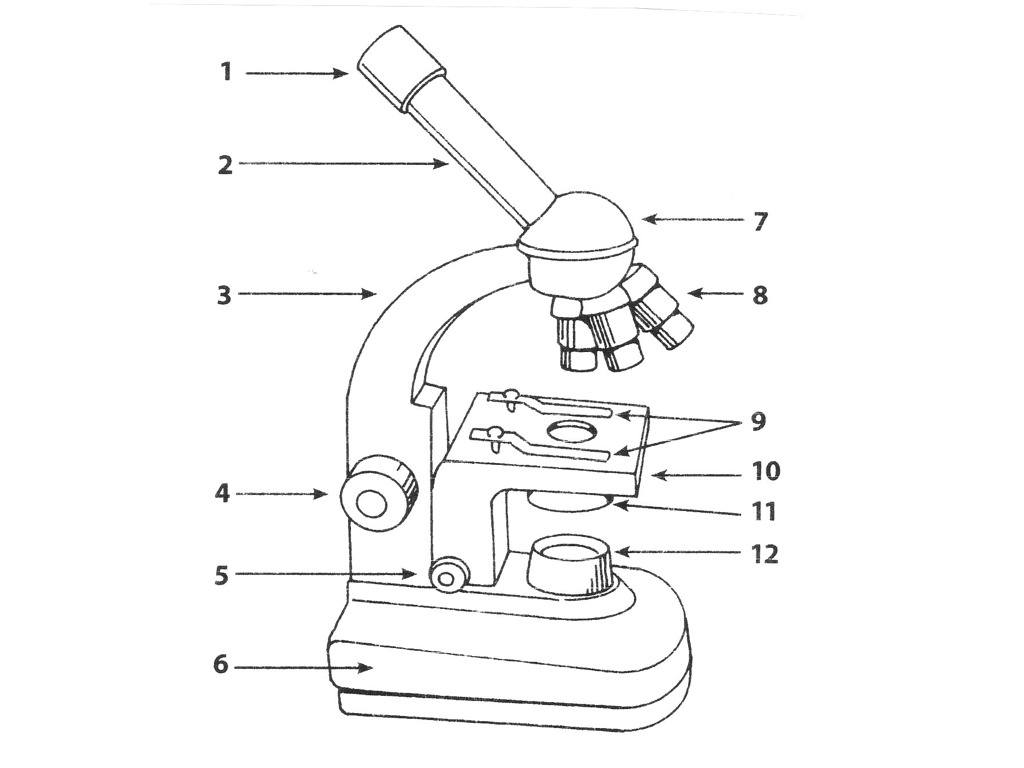


Moves stage up and down for focusing; locates the specimen
Coarse Adjustment Knob
Large Focus Knob
Course Focus Knob
Small Focus Knob
Which objective lens should you start on to locate an image?
medium power
low power
high power

Label the part of the microscope. What is part E?
stage
stage clips
focus knob
eyepiece tube
On the revolving nose piece of the light microscopes we practiced labeling, there were three ________________ which allows different amounts of magnification.
detail
magnification
objectives
body

Arm
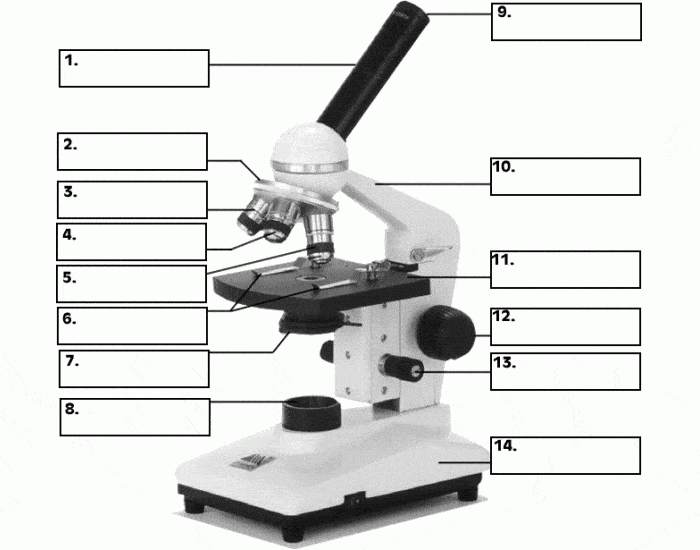


Which part of the microscope is labeled 10?
Ocular Lens
Fine adjustment knob
base
light source

