
 Worksheets
Body Systems Review
Total questions: 50
Worksheet time: 25mins
First & Last Name
Which of the following is part of the human respiratory system?
aorta
pancreas
nose
all of the above
What path does food take through your digestive system?
stomach, esophagus, small intestine, large intestine
stomach, small intestine, large intestine, esophagus
esophagus, stomach, large intestine, small intestine
esophagus, stomach, small intestine, large intestine
After running for a few minutes, your pulse is likely to have ______________.
increased
decreased
stayed the same
first decreased and then increased
Touch receptors are part of which system?
immune
nervous
muscoskeletal
endocrine
What is most likely to happen to your resting pulse after exercising regularly for several months?
It will increase
It will decrease
It will stay the same
It will become more variable
Which best describes the organization of the human body from largest to smallest?
organs, organ systems, tissues, cells
organ systems, organs, tissues, cells
organ systems, tissues, organs, cells
cells, tissues, organs, organ systems
For food to be absorbed by your body, which must occur?
mechanical breakdown
chemical breakdown
both a and b
neither a nor b
One main function of capillaries is to _____________.
carry oxygen and nutrients to every cell
reverse the flow of blood
prevent people from bleeding too much when they are cut
maintain normal blood pressure
Which is most responsible for the mechanical breakdown of food?
saliva
teeth
stomach
small intestine
Chemical digestion mostly occurs in the _________.
liver and pancreas
liver and gall bladder
stomach and intestines
esophagus and stomach
How does mechanical breakdown affect chemical breakdown during digestion?
Mechanical digestion increases the speed of chemical breakdown.
Mechanical breakdown decreases the speed of chemical breakdown.
Mechanical breakdown has no effect on chemical breakdown.
None of the above
Variables that might affect how long it takes Ali's baby sister to fall asleep include ______________.
time of day
noise levels
both a and b
none of the above
Which variable(s) is Miko planning to control in the race?
time
distance
both a and b
none of the above
Sean waters five plants with seawater and five with fresh water. Which variable did he keep constant?
daily amount of sunlight
daily amount of water
both a and b
none of the above

Sean waters five spider plants with seawater and five with fresh water for 20 days. Based on the results, what can Sean conclude?
Spider plants grow better with fresh water than salt water.
Spider plants need water to grow.
Spider plants need to be near a window.
Salt water does not affect the growth of spider plants.

Sean waters five plants with seawater and five with fresh water for 20 days. Which statement about his experiment is TRUE?
His experiment included a control.
His experiment included too many variables.
The results of his experiment apply to all plants.
The results of his experiment cannot be used to make a conclusion.
If you participate in a clinical trial for a new asthma medicine, you could receive ______________.
the medicine
the placebo
either a or b
neither a nor b
The benefit gained from testing medicines on people is known as ______________.
a consequence
evidence
a trade-off
a conclusion
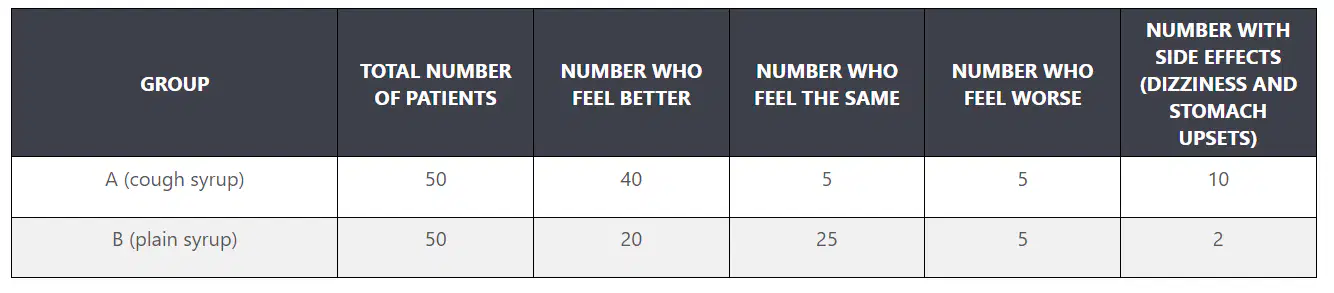
Scientists tested a new cough medicine on two groups. Group A got the medicine, and Group B got a placebo. They checked if the coughs improved and noted any side effects. How well does the medicine work?
(a)
A tissue in your body that includes both cells and liquid materials
arteries
capillaries
blood
veins
neuron
The tubes that carry blood back to your heart
arteries
capillaries
blood
veins
neuron
Tubes with walls so thin that oxygen, nutrients, and waste can pass through
arteries
capillaries
blood
veins
neuron
The tubes that carry blood away from your heart
arteries
capillaries
blood
veins
neuron
The smallest structural unit, enclosed by a membrane, that makes up all living organisms
cell
fat
protein
organ
system
A collection of tissue that performs a particular function
cell
fat
protein
organ
system
One of the three macronutrients in food that provide energy, used primarily for building tissues like muscle and bone.
cell
fat
protein
organ
system

