
 Worksheets
Jamestown and 13 Colonies
Total questions: 120
Worksheet time: 1hrs 29mins


Which group of colonies had a combination of a warm climate and rich soil that supported plantations?
New England Colonies
Middle Colonies
Southern Colonies
These colonies had more religious diversity than other colonies:
New England Colonies
Middle Colonies
Southern Colonies
What are cash crops?
Trees that grow money
Crops that are grown to be sold for profit
Plants that are really, really tall
Crops that are grown for the farmer to consume
True or False: Puritans generally settled in the Southern colonies
True
False
Who was the tough governor of Jamestown who improved the settlement?
John Cabot
George Washington
John Smith
Christopher Columbus
An immigrant...
was friendly with the settlers, but then turned hostile.
comes to live permanently in a foreign country.
makes the laws of the land.
was heavily invested in colonial trade.

This is a large estate or farm, also known as...
a plantation
a colony
St. Augustine
garden
What were a series of transatlantic trade routes that typically went from Europe to Africa to the West Indies or colonies and then back to Europe?
Atlantic Trade
Octagon Trade
Triangular Trade
Square Trade
What's another name for the trip from Africa to the West Indies or the colonies, generally shipping enslaved people?
Middle Passage
Southern Passage
Northwest Passage
Atlantic Passage
The first colony founded was
(a)
The settlement of Jamestown was founded in
1626
1607
1732
1712
Most people came to the New England colonies for religious reasons.
True
False
The land the became known as the colony of New York was first owned by what country?
(a)
Who founded the colony of Massachusetts Bay?
Pilgrims
Quakers
Puritans
Which group of colonies is called the "breadbasket of the colonies?
New England
Middle
Southern
Who founded Georgia?
James Oglethorpe
John Winthrop
William Bradford
What was the last colony founded?
Carolina
New York
Georgia
Which group of colonies was mostly started for economic reasons?
New England
Middle
Southern
Lord Baltimore founded which colony?
Rhode Island
Pennsylvania
Maryland
South Carolina
Which colony was founded as a refuge for Catholics?
North Carolina
Delaware
Maryland
a crop grown for sale rather than for use by farmers
backcountry
commodity
cash crop
neutrality
a person under contract to work, usually without pay, in exchange for free passage to the colonies
charter
indentured servant
traitor
joint stock company
a person who disagrees with a majority belief or position
separatists
indentured servant
traitor
dissenter
a company whose shareholders own stock in the company
charter
indentured servant
traitor
joint stock company
the basic substances and elements used to make products
neutrality
raw materials
provisions
conformity
acceptance of others
religious freedom
conformity
artisan
tolerance
the right to practice the religion of one’s choosing without government interference
commodity
banished
artisan
religious freedom
the right to practice the religion of one’s choosing without government interference
commodity
banished
artisan
religious freedom
Which group of colonies had a combination of a warm climate and rich soil that supported plantations?
New England Colonies
Middle Colonies
Southern Colonies
True or False: Puritans generally settled in the Southern colonies
True
False
True or False: Quakers in the Middle colonies enjoyed rich goods, like fancy clothes and large houses
True
False
Which colonies used natural resources like white pine trees and cod to meet their needs?
New England Colonies
Middle Colonies
Southern Colonies
A group of people elected to make laws is a:
Constitution
Compact
Declaration of Justifce
Legislature
A person who goes agrees to work for another in exchange for the price of passage to the colonies is a(n):
colonist
skinner
indentured servant
merchant
The economic theory that motivated England to start colonies is:
colonialism
mercantilism
capitalism
export theory
An item that is traded outside of one's country is called a(N):
export
import
mercantile
colonialist
An item that is purchased from another country is a(n):
Import
export
mercantile
colonialist
Which of the following groups did NOT come to Colonial America by choice:
indentured servants
Pilgrims
colonists
slaves
There was a great deal of economic opportunity in Colonial America because there was so much:
Religious freedom
available land
gold
spice
Charter
A type of boat
A paper that describes a colony
A code of laws
A document that granted the right to form a colony.
Raw Materials
Headright
A document granting land ownership
A system used in the Virginia Colony to encourage farming
Burgesses
A type of meal had in the colonies
Appointed government officials
A city in the Virginia colony
Land owning elected representatives
Self - Governance
when the King granted a charter to a person or group to set up its own independent governing system.
(set up to make money for the colonists)
when a governor runs the colony to only benefit himself
when a colony is no longer a part of Britain
when the King granted a charter to a person or group to set up its own independent governing system.
(set up to make money for the King)
Pilgrim

A person who likes to wear hats
A name for those who "live off the land"
A person who travels to a place for a religious or spiritual reason.
A person who moves to find new work or land
Triangular Trade
A trade of triangles
Mercantilism
An economic theory that there should be no taxation on local goods.
An economic theory that a nation’s power depends on its ability to increase wealth through bullion supply
An economic theory to use bullion (gold or silver) as currancy
Which settlement did the Virginia Company establishing for economic reasons?
Jamestown
Plymouth
New York City
Boston
The FOC, VHoB, and Mayflower Compact are early examples of -
Self-government in the north america
Economic policies that influenced the constitution
Religious doctrines that early colonists practiced
Foreign trade policies meant to restrict colonial economy
Why did Europe colonize North America?
To win wars against other european nations
To expand in africa
For trade and new resources
To spread political ideas
What was Mercantilism?
An economic system meant to benefit the mother country
A system for adding states to the union
A policy that forbid settlement west of the appalachian mountains
A series of taxed meant to pay off England’s war debt
The Northern Colonies economy was primarily -
Industrial
Agricultural
Plantation Farming
Slave Labor
The Southern Colonies economy was primarily -
Industrial
Agricultural
Subsistance Farming
Wage Labor
Which region had a climate that only allowed for a very short growing season?
Southern
New England
Middle
Which region had lots of fishing, ship-building, and lumber?
Southern
Northern
New England
Which region had a more diverse population of immigrants (mostly due to the fact that they had a law protecting the religious freedom of many different groups)?
Middle
Southern
New England
Which region had good farming soil but supported mostly smaller, family farms instead of large plantations?
Southern
New England
Middle
Which region depended heavily on indentured servants for labor?
Southern
New England
Middle
Which region is known for its large plantations and expansive cotton fields?
Southern
Middle
New England
The New world offered an opportunity to own...
LAND
the answer is land
pick land
land was very important

Who benefits most from mercantilism?
The Colonies
The Mother Country
Who benefits most from mercantilism?
The Colonies
The Mother Country
Mayflower Compact
An agreement to form a government
A list of questions for a judge
Something used by women to apply makeup
What year did the colonist settle in Jamestown?
1607
1706
1608
1886
What was the name of the group of men who were financially investing in the colony?
King James Industries
Captain Smith and Sons
The Virginia Company of London
The Jamestown Initiative
The practice of farming.
brackish
agriculture
palisade
cash crop
Jamestown is the first _______________ settlement.
Irish
English
Welsh
Royal
What kind of crop grew well around Jamestown and became the colony's first cash crop to England?
tabacco
cotton
corn
rice
Which of these describes the experience of the first Jamestown settlers?
they were challenged by the environment
the found an area already settled by the Dutch
they were welcomed by the Indigenous people
they quickly established a prosperous settlement
Why did the London Company send settlers to Virginia?
to create maps of the area
to establish a trading post
to start a moneymaking colony
to make peace with Indigenous people
Explorers & People:
the leader of the Jamestown colony
John Cabot
Sir Walter Raleigh
John White
John Smith
Explorers & People:
the daughter of an Indian leader, brought food to the Jamestown settlers and helped them survive
Pocahontas
John Rolfe
Chief Powhatan
John Smith
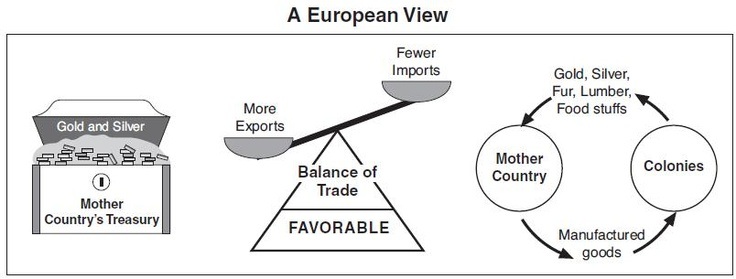
What is mercantilism?
A system where a mother countries gains money and power from natural resources that come from its colonies.
where colonies trade gold and silver with each other.
Wars that start over money.
Plantation colonies trading slaves for money.

True or False? Great Britain wanted to create wealth by importing more goods than it exported.
True
False

EXPORTS of the 13 colonies included:
Manufactured goods
Raw Materials
Slaves
Gold

This group of people suffered the most after Bacon's Rebellion. They received harsh punishments.
Poor whites
Slaves
Landowners
Bacon's Rebellion revealed that there was _____ in which the poor and the rich in the colonies were at odds with each other.
Class Conflict
Racism
Slavery
What effect did Bacon's Rebellion have on the colonies/U.S.?
Land owners were now fearful of using slaves
Slavery became the dominant form of labor in the South
Governor Berkeley left the colonies unprotected from Spain

Where was the House of Burgesses located?
In England
In Plymouth
In Jamestown
None of the answers are correct

Virginia House of Burgesses was the first _______ in the New World?
permanent settlement
monarchy
representative assembly
none of these answers
Who could be elected to the Virginia House of Burgesses?
White, female property owners who were at least 17 years old.
White, male property owners who were at least 17 years old
Black, male property owners who were at least 17 years old.
White, male non-property owners who were at least 17 years old.
What was the impact of the Virginia House of Burgesses?
It created the first social club for wealthy landowners in Virginia.
It was a religious organization that promoted Puritan beliefs.
It marked the beginning of representative government in America.
It was the first monarchy in the American colonies.
What was Bacon's Rebellion?
A peaceful protest against high taxes in the colonies.
An armed rebellion in 1676 by Virginia settlers against the rule of Governor William Berkeley.
A revolt led by Native American tribes against European settlers.
A rebellion in colonists in New England against British colonial rule.
What were the main causes of Bacon's Rebellion?
Poor harvests, religious tensions, and economic inequality.
Political corruption, foreign invasions, and natural disasters.
Social unrest, trade disputes, and military conflicts.
Lack of representation and conflicts with Native Americans.
How did Bacon's Rebellion impact enslavement in Virginia?
The rebellion resulted in the abolition (elimination) of slavery in the Virginia colonies.
The rebellion had no impact on enslavement in the Virginia colonies.
The rebellion led to a decrease in the use of enslaved Africans as laborers in the Virginia colonies.
The rebellion led to an increase in the use of enslaved Africans as laborers in the Virginia colonies.

From 1607 to 1609, only 60 of more than 900 Jamestown colonists survived. One reason for the low survival rate was that the-
swampy location caused disease to spread.
colonists were frequently attacked by Spanish explorers.
colonists endured unexpected flooding.
punishment for all criminal offenses was execution.
Smuggling means
Trading good illegally
Trading slaves
Trading provisions
None of these
Which of the following describes why the colonist began to smuggle goods:
They hated the English taxes on their exports
The English would pay more for smuggled goods
Pirates saw an opportunity to steal from ships
None of these
All of these
Which British Act governed trade between the colonies and Britain (England)?
Bribe Act
Smuggling Acts
Triangular Trade
Navigation Acts
Which type of colony had their own government with no King involvement?
Proprietary
Royal
Charter
business
Which of the following was a american colony that was ruled by the King?
Proprietary
Charter
Royal
Business
Which type of colony was ruled by a small group of men and colonists had to pay to live there?
Proprietary
Royal
charter
business
What opportunities did the English government give the people to come to the Americas? Check all that apply.
Gave them land if they paid their own way
Gave them slaves to work land
Indentured Servants
Gave them ships to come to the new land
Check all that apply.
What types of colonies were created in the Americas?
Charter Colonies
Proprietary Colonies
Royal Colonies
Constitution Colonies

