
 Worksheets
AV 7th Grade Semester Review
Total questions: 50
Worksheet time: 1hrs 2mins
What are two features that plant cells have that animal cells do not?
lysosomes and cell walls
cell walls and chloroplast
cell membrane and nucleolus
Which cell feature is responsible for storing water?
vacuole
mitochondria
lysosomes
nucleus
You will NOT find a cell wall in which of these kinds of organisms?
fungi
animal
plants
Cell -Tissue-Organ- ____________
organelle
organ system
______-Tissue-Organ-Organ System
body
cell

Which part of the cell is often called "the brain of the cell"?
nuclear membrane
endoplasmic reticulum
nucleus
mitochondria
The site of photosynthesis
ribosome
mitochondria
chloroplast
nucleus

I am the outer most layer of an animal cell. What am I?
cell wall
nucleus
cell membrane
cell skin
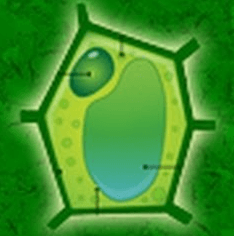
A rigid layer that lies outside the cell's membrane is...
Cytoskeleton
Cilia
Cell Wall
Flagella
A group of tissues that work together to perform a similar function is called_____. (Examples include the heart, lungs or stomach)
cells
tissues
organs
organ system

The _____________ stores food, water, wastes, and other materials in both plant and animal cells.
Vacuole
Mitochondria
Ribosomes
Chromatin
Absorption: After digestion, the useful parts, called nutrients, are _____________ by your body.
Protein
Digested
Absorbed
Metabolism
Digestion: It all starts with the food you eat. Your body breaks down the food into smaller parts through a process called __________.
Enzymes
Metabolism
Protein
Fats
Your body breaks down the food into smaller parts through a process called _______.
digestion.
absorption
Where does digestion start?
mouth
stomach
small intestine
What is cellular respiration, and where does it occur?
Inside of the cells.
Outside of the cells.
What is the role of enzymes in metabolism?
To supply your cells with energy.
To slow down chemical reactions in your body.
To speed up and help with chemical reactions in your body.
Energy in food is measured in which unit?
calories
proteins
carbohydrates
enzymes
The enzymes in you mouth are found in your...
teeth
tongue
saliva
Marisol has been chewing and swallowing her food, but her digestive system is not doing what it usually does. Why is this a problem for her ability to exercise?
A Her cells will not work well because molecules from her food are not being broken down small enough to get to her cells.
B Her body will run out of energy because molecules from the air are not being combined into larger molecules for the cells.
C Her respiratory system will have to work twice as hard to break down molecules from food.
D Her cells will not work well because the molecules from food will be too small for cells to use.
Raoul ate a meal of oats before seeing his doctor. Oats are made of mostly starch molecules. Raoul feels tired, so his doctor gave him a test and found that Raoul’s cells contained glucose molecules, but they did not contain enough oxygen molecules. Does this explain why Raoul feels tired?
A No, something else must be wrong because his cells have all the molecules they need.
B Yes, his digestive system is breaking down starch molecules, but his respiratory system may not be working properly.
C Yes, his respiratory system is working, but his digestive system is not getting energy from combining glucose molecules.
D Yes, his digestive system is working, but his respiratory system is not breaking down oxygen, so his body stopped making energy.
What is starch?
a type of energy storage molecule made of many glucose molecules connected together
a molecule that organisms can use to release energy and that is made of carbon, hydrogen, and oxygen atoms
a category of large molecules that perform important functions inside living things
a molecule that organisms get from the air or water around them and use to release energy
An offspring cannot have a trait if neither of its parents have it.
True
False
Rabbit friends (not related) have different shaped ears because:
the genes are only standing straight up in the cells of one rabbit's ears
Offspring from different parents will always have different ear shapes
the rabbits have different versions of the gene for ear shape, which instruct for different proteins that connect in different ways
Why do siblings and parents different from each other?
Siblings get different amounts of genes from their mother or father making them different.
Siblings use their environment and experiences to determine their traits.
Each sibling has a mutation that causes them to have different traits.
Offspring inherit different combinations of gene versions from parents.
tt

In the punnett square, what is the probability for white fur?
BB
Which of the following is a phenotype?
Aa
red hair
heterozygous
DNA
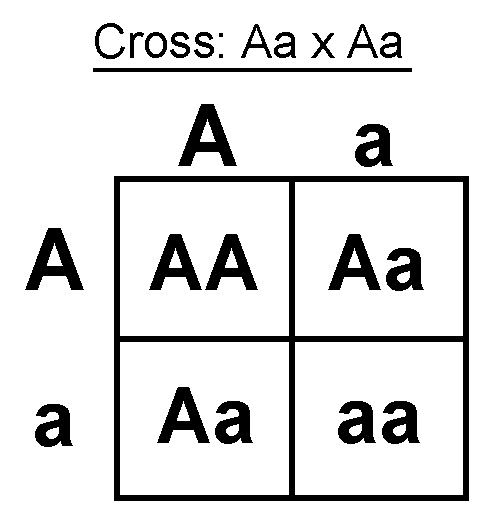
What is the phenotype of the offspring? (A-Brown hair; a-blond hair)
50 % Brown Hair and 50% Blond Hair
25 % Brown Hair and 75% Blond Hair
75 % Brown Hair and 25% Blond Hair
0% Brown Hair and 100% Blond Hair
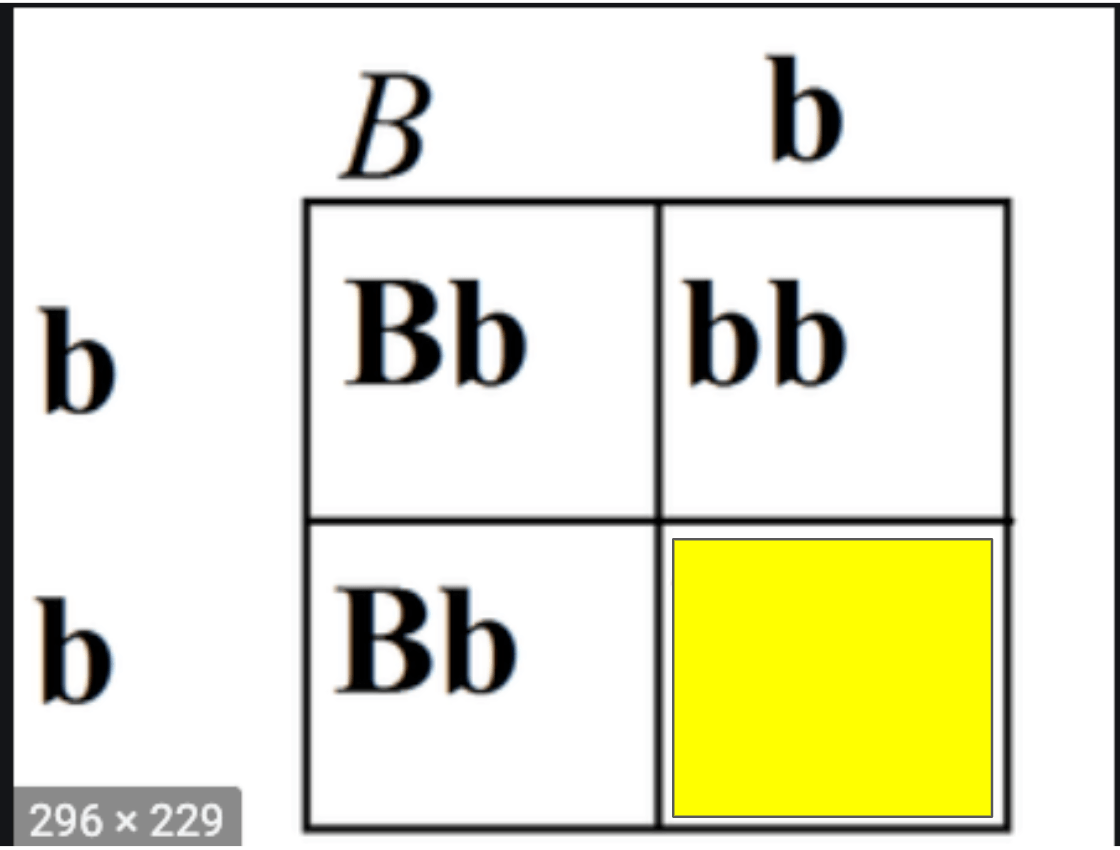
Fill in the Yellow Box
Bb
BB
bb
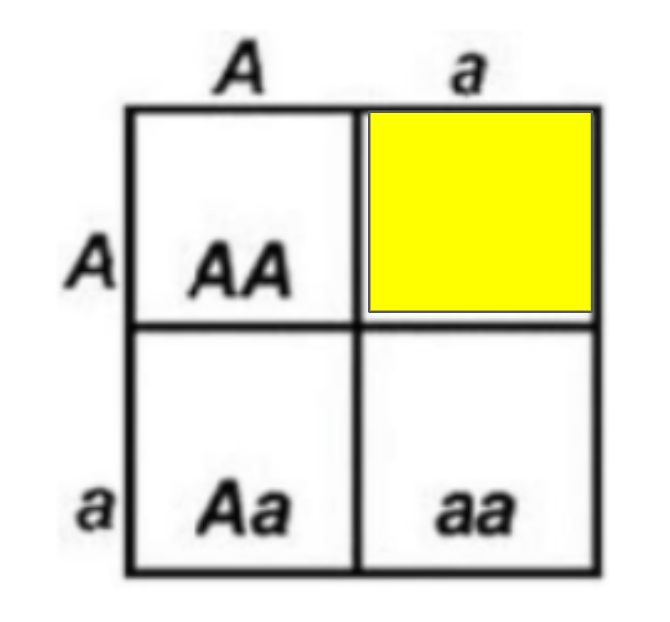
Fill in the Yellow Box
AA
Aa
aa

What allele combination should go in the missing box?
AA
Aa
aa
none of these
What is a mutation and how does it affect genes?
A mutation is a change in an organisms genes
A mutation is a feature of an organism
A mutation is a copy of a gene
A mutation is a growth on an organism
What do genes do?
Give the organism its genes
Provide instructions for proteins
Build proteins
Pass on the genes to the offspring
What does homozygous mean?
two copies of a gene that are mutated
two copies of a gene version that are the same
two copies of a gene version that are different
two copies of a gene that are used to create another gene
An allele whose trait always shows up in the organism when the allele is present. The "stronger" gene.
Dominant Allele
Recessive Allele
An allele that is masked when a dominant allele is present. The "weaker" gene.
Dominant Allele
Recessive Allele
The human microbiome contains approximately 100 trillion ___________. Most of these are bacteria.
microorganisms
blood cells
fungi
C. jejuni
The human body provides an environment (food and _______) for bacteria to survive.
nitrogen
blood
oxygen
space
A healthy _______________ has various helpful types of bacteria.
nanometer
micrometer
microbiome
computer

About how many microorganisms live in and on the human body?
100 trillion
100 billion
100 million
100 gazillion
what is a cell classified as?
a basic unit of structure and function of all living organisms
a unit based on only plants and animals that are living
Which is bigger, a molecule or a cell?
molecule
cell
Within a population organisms are always being born and dying.
True
False
When a population is stable it means....
there are more births than deaths.
there are less births than deaths.
there are the same number as births than deaths.
If a population is INCREASING this means...
there are more births than deaths.
there are less births than deaths.
there are the same amount of births and deaths.
Energy storage molecules are:
molecules required only for the birth rate
potatoes
a molecule organisms use to stabilize a population
a molecule that organisms can use to release the energy needed to survive

The dark structure in the middle of each cell is a
nucleus
lysosome
mitochondria

When similar cells group together it is called a tissue
true
false

