
 Worksheets
Regulations Final study guide BL
Total questions: 129
Worksheet time: 11hrs 45mins
no person may operate a civil aircraft unless it has within it, an appropriate and current airworthiness certificate and in addition to that;
A.Aircraft engine and airframe logbooks, Radio operator's permit
Aircraft engine and airframe logbooks
A.FOM or Operating limitations placard and markings showing perating limitations and Registration Certificate.
Airworthiness Certificate of an aircraft remain valid without expiration.
A.if the aircraft has a current Registration Certificate.
A.if the aircraft is maintained and operated as required by Federal Aviation Regulations.
if the aircraft is not damaged
No person may operate a civil aircraft unless the airworthiness certificate
has been applied for
has been affixed to an aircraft on the outside surface
displayed at the cabin or cockpit entrance so that it is legible to passengers or crew.
Which instrument of an powered civil aircraft with standard category U.S. airworthiness certificates is not required for an VFR flight?
Airspeed indicator and altimeter
navigation equipment suitable for the route to be flown.
magnetic direction indicator
tachometer for each engine and oil pressure and temperature gauges.
For small civil airplanes certificated after March 11, 1996, in accordance with part 23 of this chapter, an approved aviation red or aviation white anticollision light system is required
after sunset to sunrise.
1 hour after sunset.
Anytime
Which is required equipment for powered civil aircraft with standard category U.S. airworthiness certificates during VFR night flights?
Gyroscopic bank-and-pitch indicator.
Slip-skid indicator.
Anticollision light system.
Which is required equipment for powered civil aircraft with standard category U.S. airworthiness certificates during VFR night flights?
landing light if the flight is for hire.
Slip-skid indicator.
Flashlight
For IFR flight in addition to instruments and equipment are required for VFR and night, an aircraft requires;
VOR receiver
GPS navigation
a slip-skid indicator.
For IFR flight in addition to instruments and equipment are required for VFR and night, an aircraft requires;
Gyroscopic direction indicator.
ILS
VOR
For IFR flight, an aircraft requires;
VOR/LOC receiver, Glide Slope indicator
a coded transponder with C mode
navigation equipment suitable for the route to be flown.
For IFR flight, an aircraft requires;
a coded transponder with C mode
ADS-B equipment
A clock displaying hours, minutes, and seconds with a sweep-second pointer or digital presentation.
DME requirement for IFR for?
A.Flight at and above 24,000 feet MSL (FL 240). If VOR navigation equipment is required.
above 18,000 feet MSL.
In controlled airspace.
If DME fails at and above FL 240, the pilot in command of the aircraft must
Continue and request other route or approach which do not require DME
must notify ATC immediately, and then may continue operations at and above FL 240 to the next airport of intended landing where repairs or replacement of the equipment can be made.
Land as soon as possible where repairs or replacement of the equipment can be made.
Batteries used in the emergency locator transmitters required must be replaced when the transmitter has been in use for more than
60 minutes.
120 minutes.
30 minutes.
Each emergency locator transmitter required by paragraph (a) of this section must be inspected within ____ calendar months
12
48
24
A pilot should turn on the position lights:
1 hour after sunset.
from sunset
30 minutes after sunset.
No person may operate a civil aircraft of U.S. registry unless the required minimum flight crew is provided with and uses supplemental oxygen
entire flight time above 12,500 feet MSL
entire flight time above 14,000 feet.
only for 30 minutes during flight between 12,500 to 14,000 feet MSL
Entire time beyond 30 min between 12,500 to 14,000 feet MSL
At cabin pressure altitudes above 15,000 feet (MSL) what are the oxygen requirements?
Only passengers must be provided with supplemental oxygen but don't have to use.
each occupant (flight crew and passengers) of the aircraft are provided with and uses supplemental oxygen
minimum flight crew is provided with and uses supplemental oxygen
A coded transponder equipped with C mode (altitude reporting) is mandatory for
1. Class A, Class B, and Class C airspace areas.
2. all airspace of the 48 contiguous U.S. and the District of Columbia at and above 10,000 feet MSL (excluding the airspace at and below 2,500 feet above the surface).
3. the lateral boundaries of a Class B or Class C airspace area designated for an airport upward to 10,000 feet MSL;
4. Within the boundary of 30 miles of certain Class B airspace.
Only in 1 and 2
Only in 1,2 and 3
Only in1.
All of the above
For operation of an aircraft that is not equipped with a transponder, the request to ATC must be made at least _____ hour before the proposed operation.
controlling ATC facility at any time prior to entering the controlled airspace.
24 hrs
1 hrs
No person may operate any automatic pressure altitude reporting equipment associated with a radar beacon transponder within Unless, as installed, that equipment was tested and calibrated to transmit altitude data corresponding within
50 feet.
125 feet.
25 feet.
No person may operate an aircraft in B,C, A airspace unless the aircraft has equipment installed
Universal Access Transceiver in all altitude
A.Universal Access Transceiver above FL 180
1090-ES in all altitude or Universal Access Transceiver below FL180
no person may operate an aircraft in Class A airspace unless the aircraft has equipment installed that
ADS-B and FIS-B.
ADS-B.
ADS-B and TIS-B.
Each person operating an aircraft equipped with ADS-B Out must operate this equipment in the transmit mode at all times unless—
In sensitive government mission
in Class G airspace.
Pilot's judgement dictate
Dependent Surveillance-Broadcast (ADS-B) Out equipment must be installed and turned on for operations in?
Above the ceiling and within the lateral boundaries of Class D airspace up to 10,000 feet MSL.
Under the shelf of class B, C airspace.
Above the ceiling and within the lateral boundaries of a Class B or Class C airspace area designated for an airport upward to 10,000 feet MSL
BL When may the 100-hour inspection limitation be exceeded?
Up to 110 hours anytime.
Only when 110 hours not exceeded when landing
The 100-hour limitation may be exceeded by not more than 10 hours while en route to reach a place where the inspection can be done
Select correct statement regarding maintenance inspections?
An annual inspection may be substituted for a 100-hour inspection.
The frequency and detail of the progressive inspection shall provide for the complete inspection of the aircraft within each 100 hours and be consistent with the manufacturer's recommendations,
A 100-hour inspection may be substituted for an annual inspection.
For IFR flight which test and inspection are required?
A.transponder, altimeter and altitude reporting system check within 24 calender months and VOR check in 30days and aircraft annual check
aircraft annual check
ELT check.
100 hours inspection
No person may operate an aircraft that has an experimental certificate—
under instrument flight rules (IFR).
For aerobatic flight
Carrying persons or property for compensation when carrying property for hire.
In order to tow an advertising banner, what is required?
Special training conducted by the Administrator.
Approval from ATC
A certificate of waiver issued by the Administrator.
An annual inspection record should be kept
in FAA records
on the airworthiness certificate.
in the aircraft maintenance records.
When do you require to wear an parachute?
when 60 degree bank and 30 degree pitch is exceeded.
more than 3.8 G
for spin training for CFI rating.
flight test
flight test
A 'restricted' category airplane is limited to an operating radius of 50 miles from its departure point
No person may operate a 'restricted' category airplane carrying passengers or property for compensation or hire.
A pilot of a 'restricted' category airplane is required to hold a commercial pilot certificate appropriate category, class, and type ratings .
No pilot of a civil aircraft may allow a parachute that is available for emergency use to be carried in that aircraft unless it is an approved type and has been packed by a certificated and appropriately rated parachute rigger within preceding ____ days, if its canopy, shrouds, and harness are composed exclusively of nylon, rayon, or other similar synthetic fiber or materials that are substantially resistant to damage from mold, mildew, or other fungi and other rotting agents propagated in a moist environment;
100 days
180 days
365 days
60 days
Each manufacturer or agency that grants zero time to an engine rebuilt by it shall enter in the new record
operating hours of the engine.
changes as required by Airworthiness Directives.
list of old parts used which conform to the production drawing tolerances and limits for new parts
carrying persons or property for compensation or hire are.
authorized in a 'utility' category aircraft.
authorized in 'experimental' category aircraft.
authorized in a 'limited' category aircraft.
owner or operator shall keep the following maintenance records
life-limited parts of each engine, each propeller, and each rotor.
applicable airworthiness certificate data
life-limited parts of each airframe, engine, propeller, rotor, and appliance.
When can the engine logbook show no previous operating time and history?
After the engine has been overhauled
After the engine has been rebuilt by the manufacturer.
When the engine is sold by the manufacturer
What is the minimum visibility required and altitude for aerobatic flight?
3 status miles and 2,000 feet
5 statute miles and 2,000 feet
3 status miles and 1,500 feet
5 status miles and 1,500 feet
If an Aircraft that has been maintained, rebuilt, or altered in a manner that may have appreciably changed its flight characteristics or substantially affected its operation, until an appropriately rated pilot with at least a private pilot certificate flies the aircraft, makes an operational check, it should not be operated;
for compensation or hire.
under IFR rules.
with passengers aboard.
Who is primarily responsible for maintaining an aircraft in an airworthy condition?
Owner or operator of the aircraft.
Pilot in command or operator.
The lead mechanic responsible for that aircraft.
If the preventive maintenance accomplished by a pilot?
A record of preventive maintenance must be entered in the maintenance records.
A record of preventive maintenance is not required.
A placard is required
When 100 hour inspection is required?
when the aircraft is used for cross country flight
When the aircraft is used for hire.
Every time when annual inspection is done
When the aircraft is used to carry passengers (not for hire)
BL Select correct statement regarding the operating limitations of a 'primary' category airplane?
No person may operate a 'primary' category airplane carrying passengers or property for compensation or hire.
A 'primary' category airplane is limited to a specified operating radius from its home base.
A pilot of a 'primary' category airplane must hold a commercial pilot certificate when carrying passengers
Done
15-1 An aircraft's operating limitations may be included in the
FAA-approved aircraft flight manual.
Pilot Operating Handbook or Owner's handbook published by the aircraft manufacturer.
AFM(Airplane Flight Manual) for that airplane, if one is required, and with any placards, listings, instrument markings, or any combination thereof
Part 91 Subpart F - Large and Turbine-Powered Multiengine Airplanes and Fractional Ownership Program Aircraft is for:
when common carriage is not involved,
when common carriage is involved,
An additional charge equal to 100 percent of the expenses plus profit is charged for the transportation of persons or cargo.
Flights conducted by the operator of an airplane for the transportation of his guests when charge, assessment, or fee is made for the transportation;
For large Turbine powered Multiengine airplanes, which equipment must be assessible for the pilot?
Protective breathing equipment
heart defibrillator
A flashlight having at least two size "D" cells, or the equivalent, that is in good working order.
sunglasses
In which case you may not need SIC (second in command)
In which case you may not need SIC (second in command)
commuter category airplane.
airplane that is type certificated for more than one required pilot.
The airplane was originally designed with more than one pilot station, but single pilot operations were permitted by the airplane flight manual
No person may operate an airplane unless at least the following number of flight attendants are on board the airplane:
For airplanes having more than 100 passengers on board, two flight attendants plus one additional flight attendant for each unit (or part of a unit) of 50 passengers above 100.
For airplanes having more than 50 but less than 101 passengers on board, one flight attendants.
For airplanes having more than 19 but less than 51 passengers on board, no flight attendant.
What is the factor that does not affect in operation of a turbine-engine-powered transport category airplane for take off:
short field performance data
accelerate-stop distance
Maximum Lading weight
ambient temperature
FDR if equipped must be operated ?
continuously from the instant the airplane is powered up.
continuously from the instant the airplane begins the takeoff roll
continuously from the instant the airplane begins the taxi
CVR, if installed, must be operated from:
continuously from the instant the airplane begins the takeoff roll
use of the checklist before the flight
continuously from the instant the airplane begins taxi
CVR can be used:
in company disciplinary action
in determining the cause of accidents or occurrences in connection with the investigation
in any FAA violation
in any civil penalty or certificate action.
Done
When you operate within a foreign country, comply with the regulations relating to the flight and maneuver of aircraft there in force; and
Disregard entire rules in Part 91 but only comply with rules in foreign country.
comply with Par 91 so far as it is not inconsistent with applicable regulations of the foreign country
only comply with ICAO rules and disregard 91.
disregard foreign rule, but comply with Part 91 rules.
The current FAA noise standards applicable to new type certifications of jet and large turboprop aircraft is :
Stage 5
Stage 2
Stage 4
Stage 3
Fractional ownership programs are subject to an FAA oversight program similar to that provided to air carriers, with the exception of line checks and en route inspections. Fractional Ownership Operation are subject to:
Operation Specification
management specifications
industry specification
self regulated industry standards
What is maximum normal flight times for 2 pilots in Subpart K—Fractional Ownership Operations?
8 hours
10 hours
12 hours
14 hours
How often you have to get instrument proficient check if you are a flight crew in
Subpart K—Fractional Ownership Operations ?
PIC - 6 months SIC - 6 months
PIC - 6 months SIC - 12 months
PIC - 12 months SIC - 12 months
Done
Part 141 school have to provide training of such quality of pass rate of ____ % at the first attempt for all tests.
70%
80%
90%
100%
To be designated as a check instructor for conducting student stage checks, end-of-course tests, and instructor proficiency checks under 141, a person must meet a certain requirements. Select that is not necessary:
the person must pass a test and proficiency test, given by the chief instructor
Hold a commercial pilot certificate and a current flight instructor certificate and approved by FAA Flight Standard office
Meet the pilot-in-command recent flight experience requirements
3 years and a total of 1,000 flight hours; or 1,500 flight hours.
How long is the duration of a pilot school's certificate?
24th calendar month
unlimited until change of ownership
unlimited until change of facilities.
unlimited until aircraft or personnel required are not maintained
Select the incorrect statement:
A check instructor may not conduct a stage check or an end-of-course test of any student for whom the check instructor has served as the principal instructor
A check instructor may not conduct a stage check or an end-of-course test of any student for whom the check instructor has Recommended for a stage check or end-of-course test.
A check instructor may conduct a stage check or an end-of-course test of any student for whom the check instructor has served as the principal instructor
Done
Select the item not required to give a flight training as a flight instructor:
a briefing by the school's chief instructor, assistant chief instructor, or check instructor.
an initial proficiency check in each make and model of aircraft used in that training course.
a recurrent proficiency check in one of the aircraft in which the person trains students in every 12 calendar months.
an approved syllabus of training consisting of ground or flight training, or both, or an approved flight instructor refresher course in every 12 calendar months.
How many total flight training is required for Part 141 - Private pilot certification course?
30 hours
35 hours
40 hours
45 hours
Select incorrect answer regarding the training records keeping in Part 141 school.
maintain record of The date the student was enrolled in the approved course;
maintain chronological log of the student's course attendance, subjects, and flight operations covered in the student's training, and the names and grades of any tests taken by the student
maintain record of the date the student graduated, terminated training, or transferred to another school.
All the record required to be maintained can be in a student's logbook and that will be sufficient.
How many hours ground training on the aeronautical knowledge will be required for initial instrument rating? (141)
30 hours
35 hours
20 hours
25 hours
how many hours of flight training in a complex airplane is required for commercial pilot certification course?
5 hours
20 hours
15 hours
10 hours
BL. Part 119 does not applicable to which commercial operations?
Banner towing; Aerial photography or survey; Fire fighting;
Air carrier or passenger commercial operator, or both, in air commerce;
Air taxi operation or on-demand cargo operations
Select the service that will be certified under Part 119:
Ferry or training flights
Aerial work operations such as crop dusting, banner towing, pipeline patrol.
common carrier who "hold out" its service
Student instruction;
Which operation defined as "private carriage"?
A carrier operating pursuant to 18 to 24 contracts
The operation whose three contracts have been the sole basis of the operator's business.
"holds itself out" or to a segment of the public, as willing to furnish transportation within the limits of its facilities to any person who wants it.
Signs and advertising its service to public.
Which certificate is not issued under FAR part 119?
Air Transport Certificate
Operating Certificate
Air Carrier Certificate.
Flag Air Carrier Certificate (Overseas)
Select incorrect answer: The operation under part 121 or part 135 should meet following requirements:
Obtains an Air Carrier Certificate
Obtain management specifications
A person who is operating the carrier should be a citizen of U.S.
Obtains operations specifications
Select the service that is under Part 119:
common carrier who "hold out" its service
Student instruction;
Aerial work operations such as crop dusting, banner towing, pipeline patrol.
Ferry or training flights
(i) Nontransport category turbopropeller powered airplanes type certificated after December 31, 1964, that have a passenger seat configuration of 10-19 seats;
(ii) Transport category turbopropeller powered airplanes that have a passenger seat configuration of 20-30 seats; or
(iii) Turbojet engine powered airplanes having a passenger seat configuration of 1-30 seats.
The operators of the above airplanes require (after March 20, 1997):
obtains operations specifications to conduct its scheduled operations under part 121
obtains operations specifications to conduct its scheduled operations under part 135
obtains operations specifications to conduct its scheduled operations under part 119
obtains operations specifications to conduct its scheduled operations under part 91
Under part 135 An “eligible on-demand operation” require the second in command:
with Commercial pilot and instrument ratings.
with ATP
A minimum of 1,500 hours.
A minimum of 1,300 hours.
Part 135 operators should operate flight operation under:
only Part 135 operation rules.
Part 135 and Part 91 operation rules.
Part 135 or Part 121
only Part 91
Under Part 135 If one pilot leaves a pilot duty station of an aircraft when operating at altitudes above _______feet MSL, the remaining pilot at the controls shall put on and use an approved oxygen mask until the other pilot returns to the pilot duty station of the aircraft.
12,000
25,000
35,000
10,000
No flight crewmember may engage in, nor may any pilot in command permit, any activity during a critical phase of flight which could distract any flight crewmember from the performance of his or her duties or which could interfere in any way with the proper conduct of those duties. What is critical phase of flight?
all ground operations involving taxi, takeoff and landing, and all other flight operations conducted below 10,000 feet, except cruise flight.
all ground operations involving taxi, takeoff, all approach and landing
all flight operations involving take off, climb, approach and landing.
all operations captain considered to be critical
FAR Par 117 This part prescribes flight and duty limitations and rest requirements for all flightcrew members and certificate holders conducting _____________________________
passenger operations under part 121
passenger operations under part 135
passenger and cargo operations under part 121
passenger and cargo operations under part 91
Per Part 117, What is a suitable accommodation
a bunk or other surface that allows for a flat sleeping position and is located separate from both the flight deck and passenger cabin in an area that is temperature-controlled, allows the flightcrew member to control light, and provides isolation from noise and disturbance.
a seat in an aircraft cabin that allows for a flat or near flat sleeping position; is separated from passengers by a minimum of a curtain to provide darkness and some sound mitigation; and is reasonably free from disturbance by passengers or flightcrew members
a seat in an aircraft cabin or flight deck that reclines at least 40 degrees and provides leg and foot support.
temperature-controlled facility with sound mitigation and the ability to control light that provides a flightcrew member with the ability to sleep either in a bed, bunk or in a chair that allows for flat or near flat sleeping position. Suitable accommodation only applies to ground facilities and does not apply to aircraft onboard rest facilities.
Per Part 117, if you reported duty at 0700 AM, how many hours can you fly? ( two pilot flight crew )
8
9
10
11
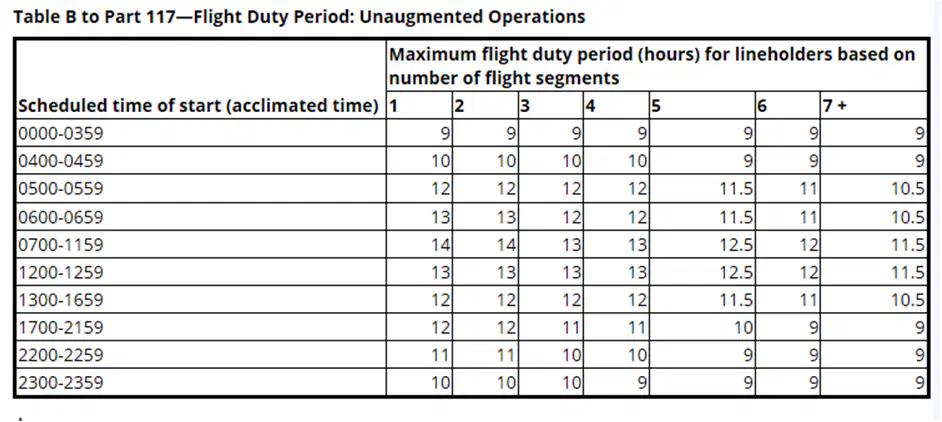
If you reported for the duty at 0700 AM and you have four flight legs are scheduled.
What time is the latest duty out time for you? (unaugmented and acclimated)
7:00 PM
8:00 PM
9:00 PM
10:00 PM
No certificate holder may schedule and no flightcrew member may accept an assignment for any reserve or flight duty period unless the flightcrew member is given a rest period of at least ___ consecutive hours immediately before beginning the reserve or flight duty period measured from the time the flightcrew member is released from duty. The ___ hour rest period must provide the flightcrew member with a minimum of ___ uninterrupted hours of sleep opportunity.
10, 10, 8
12, 12, 9
12, 12, 8
9, 9, 8
while operating an airplane within a foreign country,
comply with the air traffic rules of the U.S and the part 121 even if rule of the country concerned is more restrictive.
comply with the air traffic rules of the country concerned and the local airport rules, and disregard the Part 121.
comply with the air traffic rules of the country concerned and the local airport rules, only when the part 121 is same as the country rule.
comply with the air traffic rules of the country concerned and the local airport rules, except where any rule of part 121 is more restrictive and may be followed without violating the rules of that country.
Each certificate holder conducting domestic or flag operations must show that a two-way communication system, or other means of communication approved by the responsible Flight Standards office, is available over ____________
the route as much as the operator can, whenever possible
250 miles from the origin
the entire route.
250 miles from the certificate holder's primary business location
Select the weather report the Part 121 certificate holder cannot use:
For operations within the 48 contiguous States and the District of Columbia, it was prepared by the U.S. National Weather Service or a source approved by the U.S. National Weather Service;
For operations conducted outside the 48 contiguous States and the District of Columbia, it was prepared by a source approved by the Administrator.
The weather report prepared by the any reliable commercial sources.
Each certificate holder conducting domestic or flag operations shall adopt and put into use an approved system for obtaining forecasts and reports of adverse weather phenomena
Each certificate holder shall prepare and keep current a manual for the use and guidance of flight, ground operations, and management personnel in conducting its operations. Who is responsible for keeping this manual up-to-date with the change and additions?
The person the manual furnished such as crewmembers.
Its appropriate ground operations and maintenance personnel;
Representatives of the Administrator assigned to it.
All of the above
Done
No person operating a turbine engine powered airplane may take off that airplane unless its weight on arrival, allowing for normal consumption of fuel and oil in flight would allow a full stop landing at the intended destination airport within ____ percent of the effective length of each runway described below from a point 50 feet above the intersection of the obstruction clearance plane and the runway. (Part 121)
50
60
70
80
A third in addition to two gyroscopic bank and pitch indicators (artificial horizons) for use at the pilot stations must be installed in turbojet airplane per Part 121. The third gyroscopic bank-and-pitch indicator must continues reliable operation for a minimum of ___ minutes after total failure of the electrical generating system;
10
20
30
40
In addition to smoke detector, what is required to be installed in lavatory under part 121?
automatically discharging a built-in fire extinguisher for each disposal receptacle for towels, paper, or waste
manual fire extinguisher
Protective Breathing Equipment
oxygen bottle
“conditions conducive to airframe icing” meansvisible moisture at or below a static air temperature of °C or a total air temperature of °C, in Part 121, operation in icing.
5, 10
- 5, -10
-10, -5
0, 5
Part 121 require at cabin pressure altitudes above _______ feet, up to and including ______ feet, oxygen must be provided for and used by each member of the flight crew on flight deck duty and must be provided for other crewmembers for that part of the flight at those altitudes that is of more than ___ minutes duration.
10,000 12,000 10
10,000 12,500 30
10,000 12,000 30
12,000 15,000 5
Done
BLM When operating at flight altitudes above 10,000 feet, operating a turbine engine powered airplane with a pressurized cabin, the certificate holder shall supply supplemental oxygen for for each flight crewmember on flight deck duty ;
2 hours for constant rate of descent from the airplane's maximum certificated operating altitude to 10,000 feet in ten minutes and followed by 110 minutes at 10,000 feet
Sufficient for the duration of the flight above 10,000 feet cabin pressure altitude, not to exceed 1 hour 50 minutes
Sufficient for the duration of the flight above 8,000 feet cabin pressure altitude.
When an airplane is operated at flight altitudes up to and including flight level 250,
the supplemental oxygen requirements for passenger is dependent upon the airplane's ability to make an emergency descent to a flight altitude of
10,000 feet within 4 min
14,000 feet within 4 min.
12,000 feet within 4 min
For Part 121 operations, if one pilot to leave his station at the controls of the airplane when operating at flight altitudes above flight level 250 but at or below FL410, the other pilot
shall put on the oxygen mask and use oxygen.
and the flight engineer shall put on their oxygen masks and use oxygen
must have a quick-donning type oxygen mask available
(BLM) If 149 passengers seats are installed in an airplane. What is the minimum number of flight attendants required with 90 passengers onboard?
1
3
2
4
BL The training required for crewmembers who have been qualified and served in the same capacity on the other airplane of the same group is:
upgrade training
transition training
difference training
(BLM) Whenever a crewmember or aircraft dispatcher who is required to take recurrent training, a flight check, or a competence check, takes the check or completes the training in December 2020 and the required annual recurrent check or training in January 2021, the latter check is considered to have been taken in
November 2020
January 2021
December 2020
A pilot in command and second in command (no type experience) crewmembers must each acquire at least 100 hours of line operating flight time for consolidation of knowledge and skills (including operating experience required under paragraph (c) of this section) within ___ days after the satisfactory completion of type rating practical test
120 days
90 days
180 days
60 days
BL A required pilot flight crewmember who has not met the requirements must reestablish recency of experience by 3 take offs and landings in the same type, which include?
At least one ILS approach to the lowest ILS minimums authorized for the certificate holder and a landing from that approach.
At least three landings must be made to a complete stop
At least one landing must be made with a simulated failure of the most critical engine.
BL What are the line check requirements for the pilot in command for an air carrier?
The line check is required every 12 months in each type the pilot is to fly
The line check is required every 12 calendar months in one of the types of airplane the pilot is to fly
The line check is required every 6 months for all type of airplane the pilot is to fly.
Q 25- 3 BL : "Operational control" means;
exercising the privileges of pilot-in-command of an aircraft
the specific authority of any pilot in command
exercising authority over initiating, conducting, or terminating a flight
FAA 557. When the pilot in command is responsible for a deviation during an emergency, the pilot should submit a written report within
10 days after returning to home base
10 days after returning home
10 days after the deviation
FAA 561 What action shall the pilot in command take if it becomes necessary to shut down one of the two engines on an air carrier airplane?
Land at the nearest suitable airport in point of time at which a safe landing can be made
Land at the nearest airport, including military, that has a crash and rescue unit
Land at the airport which the pilot considers to be as safe as the nearest suitable airport in point of time
FAAL26 What is meant by "sterile cockpilt"?
Crewmembers refrain from nonessential activities during critical phase of flight
Crewmembers are seated and buckled at their required stations
All preflight checks are complete and the aircraft is ready for engine starting
Cockpit is clean and ready to be used by the crewmember
FAA571 Which announcement must be made if the seat belt sign will be turned off during flight?
Clearly explain the location of the fire extinguishers and emergency exits.
Passenger should keep their seat belts fastened while seated
Passengers are free to leave their seats once the seat belt sign is turned off
Done
What is minimum altitude the autopilot can be used after takeoff and initial climb?
500 feet above airport elevation
At a minimum engagement altitude specified in the AFM; or
At an altitude specified by the Administrator, whichever is greater.
All of the above
What is the lowest altitude the autopilot with AFM specified approach altitude limitations, can be used for approach?
The minimum use altitude specified for the coupled approach mode selected;
50 feet
An altitude specified by Administrator.
The greater of the above
Q 26-1 BLM FAA8260 If A domestic air carrier airplane lands at an intermediate airport at 1215Z. Latest when can the airplane depart without a specific authorization from the dispatcher?
1315Z
1415Z
1245Z
Who should be thoroughly familiar with report and forecast weather condition on the route to be flown?
Director of flight operation
Director of flight operation
The pilot
The dispatcher and the pilot
Who is responsible, by regulation, for briefing a domestic or flag air carrier pilot in command on all available weather information?
Company meteorologist
Aircraft dispatcher
Director of operations
When do you require alternate airport for departure? And if required what is alternate airports requirement for aircraft having two engines?
If the weather conditions at the airport of takeoff are below the landing minimums: Not more than one hour from the departure airport at normal cruising speed in still air with one engine operative.
If the weather conditions at the airport of landing are below the landing minimums: Not more than one hour from the departure airport at normal cruising speed in still air with two engine inoperative.
If the weather conditions at the airport of takeoff are below the landing minimums: Not more than two hour from the departure airport at normal cruising speed in still air with one engine inoperative.
If the weather conditions at the airport of landing are below the landing minimums: Not more than two hour from the departure airport at normal cruising speed in still air with two engine operative.
Under 121 Operations, when do you need destination alternate? If so required, what weather condition at the alternate airport must be?
+/- one hour, 2000feet ceiling, 3 miles at least. must be more 600-2 for precision approach
+/- one hour, 2000feet ceiling, 3 miles at least. must be more 800-2 for non-precision approach
+/- one hour, 2000feet ceiling, 3 miles at least. must be meet the operation specification requirement
same as Part 91 operations
Done
Holdover time is the estimated time deicing/anti-icing fluid will prevent the formation of frost or ice and the accumulation of snow on the protected surfaces of an aircraft. When does holdover time begins?
v
Holdover time begins when the final application of deicing/anti-icing fluid commences
Holdover time begins when the final application of deicing/anti-icing fluid is completed.
Holdover time begins when the final application of deicing/anti-icing fluid lose its effectiveness.
Holdover time begins when the final application of deicing/anti-icing fluid is about half way through
A pretakeoff contamination check is conducted within ___________ minutes prior to beginning of take off and must be accomplished from _________ of the aircraft.
pretakeoff check is conducted ___________ the aircraft holdover time and can be accomplished _______ of the aircraft.
5, inside, within, inside
5, outside, after, inside
5, outside, within, inside
10, inside, after, outside
How much fuel supply is required for IFR domestic operation per Part 121?
To fly to the airport to which it is dispatched; Thereafter, to fly to and land at the most distant alternate airport (where required) for the airport to which dispatched; and thereafter, to fly for 45 minutes at normal cruising fuel consumption
To fly to the airport to which it is dispatched; Thereafter, to fly to and land at the most distant alternate airport (where required) for the airport to which dispatched; and thereafter, to fly for 30 minutes at normal cruising fuel consumption
To fly to the airport to which it is dispatched; and thereafter, to fly for 30 minutes at normal cruising fuel consumption
To fly to the airport to which it is dispatched; Thereafter, to fly to and land at the most distant alternate airport (where required) for the airport to which dispatched; and thereafter, to fly for 30 minutes at normal cruising fuel consumption
Can a pilot continue an approach past the final approach fix in Part 121 operation, when :
officially reported the visibility to be equal to or more than the visibility minimums prescribed for that procedure.
pilot's estimated the visibility to be equal to or more than the visibility minimums prescribed for that procedure.
forcasted visibility to be equal to or more than the visibility minimums prescribed for that procedure.
actual visibility to be equal to or less than the visibility minimums prescribed for that procedure.
Select the item the pilot in command of an airplane do not have to carry in the airplane to its destination per Part 121.
A copy of the completed load manifest
A copy of the dispatch release
A copy of the flight plan.
Communication records
FAA Which incident requires an immediate notification to NTSB
Aircraft colliding on the ground.
Flight control system malfunction.
Damage to property, other than the aircraft, estimated to exceed $10,000.
Within what time period should the nearest NTSB field office to be notified when an aircraft is involved in an accident which results in substantial damage?
Immediately
7 calendar days
10 days
BLM Which substantial damage requires an immediate notification to NTSB
to an engine damage caused by engine failure in flight.
which requires repairs to landing gear.
which adversely affects structural strength, performance or flight characteristics.
BLM Which incident requires an immediate notification to NTSB
Engine failure during flight.
Inability of any required flight crewmember to perform normal flight duties as a result of injury or illness;
Damage to the landing gear
BLM Which incident requires an immediate notification to NTSB
Fire on aircraft while in a hangar which results in damage of $25,000.
Ground fire
In-flight fire.
BLM A report on an incident for which immediate notification is required by § 830.5(a) shall be filed
within 7 days.
only if requested to do so.
within 10 days.
BLM How soon is a report required to be filed with the nearest NTSB field office after an accident ?
7 days
10 days
5 days
BLM How long must a person be hospitalized before an injury may be defined by the NTSB as a "serious injury"?
72 hours; within 10 days after date of the injury.
48 hours; within 7 days after date of the injury.
7 days
BLM After aborting the take off you find that the elevator control cable has broken. An operator
must file a NASA report within 10 days
must immediately notify the nearest NTSB office.
should submit the report the NTSB within 7 days.
BLM Pilots and/or flight crew members involved in near midair collision (NMAC) to report each incident immediately by
Telephone to the nearest FAA Flight Standards District Office
by radio or telephone to the nearest FAA ATC facility or FSS.
In writing to local law enforcement.
BLM Who should file a Near Midair Collision (NMAC) Report?
ATC
Pilot and/or Flight Crew of the aircraft involved in the incident.
An Operator of the aircraft
Done

