
 Worksheets
KEMINO2 - LE3, COORDINATION CHEM
Total questions: 45
Worksheet time: 25mins
what kind of bond is found between the metal and ligand of a transition metal complex
ionic
coordinate covalent
pi back bond
sigmatropic
homolytic bond
What is not likely to be found in a primary coordination sphere
metal
ligand
covalent bond
counterions
What ligand doesnt exist
cationic ligand
anionic ligand
neutral ligand
what type of ligand has multiple binding sites, but can only use one site at a time
anionic
neutral
polydentate
ambidentate
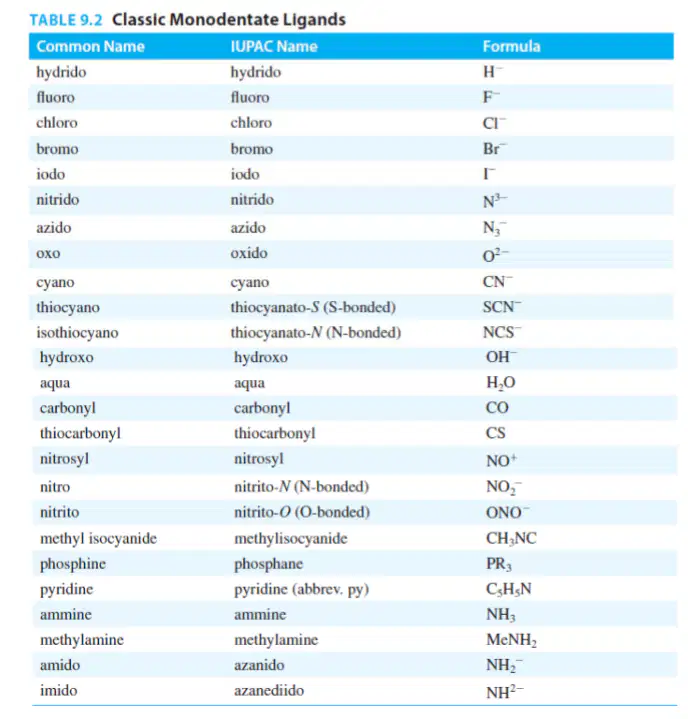
What is the O.S. (oxidation state) of Cu in [CuH4]2-
+2
+1
0
-1
-2
Dithiocyanato-S-aurate(I)
[Au(SCN)2]
[Au(SCN)2]-1
[Ag(SCN)2]-1
[AgSCN2]-1
[Ru(CO)5]
Ruthenium pentacarbonyl
Pentacarbonylruthenium (0)
Rubidium pentacarbonyl
Pentacarbonylrubidium(0)
Choose the odd one out
Ionization isomers
Hydrate isomers
Linkage isomers
Coordination isomers
Geometric isomers
Which two isomers are MOST similar
Hydrate isomers
Linkage isomers
Coordination isomers
Ionization isomers
Optical isomers
This type of isomerism is observed when a complex has two or more metal atoms
coordination
hydrate
ionization
linkage
This type of isomerism is observed when a complex uses an ambidentate ligand
coordination
hydrate
ionization
linkage
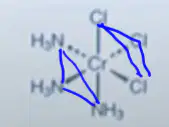
Describe the geometry of the ligand
cis
trans
fac
mer
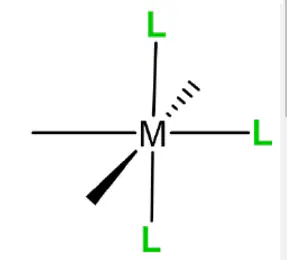
Describe the geometry of the ligand
cis
trans
fac
mer
Which symmetries indicate chirality
Oh
Td
A1g
Cn
Dn
What feature serves to increase the chirality of a complex/compound
double bonds
non bonding electrons
triple bonds
rings
what is not a factor that affects coordination geometries
more bonds = more stability
d orbital degeneracy
sterics
crystal packing effects
solvation effects
Which coordination numbers are most common
CN4-6
CN1-3
CN7-9
CN10-16
Which coordination numbers are least likely for metal complexes
CN 1 and 16
CN 4 and 5
CN 3 and 7
All our equally likely
Which coordination is common for Cu, Ag, and Au
CN 2
CN 3
CN 4
CN 5
Which CN 4 geometry is best with 2 lone pairs
see saw
trigonal bipyramidal
tetrahedral
square planar
why is it easy for CN5 complexes (trigonal bipyramidal and square pyramidal) to interconvert
usually water soluble
point charges are variable and unstable
because they have small energy differences
interconversion provides resonance and extra stability
What are Jahn teller distortions
compressions or elongations of all metal ligand bonds
compressions along the y axis
elongations and compressions along the z axis
the conversion from CN6 to CN5 complex
where do capped versions of a trigonal prismatic coordination complex go
on the triangle parts
on the rectangle parts
along the x axis of the metal
along the y axis of the metal
along the z axis of the metal
What factors make it possible for CN of 10 - 16
large metals
small metals
large ligands
small ligands
What is a limitation of Valence Bond Theory for Coordination Chemistry
only accounts for up to 4p hybridization
cannot explain spectroscopic properties
inaccurate magnetic property prediction
explains equal bonds
cannot account 3d complexes
What is not something electronic structure theories seek to explain for coordination compounds
thermodynamic data
magnetic moment
electronic spectra
geometry
resonances
In crystal field theory, the 3d orbitals split into _________
3 eg orbitals
2 eg orbitals
2 t2g orbitals
3 t2g orbitals
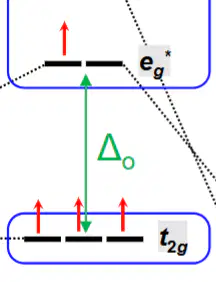
What is the CFSE of the following configuration
0 Δ0
-0.6 Δ0
2 Δ0
0.4 Δ0
-0.4 Δ0
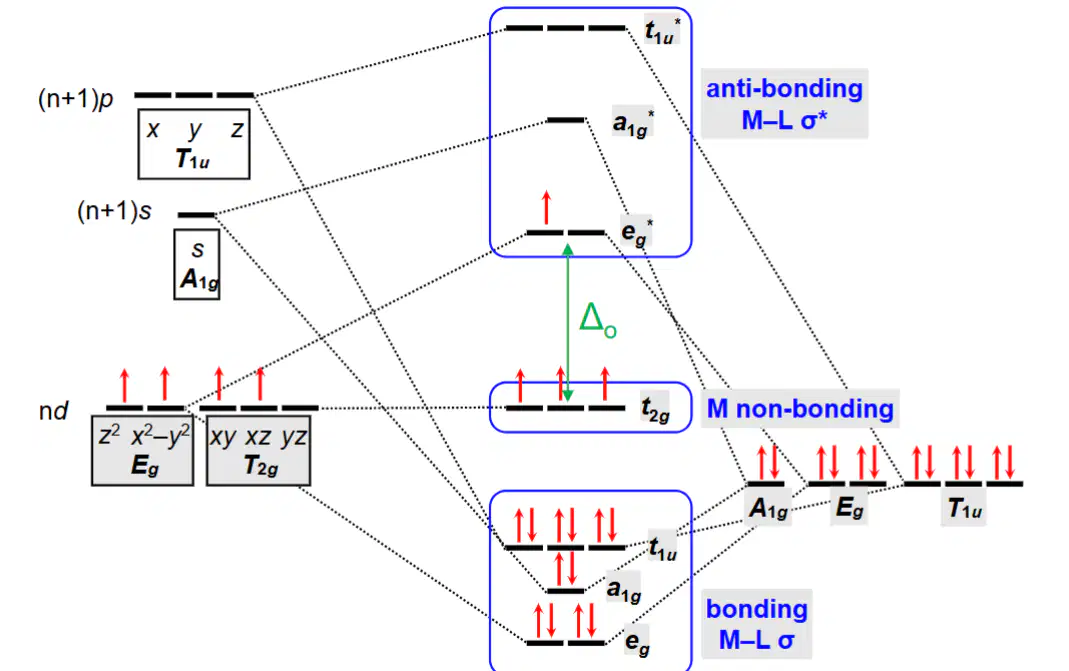
Identify this complex by its molecular orbital diagram
octahedral
tetrahedral
square planar
square pyramidal
Which metal can experience high spin or low spin configuration
d0
d1
d5
d9
d10
Πc indicates _____
destabilization
stabilization
from electron repulsion in same orbital
electrons with parallel spin in degen orbitals
What is not true about pi donor ligands
preferred for high O.S. metals
preferred for high electron count
decrease energy difference between eg and t2g
contains at least one lone pair of electrons
Pi back bonding _______ the multiple ligand bond
strenghtens
weakens
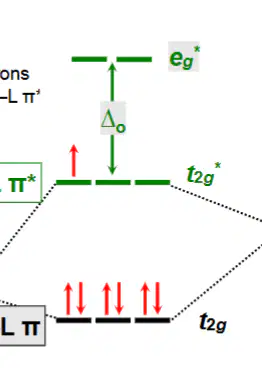
Identify the effect shown here
pi bonding
pi donor
pi acceptor
low spin high spin conversion

which ligand is likely to not change the Δ0 that much
I
Br
H2O
CN
NO2
Which metal will always exhibit low spin configuration
Sc
Ti2+
Cu+
Hg
Mn
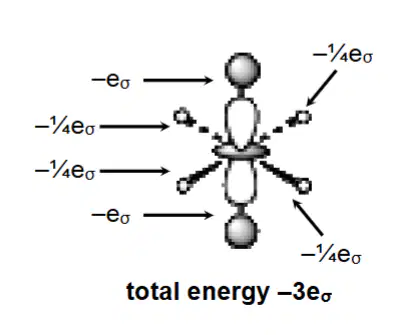
Why is magnitude highest in interaction with z axis
most overlap/ repulsion
least overlap/repulsion
larger orbitals are involved
smaller orbitals are invovled
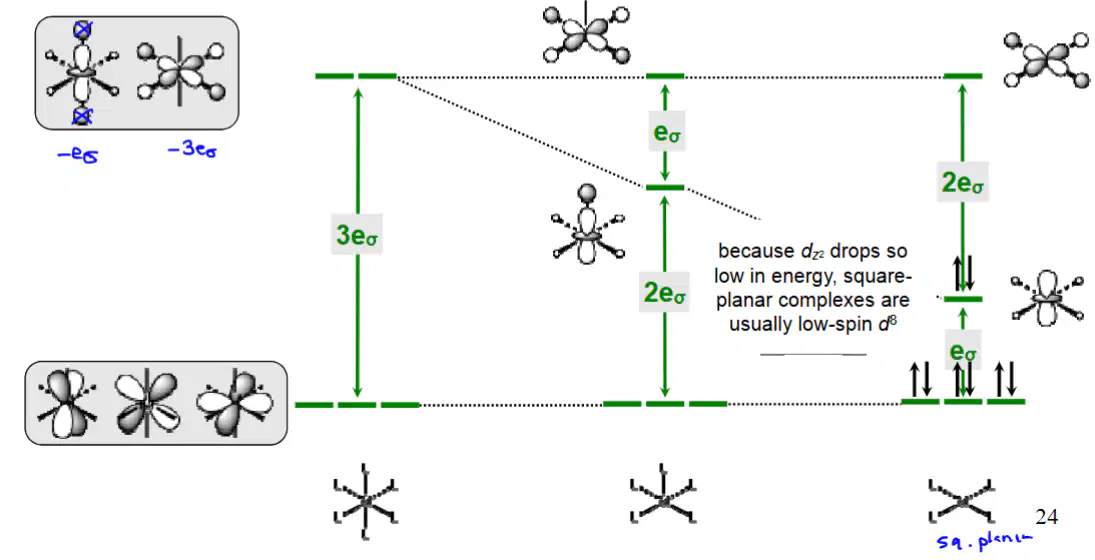
What causes a drop in the energy of the dz2 orbitals?
in phase stabilization with equatorial ligands
out of phase stabilization between ring and ligands
removal of ligand-pi interaction along the z axis
less bonds = more stability because less repulsion and steric strain between ligands
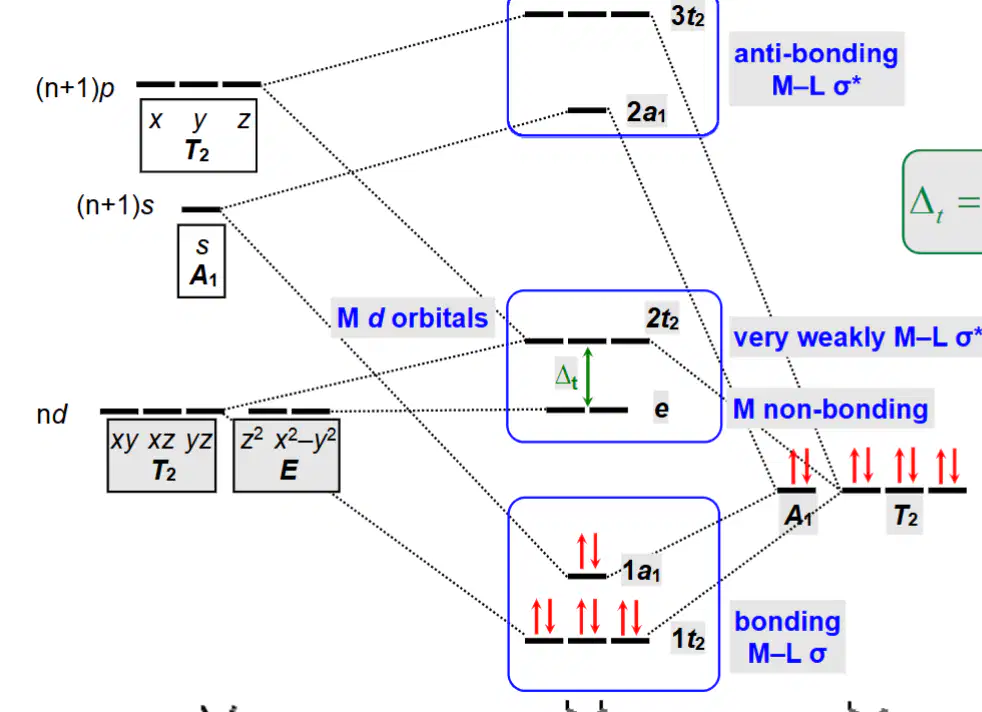
what type of complex is this based on the molecular orbital diagram
tetrahedral
linear
octahedral
square planar
Why are t2 orbitals higher energy and e orbtials in tetrahedral complexes
dz2 and x2-y2 are along axes
point charges of ligands are along the axis
point charges of ligands are between the axes
dz2 and x2-y2 are located between axes

Which complexes can NEVER be low spin
4d metal complexes
4d octahedral metal complexes
5d metal complexes
3d octahedral metal complexes
3d tetrahedral metal complexes
Which orbitals are stabilized from the conversion of a complex from octahedral to square planar
xy
yz
z2
x2-y2
xz
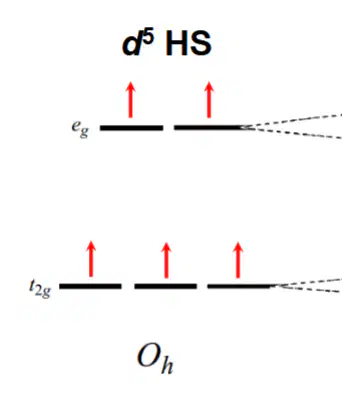
Will the following experience JT Distortion?
yes
no
Which scenario produces the strongest JT distortion
equally occupied t2g
equally occupied eg
unequally occupied t2g
unequally occupied eg
How do you compare the total energies of an octahedral complex and a square planar complex according to AOM
octahedral has more energy from more bonds
square planar has more energy from more overlap despite less bonds
they are equal
depends on whether its in phase or out of phase

