
NEW
Font size
 Worksheets
Exploring Nuclear Reactions and Half-Life
Total questions: 38
Worksheet time: 2hrs 5mins
What is nuclear fission?
The process of combining two light nuclei to form a heavier nucleus.
The process of splitting a heavy nucleus into two lighter nuclei.
The process of a nucleus absorbing a neutron without splitting.
The process of a nucleus emitting a gamma ray.
Which of the following best describes nuclear fusion?
The splitting of a heavy nucleus into lighter nuclei.
The combination of two light nuclei to form a heavier nucleus.
The emission of alpha particles from a nucleus.
The absorption of neutrons by a nucleus.
Define half-life in the context of radioactive decay.
The time taken for a radioactive substance to completely decay.
The time taken for half of the radioactive nuclei in a sample to decay.
The time taken for a radioactive substance to double in mass.
The time taken for a radioactive substance to emit all its radiation.
Calculate the half-life of a substance if its initial quantity is 80 grams and it reduces to 10 grams in 6 hours.
1 hour
2 hours
3 hours
4 hours
Explain why nuclear fusion is considered a potential source of energy for the future.
It produces large amounts of radioactive waste.
It requires very little energy to initiate.
It produces minimal radioactive waste and no greenhouse gas emissions.
It is currently the most cost-effective energy source.
What is the energy release in nuclear fission primarily due to?
The conversion of mass into energy according to Einstein's equation E=mc2 .
The absorption of energy by the nucleus.
The emission of gamma rays.
The increase in atomic number.
A radioactive isotope has a half-life of 5 years. How much of a 100g sample will remain after 15 years?
12.5g
25g
50g
6.25g
Discuss the challenges associated with harnessing nuclear fusion for energy production.
Fusion reactions are easy to control and require low temperatures.
Fusion reactions require extremely high temperatures and pressures, making them difficult to sustain.
Fusion produces large amounts of radioactive waste.
Fusion reactions are currently the most cost-effective energy source.
Which of the following elements is commonly used as fuel in nuclear fission reactors?
Hydrogen
Helium
Uranium
Carbon
If a radioactive substance has a half-life of 10 years, how many years will it take for the substance to reduce to 12.5% of its original amount?
20 years
30 years
40 years
50 years
What is the primary difference between nuclear fission and nuclear fusion?
Fission combines nuclei, while fusion splits them.
Fission splits nuclei, while fusion combines them.
Fission and fusion both split nuclei.
Fission and fusion both combine nuclei.
A sample of a radioactive isotope decays from 200g to 25g in 12 hours. What is its half-life?
2 hours
3 hours
4 hours
6 hours
If 10 mg of iodine 131 is given to a patient, how much is left after 24 days? The half-life of iodine-131 is 8 days.
1.25mg
1.25g
10g
10mg

Based on the graph provided, what is the half life of Carbon-14?
25%
50%
5,730 years
0 years
11,460 years
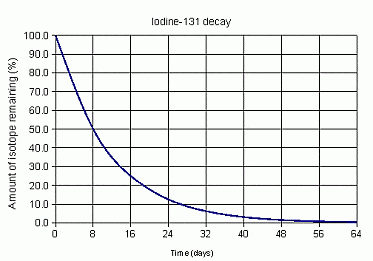
The half life of Iodine-131 is 8 days. Based on the graph, how much of the original sample remains after 3 half lives?
50%
12.5%
25%
6.25%

Using this graph, what is the half-life of the Strontium-90?
10 years
25 years
50 years
150 years
Which of the following correctly display nuclear fission?


What is the reaction that occurs in nuclear power plants?

The nuclear equation shown models which nuclear process?
fusion
fission
beta decay
gamma emission

The nuclear equation shown models which nuclear process?
fission
fusion
alpha decay
beta decay

How many neutrons are released in the above equation?
1
2
3
4

What is the missing element in the nuclear equation?
Rubidium-89
Rubidium-90
Cesium-144
Cesium-145

For the nuclear equation, which particle is represented by X?
0-1 e
11 H
42 H
10 n
Which reaction represents nuclear fusion?




What is the function of Control Rods in a Nuclear Power Plant?
To control the power of a nuclear reactor
To transfer heat from the primary reactor coolant to the secondary side
To confine fission products in case of an accident
To cool exhaust steam from a turbine
A serious risk factor associated with the operation of a nuclear power plant is the production of
acid rain
helium gas
greenhouse gases, such as CO2
radioisotopes with long half-lives
What is a problem commonly associated with nuclear power facilities?
A small quantity of energy is produced
Reaction products contribute to acid rain
It is impossible to control nuclear fission
It is difficult to dispose of nuclear waste
Which components of a fission reactor are used to slow neutrons during a fission reaction?
moderators
shields
coolants
control rods
Control rods in nuclear reactors are commonly made of boron and cadmium because these two elements have the ability to
absorb neutrons
emit neutrons
decrease the speed of neutrons
increase the speed of neutrons

After 22,800 years, approximately what percentage of the original carbon-14 remains?
Which radioisotope is used to determine the age of once-living organisms?
carbon-14
cobalt-60
iodine-131
uranium-238
What type of disaster happened in Chernobyl?
Flood
Hurricane
A nuclear reactor meltdown
Fire
What is it called when a nuclear reactor core is damaged from overheating?
A nuclear crash
A nuclear meltdown
Nuclear fallout
A chain reaction
Nuclear fission
True or False: All radioisotopes decay at the same rate
True
False

