
Font size
 Worksheets
Chemistry Lab Final Part 2
Total questions: 87
Worksheet time: 1hrs 1mins
To carefully pour a liquid into another container.
(a)
The liquid that was carefully poured into a new container.
(a)
CH3COOH and HC2H3O2 are different ways of writing the chemical formula of the which chemical ?
acetic acid
acetate ion
peracetic acid
acetone
Which of the chemicals are oxidants?
HCl
HNO3
K2CrO4
NH3
SnCl2
You have two test tubes. One test tube contains Pb+2 (aq) solution and the other test tube contains Bi+3(aq).
Predict what will happen when HCl (aq) is added to both test tubes.
If a reaction occurs, what is the new chemical fomula?
Pb+2 (aq) will remain unchanged.
Bi+3 (aq) will form a white precipitate, Bi(OH)3 (s).
Pb+2 (aq) will form a white precipitate, PbCl2 (s).
Bi+3 (aq) will remain unchanged.
Pb+2 (aq) will form a yellow precipitate, PbCrO4 (s).
Bi+3 (aq) will remain unchanged.
Pb+2 (aq) will remain unchanged.
Bi+3 (aq) will form a white precipitate, Bi (s).
You have one test tube which contains a colorless solution that is either Cu+2 (aq) or Bi+3(aq).
Select a reagent that will allow you to differentiate between the two chemical species.
If the solution is Cu+2, what will happen when the reagent is added?
If the solution is Bi+3, what will happen when the reagent is added?
Select one:
15 M NH3
If it is Cu+2, a dark blue solution will form after adding the 15 M NH3.
If it is Bi+3, a white precipitate will form after adding the 15 M NH3.
HCl
If it is Cu+2, a white precipitate will form after adding the HCl.
If it is Bi+3, the solution will remain the same after adding the HCl.
NaOH + SnCl2
If it is Cu+2, a black solid will form after adding the NaOH + SnCl2.
If it is Bi+3, a white solid will form after adding the NaOH + SnCl2.
HCl
If it is Cu+2, the solution will remain the same after adding the HCl.
If it is Bi+3, a white precipitate will form after adding the HCl.
You have two test tubes. One test tube contains Pb+2 (aq) solution and the other test tube contains Bi+3(aq).
Predit what will happen when HCl (aq) is added to both test tubes.
If a reaction occurs, what is the new chemical fomula?
Pb+2 (aq) will remain unchanged.
Bi+3 (aq) will form a white precipitate, Bi(OH)3 (s).
Pb+2 (aq) will form a white precipitate, PbCl2 (s).
Bi+3 (aq) will remain unchanged.
Pb+2 (aq) will form a yellow precipitate, PbCrO4 (s).
Bi+3 (aq) will remain unchanged.
Pb+2 (aq) will remain unchanged.
Bi+3 (aq) will form a white precipitate, Bi (s).
Match the correct inference to the description of the reactions from the Group 1 & 2 Qualitative Analysis Experiment.
In step 1-D, after the 6 M NH3 was added, the white precipitate dissolved creating a colorless solution. Then, after the addition of 6 M HNO3 (and the solution tested acidic), a white precipitate formed.
Ag+ is confirmed as present
Pb+2 is confirmed as present
Ag+ and Pb+2 are indicated as possibly present
Match the correct inference to the description of the reactions from the Group 1 & 2 Qualitative Analysis Experiment.
In step 1-C, after adding the CH3COOH and K2CrO4, the colorless solution turned yellow and no solid formed.
Ag+ is confirmed as present
Pb+2 is confirmed as present
Ag+ and Pb+2 are indicated as possibly present
Match the correct inference to the description of the reactions from the Group 1 & 2 Qualitative Analysis Experiment.
In step 1-A after adding the 6 M HCl to an unknown, a white precipitate formed with a colorless decantate.
Ag+ is confirmed as present
Pb+2 is confirmed as present
Ag+ and Pb+2 are indicated as possibly present
Separation can be achieved when a reaction occurs in a mixture. The resulting mixture will have one chemical species in a solution and the other chemical species as a solid. The mixture is centrifuged and the supernate is decanted into a separate test tube. Now the solid and solution are separated from each other.
What reagent could you add to a mixture of Ag+ and Cu+2 to separate the two species?
SnCl2
NH3
HCl
K4Fe(CN)6
K2CrO4
Separation can be achieved when a reaction occurs in a mixture. The resulting mixture will have one chemical species in a solution and the other chemical species as a solid. The mixture is centrifuged and the supernate is decanted into a separate test tube. Now the solid and solution are separated from each other.
What reagent could you add to a mixture of PbCl2(s) and AgCl(s) to separate the two species?
SnCl2
hot water
HCl
K4Fe(CN)6
K2CrO4
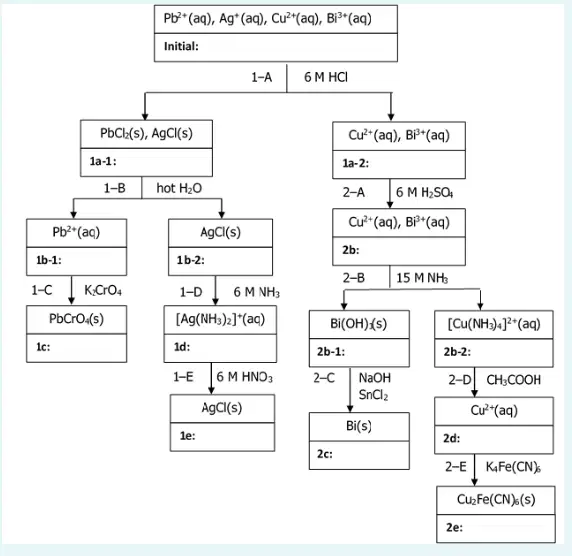
Box 1a-1
white precipitate
light blue solution
yellow solution
Box 2d
white precipitate
light blue solution
yellow solution
Box 1e
white precipitate
light blue solution
yellow solution
Box 1c
white precipitate
light blue solution
yellow solution
Select the step(s) that will compose a rationale for the cation Bi+3 being absent in an unknown.
A white precipitate did not form in step 2-B.
The presence of a light blue decantate in step 1-A.
yellow precipitate did not form when K2CrO4 was added in step 1-C.
All of the white precipitate from step 1-A dissolved in hot water.
Select the step(s) that will compose a rationale for the cation Cu+2 being present in an unknown.
The formation of a dark blue solution in step 2-B.
A reddish brown precipitate formed after adding K4Fe(CN)6 in step 2-E.
Dark blue solution turned to light blue in step 2-D after the addition of CH3COOH and then
A white precipitate formed when 6 M HCl was added to the unknown solution in step 1-A.
The white precipitate from step 1-B dissolved in 6 M NH3 and then reformed when 6 M HNO3 was added.
Using the Chemical Alert Table, select all the chemical species that are corrosive.
NaOH
H2O2
HNO3
HCl
NH3
What is the formula for nitric acid
(a)
What is the name for H2O2?
(a)
You have two test tubes. One test tube contains Mn+2(aq) solution and the other test tube contains Zn+2(aq).
Predict what will happen when NaOH(aq) is added to both test tubes.
If a reaction occurs, what is the new chemical formula?
Mn+2(aq) will form a very pale pink precipitate, Mn(OH)2 (s).
Zn+2(aq) will form a colorless solution, [Zn(OH)4]-2 (aq).
Mn+2(aq) will form a very pale pink precipitate, Mn(OH)2(s).
Zn+2(aq) will form a white precipitate, Zn(OH)2 (s).
Mn+2(aq) will will remain unchanged, a nearly colorless solution.
Zn+2(aq) will form a green solution, [Zn(OH)4]-2 (aq).
Mn+2(aq) will form a purple solution, MnO4-(aq).
Zn+2(aq) will form a grey-white solid, ZnK2Fe(CN)6 (s).
You have two test tubes. One test tube contains Cr+3(aq) solution and the other test tube contains Ni+2(aq).
Predict what will happen when NaOH(aq) is added to both test tubes.
If a reaction occurs, what is the new chemical formula?
Cr+3(aq) will form a green solution, [Cr(OH)4]- (aq).
Ni+2(aq) will form a green precipitate,Ni(OH)2 (s).
Cr+3(aq) will form a green solution, [Cr(OH)4]- (aq).
Ni+2(aq) will remain the same, a green solution.
Cr+3(aq) will remain unchanged, an indigo blue solution.
Ni+2(aq) will form a green solid, Ni(OH)2 (s).
Cr+3(aq) will form a yellow-tan solid, BaCrO4 (s).
Ni+2(aq) will form a red-pink solid, Ni(HDMG)2(s).
You have one test tube which contains a solution that is either Zn+2(aq) or Fe+3(aq).
Select a reagent that will allow you to differentiate between the two chemical species.
If the solution is Zn+2(aq), what will happen when the reagent is added?
If the solution is Fe+3(aq), what will happen when the reagent is added?
NaOH
If it is Zn+2(aq), a green solution will form after adding the NaOH.
If it is Fe+3(aq), a gold-brown precipitate will form after adding the NaOH.
NaOH
If it is Zn+2(aq), the solution will stay colorless after adding the NaOH.
If it is Fe+3(aq), the gold-brown precipitate will form after adding the NaOH.
K4Fe(CN)6
If it is Zn+2(aq), a grey-white precipitate will form after adding the K4Fe(CN)6.
If it is Fe+3(aq), a blood red solution will form after adding the K4Fe(CN)6.
HNO3
If it is Zn+2(aq), a grey-white precipitate will form after adding HNO3.
If it is Fe+3(aq), a solution will turn blood-red after adding HNO3.
In step 3-A, when NaOH was added to the original solution, a precipitate formed.
At least one of Fe+3, Ni+2, and Mn+2 is indicated as present.
Mn+2 is confirmed as absent
Cr+3 is confirmed as absent
Ni+2 is confirmed as present
In step 3-G after adding the NaBiO3 and centrifuging, a brown solution formed over the excess mustard colored NaBiO3
At least one of Fe+3, Ni+2, and Mn+2 is indicated as present.
Mn+2 is confirmed as absent
Cr+3 is confirmed as absent
Ni+2 is confirmed as present
In Step 3-H after the addition of BaCl2, the solution remained the same.
At least one of Fe+3, Ni+2, and Mn+2 is indicated as present.
Mn+2 is confirmed as absent
Cr+3 is confirmed as absent
Ni+2 is confirmed as present
When the H2DMG was added in step 3-F, a strawberry red precipitate formed.
At least one of Fe+3, Ni+2, and Mn+2 is indicated as present.
Mn+2 is confirmed as absent
Cr+3 is confirmed as absent
Ni+2 is confirmed as present
What reagent could you add to a mixture of Fe+3(aq) and Zn+2(aq) to separate the two species?
NaOH
H2DMG
NaBiO3
BaCl2
What reagent could you add to a mixture of Mn+2(aq) and Cr+3(aq) to separate the two species?
NaOH
H2DMG
NaBiO3
BaCl2

Fe+3 (aq), Ni+2 (aq), Mn+2 (aq)
Box 3-C
Box 3-D
Box 3-F
Box 3-B
Confirmed Absent
Box 3-C
Box 3-D
Box 3-F
Box 3-B
Ni(HDMG)2
Box 3-C
Box 3-D
Box 3-F
Box 3-B
CrO4-2 (aq) and [Zn(OH)4]-2 (aq)
Box 3-C
Box 3-D
Box 3-F
Box 3-B
Select the steps that will compose a rationale for the cation Cr+3 being absent in an unknown.
The lack of a yellow solution after the addition of H2O2 in step 3-B.
After the BaCl2 was added in step 3-H, a colorless solution with no solid was present.
The lack of a green decanate after the addition of excess NaOH in step 3-A.
A precipitate did not form when 6 M NaOH was added to the unknown solution in step 3-A.
Select the step(s) that will compose a rationale for the cation Zn+2 being present in an unknown.
The colorless decantate was isolated in step 3-H when BaCl2 was added.
A grey-white solid formed in step 3-J.
A purple-grape supernate over excess NaBiO3 formed in 3-G.
A pale yellow (tan) precipitate formed in step 3-H.
q
(a)
∆Hrxn
(a)
In a certain reaction, a solid chemical dissolved in water. The temperature of the water sample rose from 22.4°C to 27.3°C.
Select all the statements that are true about this experiment.
qsystem is a (-) value.
The water is defined as the surroundings.
The reaction is exothermic.
qsystem is a (+) value.
The water is defined as the system.
If an error caused the initial temperature to be larger (and the final temperature okay), how does this affect the calculation of the heat of solution (qsolution)?
The larger Tinitial would produce a smaller ΔT, which would result in a smaller q.
The larger Tinitial would produce a larger ΔT, which would result in a smaller q.
The larger Tinitial would produce a larger ΔT, which would result in a larger q.
The larger Tinitial would produce a smaller ΔT, which would result in a larger q.
For the following error, select the answer that correctly describes how it will affect the value of the final temperature of the water/solution in the calorimeter:
Some of the HCl solution was spilled on the lab bench and not successfully added to the calorimeter.
Increases the value of final Temperature
Decreases the value of final Temperature
No affect
Consider the benzoic acid dissociation reaction below which is at equilibrium.
C6H5COOH(aq) + H2O(ℓ) ⇋ C6H5COO-(aq) + H3O+(aq)
If additional C6H5COOH, benzoic acid, is added to the system (stress), how will the system change in order to re-establish equilibrium? Select all that might apply.
The concentration of C6H5COO- will increase.
The concentration of C6H5COOH will decrease.
The concentration of H3O+ will decrease.
The concentration of C6H5COOH will increase.
What color is expected after adding some colorless A–(aq) to the equilibrium solution?
A-(aq) + H2O(ℓ) ⇋ HA(aq) + OH-(aq)
Yellow
Blue
Green
Colorless
The [CuCl4]–2(aq) ion is light green while the [CuBr4]2(aq) ion is dark brown. Originally the equilibrium below was a dark green.
[CuCl4]–2(aq) + 4 Br–(aq) ⇋ [CuBr4]–2(aq) + 4 Cl–(aq)
Predict the color of the solution after the system has re-established equilibrium.
Adding a small amount of white NaBr(s).
Brown solution
Yellow solution
Green solution
Blue solution
The [CuCl4]–2(aq) ion is light green while the [CuBr4]2(aq) ion is dark brown. Originally the equilibrium below was a dark green.
[CuCl4]–2(aq) + 4 Br–(aq) ⇋ [CuBr4]–2(aq) + 4 Cl–(aq)
Predict the color of the solution after the system has re-established equilibrium.
Placing the system in an ice-bath for 10 minutes.
Brown solution
Yellow solution
Green solution
Blue solution
[Cu(H2O)4]+2 (or simply as Cu+2) is a sky blue solution and [Cu(NH3)4]+2 is a dark royal blue solution.
[Cu(H2O)4]+2(aq) + 4 NH3(aq) ⇋ [Cu(NH3)4]+2(aq) + 4 H2O(ℓ)
Make a hypothesis on what will occur in the equilibrium system (initially a medium blue solution) if HCl is added. Then explain what will occur in terms of Le Châtelier’s principle.
The solution will become a darker blue solution.
The system must shift towards products to offset the acid by producing more [Cu(NH3)4]+2(aq).
The solution will become a darker blue solution.
The system must shift towards reactants since the acid forces the [Cu(NH3)4]+2(aq) to dissociate.
The solution will become a lighter blue solution.
The system must shift towards reactants since acid removes the NH3, the system shifts to replace the NH3.
The solution will remain the same color.
The system will re-establish the equilibrium since the HCl and NH3 cancel each other.
Predict the equilibrium shifts that will occur in the endothermic equilibrium reaction below in order to re-establish equilibrium.
Increasing the overall pressure of the equilibrium system.
CH4(g) + H2O(g) ⇋ CO(g) + 3 H2(g)
Will shift the equilibrium towards the reactants.
Will shift the equilibrium towards the products.
Predict the equilibrium shifts that will occur in the endothermic equilibrium reaction below in order to re-establish equilibrium.
Increasing the overall temperature of the equilibrium system.
CH4(g) + H2O(g) ⇋ CO(g) + 3 H2(g)
Will shift the equilibrium towards the reactants.
Will shift the equilibrium towards the products.
Predict the equilibrium shifts that will occur in the endothermic equilibrium reaction below in order to re-establish equilibrium.
Decreasing the overall total pressure of the equilibrium system.
CH4(g) + H2O(g) ⇋ CO(g) + 3 H2(g)
Will shift the equilibrium towards the reactants.
Will shift the equilibrium towards the products.
Predict the equilibrium shifts that will occur in the endothermic equilibrium reaction below in order to re-establish equilibrium.
Increasing the partial pressure of steam.
CH4(g) + H2O(g) ⇋ CO(g) + 3 H2(g)
Will shift the equilibrium towards the reactants.
Will shift the equilibrium towards the products.
Concentration stock Volume stock = Concentration dilute * Volume dilute
(a)
pH
(a)
A 4.00 mL aliquot of a 0.15 M HCl solution is diluted to a final volume of 10.00 mL.
What is the molarity of this first dilution solution?
Then a second dilution was made by taking 3.00 mL of the first dilution and diluting it to 25.00 mL.
What is the molarity of this second dilution?
1st Dilution = 0.060 M; 2nd Dilution = 7.20 x 10⁻³ M
1st Dilution = 0.0038 M; 2nd Dilution = 4.50 x 10⁻⁴ M
1st Dilution = 0.0167 M; 2nd Dilution = 4.50 x 10⁻³ M
1st Dilution = 0.150 M; 2nd Dilution = 1.06 x 10⁻² M
What is the pH of a 2.0 x 10⁻³ M HCl solution?
2.70
6.21
3.52
4.48
What is the pH of a 3.3 x 10⁻³ M NaOH solution?
11.52
8.29
10.77
9.88
pH of buffer
(a)
Any substance that receives a proton
(a)
The amount of acid or base that can be added before the pH changes by 1 pH unit
(a)
A solution that has a pH of 7
(a)
Select all the statements that are true concerning pH and buffers.
As an acidic solution is diluted the pH increases.
As a basic solution is diluted the pH increases.
The greater the concentrations of the buffer components, the greater its buffering capacity.
A buffer only works when acids are added and not when bases are added.
What is the pH of a solution that has 0.033 M CH3COOH and 0.066 M NaCH3COO present?
Ka of acetic acid = 1.80 x 10⁻⁵
5.05
4.44
6.23
5.93
6.08
What is the pH of a buffer in which the concentration of benzoic acid, C6H5COOH, is 0.050 M and the concentration of sodium benzoate, NaC6H5COO, is 0.075 M ?
Ka of C6H5COOH is 6.30 x 10⁻⁵
(a)
rate
(a)
order
(a)
change in concentration of A per change in time, Δ[A]/Δtime
(a)
rate of the slowest step
(a)
A reaction mixture was formed by adding 35 mL H2O, 10.0 mL of 0.75 M H2O2, and 5.0 mL of 0.55 M KI.
What is the molarity of the H2 O2 in the reaction mixture?
(a)
A reaction mixture was formed by adding 35 mL H2O, 10.0 mL of 0.75 M H2O2, and 5.0 mL of 0.55 M KI.
What is the molarity of the KI in the reaction mixture?
(a)
In the generic reaction below, experimental data indicate the reaction is first order in A, third order in B and rate constant is 3.5 x 10 -3 M -1 sec -1. Which is the correct rate constant expression?
3 A(aq) + B(aq) → A3B(aq)
Rate = (3.5 x 10 -3 M -1 sec -1) [A] [B]3
Rate = (3.5 x 10 -3 M -1 sec -1) [A] 3 [B]
3.5 x 10 -3 M -1 sec -1 = [A] 3 [B]
3.5 x 10 -3 M -1 sec -1 = [A] [B] 3

What is the reaction order of E?
(a)
What is the reaction order of D?
(a)

What is the average value of k (rate constant) for the data set below.
Previously it was determined that the reaction was 1st order in E and 2nd order in D.
(a)

Predict the initial rate (in kPa/sec) for Trial D using the data below.
It was previously determined that the reaction is 1st order in D, 3rd order in E, and the average rate constant, k is equal to 0.280 kPa/(sec · M4).
(a)
Cu(s) → Cu+2(aq) + 2 e -
NO3-(aq) + 4 H+(aq) + 3 e - → NO(g) + 2 H2O
How many electrons are transferred in the oxidation half-reaction?
(a)
Cu(s) → Cu+2(aq) + 2 e -
NO3-(aq) + 4 H+(aq) + 3 e - → NO(g) + 2 H2O
How many electrons are transferred in the reduction half-reaction?
(a)
Cu(s) → Cu+2(aq) + 2 e -
NO3-(aq) + 4 H+(aq) + 3 e - → NO(g) + 2 H2O
How many electrons are transferred in the overall reaction?
(a)
M titrant * equivalence point volume titrant * (mol analyte/ mol titrant)
(a)
M analyte
(a)
Ferris & Mona used the ORP sensor to titrate a ferrous ammonium sulfate solution, (NH4)2Fe(SO4)2 with KMnO4 titrant. They titrated a 15.00 mL aliquot of the Fe+2 solution with 0.0250 M MnO4- solution and determined that the equivalence point was at 20.2 mL. What is the molarity of the Fe+2 solution?
5 Fe+2(aq) + MnO4-(aq) + 8 H+(aq) → 5 Fe+3(aq) + Mn+2(aq) + 4 H2O
0.168 M
0.0928 M
0.0337 M
0.673 M
Sully, Fay & Tia worked together on the redox titration of Fe+2 with MnO4- (Part I). Fay & Tia used the equivalence point volume of MnO4- as determined from titration graph. However, Sully used the volume of MnO4- when the solution turned brown, which was a larger volume than Fay & Tia's volume.
Will Sully's calculations of the molarity of Fe+2 be different than Fay & Tia's calculation? How and why?
No difference.
It is the same titration, so all 3 students should have the same answer.
Sully's M of Fe+2 will be higher than the other two students.
Since the volume of MnO4- is in the numerator for the calculation of M of Fe+2, the higher volume of MnO4- results in higher M of Fe+2.
Sully's M of Fe+2 will be lower than the other two students.
Since the volume of MnO4- is in the denominator for the calculation of M of Fe+2, the higher volume of MnO4- results in lower M of Fe+2.
Sully's M of Fe+2 will be higher than the other two students.
Since the volume of MnO4- is in the denominator for the calculation of M of Fe+2, the higher volume of MnO4- results in higher M of Fe+2.
Piers & Aida added 1.25 mL aliquot of H2O2 to a beaker containing 5.0 mL of 6 M H2SO4 and 90 mL of water. The hydrogen peroxide solution required 19.00 mL of 0.0225 M MnO4- to reach the equivalence point using the ORP probe.
5 H2O2(aq) + 2 MnO4–(aq) + 6 H+(aq) → 5 O2(g) + 2 Mn+2(aq) + 8 H2O(ℓ)
What is the molarity of the original H2O2 solution?
(a)
In Experiment 6, Vitamin C (ascorbic acid) was titrated with dichloroindophenol (DCP) in a redox titration. But ascorbic acid, C6H8O6, can also be titrated in a redox titration with Br2(aq) solution as seen in the two half reactions below. Determine the overall reaction.
C6H8O6 → C6H6O6 + 2 H+ +2 e–
Br2 + 2 e– → 2 Br–
One vitamin C tablet was dissolved in a slightly acidic solution and titrated with 0.110 M Br2 using an ORP probe. The equivalence point of the titration curve was determined to be 20.7 mL.
What is the mass (in grams) of Vitamin C, C6H8O6, in the tablet.
(a)
What is the oxidation number of Cl in ClO – ?
-1
+1
+3
+5
What is the oxidation number of S in SO4−2 ?
+2
+3
+4
+6
Select the redox term(s) that apply to Mn in MnO4 – in the half reaction below.
MnO4 – (aq) + 8 H+(aq) + 5 e – → Mn+2 (aq) + 4 H2O
Species being reduced
Species being oxidized
Oxidizing Agent
Reducing Agent
In the redox reaction below, identify and match each reactant to their function.
3 CH3CH2OH (aq) + 2 Cr2O7−2 (aq) + 16 H+(aq) → 3 CH3CO2H (aq) + 2 Cr+3(aq) + 11 H2O(aq)
CH3CH2OH (aq)
species being reduced
acidic species
In the redox reaction below, identify and match each reactant to their function.
3 CH3CH2OH (aq) + 2 Cr2O7−2 (aq) + 16 H+(aq) → 3 CH3CO2H (aq) + 2 Cr+3(aq) + 11 H2O(aq)
Cr2O7−2 (aq)
species being reduced
acidic species

