wayground logo

Free Printable Worksheets

Font size

S
M
L
XL
Worksheets

Unit 4: One Dimensional Motion

Total questions: 32

Worksheet time: 23mins

Name
Class
Date
1.
1. What is kinematics primarily concerned with?
a)
a. The study of forces and energy
b)
b. Mathematical formulas for motion analysis
c)
c. The relationship between mass and acceleration
d)
d. The principles of thermodynamics
2.
2. Which of the following is a scalar quantity?
a)
a. Velocity
b)
b. Distance
c)
c. Displacement
d)
d. Acceleration
3.
3. The standard unit for velocity is:
a)
a. Kilometers per hour
b)
b. Miles per hour
c)
c. Meters per second
d)
d. Meters per second squared
4.
4. What does displacement measure?
a)
a. Total distance traveled
b)
b. Time elapsed during motion
c)
c. Speed at a given moment
d)
d. Distance from starting position
5.
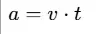
a)
a. Multiplication
b)
b. Division
c)
c. Change
d)
d. Addition
6.
6. Earth's gravitational acceleration is approximately:
a)
a. -8.9 m/s^2
b)
b. -9.8 m/s^2
c)
c. -10.2 m/s^2
d)
d. -11.0 m/s^2
7.
7. When an object is thrown upward, at its highest point its velocity is:
a)
a. Maximum
b)
b. Negative
c)
c. Zero
d)
d. Increasing
8.
8. Which mathematical method is used to find the area underneath a graphed function?
a)
a. Integration
b)
b. Derivation
c)
c. Multiplication
d)
d. Extrapolation
9.
9. The slope of a velocity-time graph represents:
a)
a. Position
b)
b. Speed
c)
c. Distance
d)
d. Acceleration
10.
10. A vector quantity must include:
a)
a. Only magnitude
b)
b. Both magnitude and direction
c)
c. Only direction
d)
d. Neither magnitude nor direction
11.
11. Average acceleration is calculated using:
a)
a.
b)
b.
c)
c.
d)
d.
12.
12. Which characteristics are mathematically related in motion?
a)
a. Mass, force, and energy
b)
b. Time, displacement, velocity, and acceleration
c)
c. Weight, speed, and momentum
d)
d. Position, energy, and power
13.
13. When analyzing free-falling objects:
a)
a. Heavier objects fall faster
b)
b. Air resistance is the primary factor
c)
c. All objects accelerate at the same rate
d)
d. Acceleration varies with mass
14.
a)
a. Newton's laws
b)
b. Einstein's relativity
c)
c. Calculus methods
d)
d. Quantum mechanics
15.
15. On a velocity-time graph, displacement is represented by:
a)
a. The slope of the line
b)
b. The y-intercept
c)
c. The area under the curve
d)
d. The x-intercept
16.
16. Velocity differs from speed because:
a)
a. It's always faster
b)
b. It includes direction
c)
c. It's always constant
d)
d. It's always positive
17.
17. The standard unit for acceleration is:
a)
a. Meters per second
b)
b. Kilometers per hour
c)
c. Miles per hour squared
d)
d. Meters per second squared
18.
18. When an object is falling:
a)
a. Its acceleration decreases
b)
b. Its velocity remains constant
c)
c. Its acceleration is constant
d)
d. Its speed decreases
19.
19. The process of finding the rate of change of a function is called:
a)
a. Integration
b)
b. Differentiation
c)
c. Multiplication
d)
d. Addition
20.
20. Average velocity calculations:
a)
a. Include all motion variations
b)
b. Consider only the endpoints
c)
c. Require constant acceleration
d)
d. Must include air resistance
21.
21. Select the correct answer from the choices provided in the underlined sections. If an object is tossed up in the air, gravity’s acceleration will slow down up the object’s initial velocity until the velocity hits zero. Then the object’s velocity will start increasing in the _____________________ direction.
a)
negative
b)
positive
22.
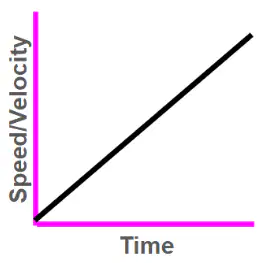
22. Choose the statement that correctly describes the graph below.
a)
a. The car is accelerating at a great speed.
b)
b. John is stopped in the middle of his race because he caught a cramp.
c)
c. Sarah is running her marathon at a constant speed.
d)
d. Roger was riding his bike at a constant speed, but then had to stop because he fell off.
23.
23. What type of graph is shown below?
a)
Velocity Graph
b)
Speed Graph
c)
Acceleration Graph
d)
Distance Graph
24.
24. How many seconds will it take for a satellite to travel 450 m at a rate of 120 m/s?
a)
3.75 s
b)
3.76 s
c)
3.77 s
d)
3.78 s
25.
25. A meteoroid changed velocity from 1.0 m/s to 1.8 m/s in 0.03 seconds. What is the acceleration of the meteoroid?
a)
26.7 m/s^2
b)
26.8 m/s^2
c)
26.9 m/s^2
d)
26.3 m/s^2
26.

At which position did the creature change direction?

a)

-7 m

b)

9 m

c)

2 m

d)

16 m

27.

Which is TRUE?

a)

the object had a constant speed in the positive direction

b)

the object never stopped

c)

the object slowed down in the positive direction

d)

the object sped up in the positive direction

28.

Which is TRUE about the acceleration?

a)

It was 0 then positive the rest of the time.

b)

It was 0 then negative the rest of the time.

c)

It was 0, then negative, then was positive by the end.

d)

It was 0, then positive then was negative by the end.

29.

Does upward movement of an object have a negative or positive velocity?

a)

Negative

b)

Positive

30.
A car is traveling at 21.0 m/s. It slows to a stop at a constant rate over 5.00 s. How far does the car travel during those 5.00 seconds before it stops? 
a)
4.20 m
b)
52.5 m
c)
105 m
d)
158 m
31.

A baseball pitcher throws a fastball at 42 m/s. If the batter is 18 meters from the pitcher, approximately how much time does it take for the ball to reach the batter?

(a)  

32.

Anna walks off the end of a 10.0-m diving platform.

How long does it take her to reach the water? (Chap 3)

a)

1.43 s

b)

4.5 s

c)

2.04 s

d)

1.5 s

e)

1 s